
Political leaders talk peace, elections


Play
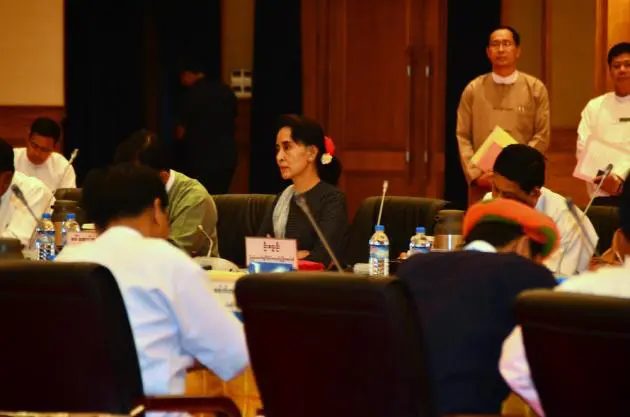
Nay Pyi Taw - More than 40 key stakeholders met for three hours Wednesday at the presidential residence, focusing on critical issues such as peace-building, the draft National Ceasefire Accord, the pending 2015 general elections and political stability be
It followed a meeting on January 12, where issues such as successful democratic transitions and reforms, union solidarity with nationwide peace, and smooth hand over of the reins of the country were discussed. The meeting produced many criticism and complaints from ethnic ministers and many opposition political leaders.
The April 8 meeting took place two days before the six-party talks would take place. Missing from the April 8 meeting was Commander-in-chief of Defense Services Senior General Min Aung Hlaing, but he was represented by Vice Senior General Soe Win, deputy Commander-in-Chief. Among the absentees was Hkun Htun Oo, chairman of Shan Nationalities League for Democracy.
Presidential spokesperson Ye Htut told the media insisted that the latest talks were satisfactory.
"Those who attended the meeting shared their knowledge of the previous elections and made suggestions," he said. "They also discussed stability of the state during and after the election."
The key players in the discussions included President Thein Sein, Opposition Leader Aung San Suu Kyi, the two parliamentary speakers, party leaders and the minister for National Races and Development Affairs.
Earlier this week, Union Parliament Speaker Thura Shwe Mann told the leaders of 18 of the country's political parties to prepare for six-party talks on Friday with the president, the house speakers, the commander-in-chief of defense services, Aung San Suu Kyi and Aye Maung, representative of various ethnic groups.
Ye Htut said those involved in Wednesday's meeting didn’t discuss specifically what will be raised at the six-party meeting on Friday, but got a perspective on what will be on the agenda.
The meeting today will cover a variety of topics relating to ethnic groups, the need for regular meetings leading up to the election and constitutional amendments, he said.
International and local journalists waited outside Aung San Suu Kyi’s residence in Nay Pyi Taw in hopes of getting a statement, but were turned away by Tin Mar Aung, chief of staff for her National League for Democracy party.
Suu Kyi has previously pushed for "four-party" talks on the democratic transition, involving just Thein Sein, the army chief Min Aung Hlaing and Thura Shwe Mann. The president has resisted those calls, saying it would exclude ethnic minorities.
Last week's draft peace deal with rebels was hailed as a historic first step, though the agreement awaits formal approval from the ethnic armed groups.
Myanmar, formerly known as Burma and ruled by the British until 1948, was plunged into isolation by a military regime that seized power in 1962.
It has won praise for enacting widespread economic and political reforms since it emerged from outright military rule in 2011, also drawing an influx of foreign investors to its untapped markets.
But there are growing concerns reforms are backsliding in certain areas, including human rights and press freedom.
