
New battles erupt in Kachin as peace talks proceed


Play
Government troops and the Kachin Independence Army (KIA) resumed battles in Kachin State last week, amid efforts by the government and some ethnic groups to end military conflicts.
Myanmar Peace Centre (MPC), an organisation dedicated to facilitating peace-building and ceasefire negotiations, was informed about the clashes.
"The army says the confrontation was sparked by the arrest of timber smugglers,” said Lamai Gum Jar from The Myitkyina-based Peace-talk Creation Group (PCG). "Currently, there is mounting tension in this region. KIA's conflict-resolution team informed the Northern Command about the clashes."
Earlier this year, authorities arrested 149 gang members and seized more than 400 vehicles from a Chinese timber smuggling gang operating in Kachin, but failed to arrest its leaders. Those arrested are jailed at Myitkyina prison, and legal proceedings are still ongoing.
The military's Northern Command did not comment on this fighting. Spokespeople from the Laiza-based Kachin Independence Organisation (KIO), the political wing of the Kachin Independence Army (KIA), were also not available for comment.
"I am on a trip for peace talks. I have no idea about the clashes. You can contact the spokesman from KIO's headquarters," KIA General Gun Maw said on Thursday.
Fighting raged for nearly a month in 2013 between the government army and the KIA over timber smuggling, and the government later seized more than 4,000 tonnes of timber. The seized timber was taken from Kachin State and northern Shan State.
Sporadic fighting occurred in several parts of the northern states of Kachin and Shan.
On Wednesday, buses and trucks loaded with goods were also held up for almost three hours on a road between Kutkai and Nantphatkha in Shan State, after an unidentified group fired on an army convoy. On April 29, The Ta’ang National Liberation Army (TNLA) took control of Union Road running between Muse and Lashio, collecting what it called a tax from passing drivers, according to witnesses.
The taxes ranged depending on whether it was a commercial vehicle or a passenger car, but were reported to be as high as Ks500,000. The TNLA admitted taking money from drivers as a way of fundraising for its cause.
The TNLA is the armed wing of the Palaung ethnic group, which has been battling the Myanmar military since 1963.
During May 1-6, armed ethnic leaders attended a conference at the United Wa State Army (UWSA) headquarters in Panghsan in Myanmar's northern Shan State, to consider the draft nationwide ceasefire agreement which is expected to be signed with the government before the 2015 general elections.
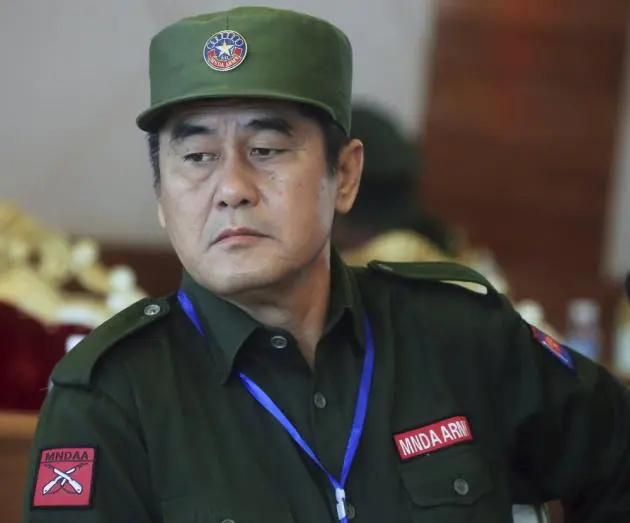
Among them were Peng Jiasheng, commander-in-chief of the Myanmar National Democratic Alliance Army (MNDAA) which now led the Kokang rebel group; and Tun Myat Naing, commander-in-chief of the Arakan Army (AA), which recently opened fires with the government army.
President Thein Sein said in his monthly radio speech on May 4: “My government is ready to sign it (the agreement) and waiting for the meeting results."
Ahead of the meeting, the Military Authoritative Information Team sent a letter to Myanmar Press Council (Interim), barring local news media outlets not to report any statements released by MNDAA). It said MNDAA is declared an unlawful organisation. According to the Unlawful Associations Act, anyone who contacts or assists the unlawful associations will face a three-year imprisonment under section 17(1) and a five-year imprisonment under section 17(2).
As there were talks that another meeting was scheduled in Yangon last weekend, there was a report that President Thein Sein to meet some rebel groups including UWSA, on Friday in Shan State.
The meeting was scheduled because the president was already in Kengtung for a regional inspection tour, said Hla Maung Shwe from the Myanmar Peace Centre, an organisation that facilitates peace-building and ceasefire negotiations.
After the meeting in Panghsan on May 6, the ethnic leaders issued a 12-points statement. They said that the ongoing conflicts that have plagued Myanmar for more than six decades are the result of political differences between the various ethnic groups and Myanmar's government and can be resolved through political means. They highlighted the necessity of the nationwide ceasefire accord to resolve the conflicts. Yet, it urged the government to involve private organisations and China into the peace-talk process. Calling for immediate end to the offensives led by rebel groups in Kachin, Shan and Rakhine states, they also urged amendments to the Constitution and tolerance of people with diverse ethnic races.
