
Coastguard fights illegal fishing


Play
Officials from Asia join US ships in a crackdown on unlawful activity on the high seas
When the United States Coastguard Cutter Mellon is on patrol in the North Pacific Ocean and a flight from Canada spots a vessel apparently engaged in illegal fishing, information passes on to the Mellon carrying some Chinese officials on board. They then ask the vessel to verify its flag. If the vessel reports it
is flying the Chinese flag, the Chinese officials have the authority to board the vessel and check if it is indeed
operating legitimately under Chinese
or international law.
This is just one of many examples of multilateral cooperation between the US and many other countries in the North Pacific in their fight against illegal fishing, according to Gregg Casad, assistant chief of the enforcement branch at US Coastguard District Thirteen based here in Seattle.
Combating illegal, unreported and unregulated (IUU) fishing is an operation which requires full international cooperation.
In two of three cases between 2011-2014, suspect vessels claimed they were Indonesian while illegally fishing in the North Pacific, he said.
In September 2011, the US Coastguard seized a fishing vessel and crew suspected of large-scale illegal high-seas drift-net fishing in the North Pacific Ocean.
High seas drift-net fishing is sometimes legal when its done within some countries’ jurisdictional waters, but the US considers it illegal as it indiscriminately kills massive amounts of fish and other marine life such as whales and turtles by means of enormous nets suspended for kilometres in open water.
The practice is universally condemned and is a significant threat to ocean ecosystems and to the food and economic security of nations that rely on fishery resources.
Acting on vessel-sighting information provided by a maritime patrol plane from the Fisheries Agency of Japan on September 7 last year, US Coastguard Cutter Munro launched its MH-65 Dolphin helicopter and crew and located the fishing vessel Bangun Perkasa with 22 fishermen aboard, approximately 4,100km southwest of Kodiak, Alaska.
The Bangun Perkasa was flying the Indonesian flag but as the Department of State called the authorities in Jakarta, they denied validity of the flag, said Casad. The vessel was seized and its crew prosecuted then deported to their country of origin, he said. A similar case took place in 2012, with another vessel claiming it was legally Indonesian, only for Jakarta to deny such claim, he said.
In another case in June last year, a Canadian CP-140 maritime patrol aircraft first sighted a vessel named Yin Yuan on the high seas of the North Pacific Ocean and reported it to US Coastguard Cutter Morgenthau, which was then on patrol. The Yin Yuan was flying the Chinese flag, leading to Chinese officials on the Morgenthau going aboard the vessel to check if it was involved in an illegal activity, he said.
The Chinese coastguard agreed to seize the vessel and prosecuted its master, Casad revealed.
These operations in the North Pacific highlight the type of international cooperation needed to
combat large scale illegal fishing.
The US Coastguard has been
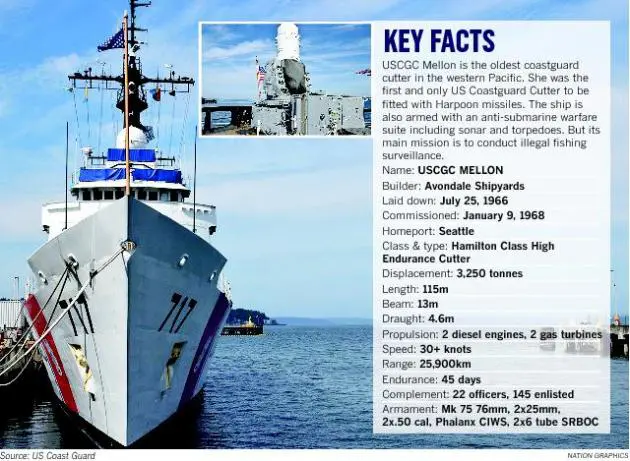
commissioned to tackle IUU fishing in the Pacific. It has various equipment at its disposal, including 12 cutters such as the oldest one the Mellon, which has been in service since 1968 to fight illegal fishing in US waters and on the high seas, he said.
The coastguard cutters have some military combat features but they mostly operate under legal frameworks and international cooperation.
“We are not authorised to sink any vessels conducting illegal fishing,” said Lieutenant Junior Grade Jamie Greendyk, weapons officer on the Mellon. “From my experience on board this ship for years, I have never engaged in any arms battle with illegal fishing vessels,” she said.
The good news is that since the coastguard began patrolling the North Pacific in 1993, sightings of drift-net fishing vessels have steadily declined on the high seas. Between 2000 and 2009, the US Coastguard and partner countries have detected more than 160 ships engaged in illegal drift-net fishing. The number has dramatically decreased since 2010, as only five have been spotted or seized.
No case has been reported in 2015 so far, according to Chris German, the executive officer on USCG Cutter Mellon, which completed a 14-week patrol in the North Pacific Ocean in the middle of July.
