
Bomber stopped by security at Stade de France
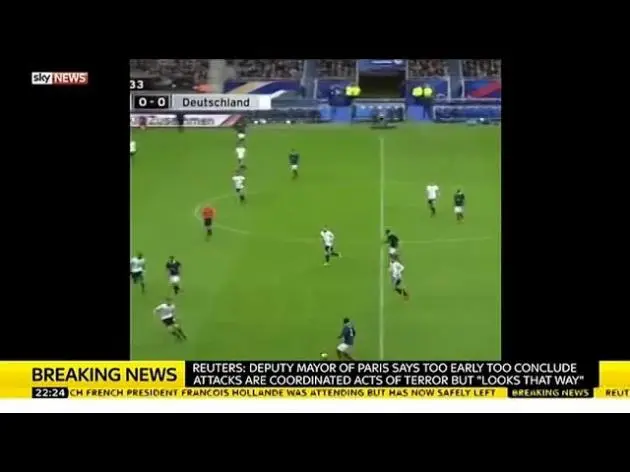


Play
One of the Paris bombers tried to enter the Stade de France during Friday's friendly between France and Germany. He however was turned away when his explosive vest was discovered, a security guard and a police officer have told the Wall Street Journal.
The man had a ticket and tried to enter the game about 15 minutes after it had started, but security officers found the device when they searched him at the gate.
He then ran away and detonated the vest said a guard who was stationed elsewhere in the stadium and briefed on the incident.
A police officer told the Wall Street Journal the attacker had planned to detonate the vest inside the stadium.
The blast was soon followed by a second explosion outside the stadium, with a third happening at a nearby McDonald's.
The newspaper said one civilian had died in the attacks, while French Football Federation president Noel Le Graet earlier told TVInfosport+ that "three people have been killed and several injured after a bomb explosion in front of stadium door number J."
The explosions were part of six coordinated attacks in Paris that left at least 129 people dead, French president Francois Hollande said.
Hollande was attending the game, but was evacuated from the stadium after the first explosion.
The two blasts near the stadium were heard during the match, which was not stopped and continued to its conclusion. France won 2-0.
AFP's Andy Scott and ESPN FC's Gab Marcotti expound upon the events that took place during France's match against Germany.
Supporters were gradually allowed to leave the Stade de France in small groups, although many waited on the pitch as reports of the violence in the city came in.
An announcement over the loudspeakers after the match told people to avoid certain exits "due to events outside.''
At first that prompted some panic, but then the crowds walked slowly to exits. It took an hour and a half to evacuate the stadium after the game.
"We felt safer inside the stadium, but we were getting more and more terrifying news," Arnaud Assoumani, the 2008 Paralympic long jump champion, told L'Equipe's TV channel.
"There was an announcement at the end to say certain gates were open. I feared a crowd surge, which is what happened. Everyone was trying to get out of the doors at the same time.
"Some people were running and they were pushed up against walls and barriers. I don't think there were injuries, but it was a panic surge."
Germany, whose hotel had been subject to a bomb threat on Friday morning, returned to Frankfurt on Saturday after spending the night inside the Stade de France. France's players refused to return to their homes as a show of solidarity with their opponents.
"The French said that they were staying as long as Germany had to stay," said the German Football Association's caretaker president Reinhard Rauball. "That was an outstanding gesture of camaraderie."
Later on Saturday, France midfielder Lassana Diarra revealed that his cousin Asta Diakite died in the attacks.
The Paris tragedy raised concerns about how to protect fans at next summer's European Championship, when 51 matches are scheduled for 10 stadiums around France. The Stade de France will host the opener on June 10 and the final a month later.
"There was already a concern for the Euros, and now it's obviously a lot higher," Le Graet said.
