
'Black and White' triumph
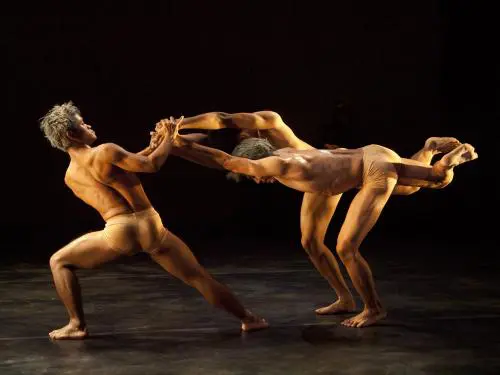


Pichet Klunchun foregoes the spotlight to let his troupe shine in Singapore
Short of support in its homeland, the Pichet Klunchun Dance Company was artistinresidence at the justended da:ns festival at Singapore’s Esplanade Theatres on the Bay.
Last month, two weeks into that residency, the troupe tried out a new piece, “Black and White”, before invited guests, and a new phrase was coined: “khon contact improvisation”. The performers just didn’t look comfortable with some of the contemporarydance movements they were testing.
But at the actual performance on the festival’s opening weekend, Pichet seemed to have significantly adjusted his choreography. The movements were more like classical khon, though still experimental in some ways, and the dancers were more at ease.
While the four male dancers shifted back and forth between monkey and demon characters, the choreography allowed them to support one another in their battles.
The spotlight was mainly on them, but Pichet, portraying a demon character, was always prancing around, holding a metal rod, the most wicked of all.
Then he disappeared offstage with a female character who seemed fragile despite her long, sharp nails, and indeed it was only her who reappeared – with his weapon and mask.
In this way “Black and White” showed balance – Pichet’s key word for this work – not only between good and evil but also between traditional and modern.
The 55minute performance featured striking costumes by Anuthep Pojprasert, deft lighting by Asako Miura, and nifty sound by Wu Na, who was onstage as well, playing her quqin.
Miura’s lighting gave the audience a clear look at the movements while adding dramatic tension. Wu’s score helped remind us that we weren’t watching a classical Thai performance.
It’s also noteworthy that the company worked closely with Malaysian Lim How Ngean on this project from the inception. Evidently Lim made sure that “Black and White” could be comprehended and appreciated by fans of both contemporary dance and khon.
Last Wednesday and Thursday, as part of Rasas – the festival’s platform for traditional Asian dance – Pichet watched from the audience as his company gave a khon demonstration in the Esplanade concourse.
From Friday through Sunday they presented short episodes of the Ramakien at the Esplanade Outdoor Theatre. Pichet portrayed Nontuk in one segment.
Both events, attended by hundreds of people, had dance scholar Pornrut Damrhung serving as emcee – speaking in English. And they proved how much respect these dancers have for tradition, no matter how far they venture from it in some works.
Not only did the artistinresidence programme give the Thai company ample time and money to develop its new work, but living and working together for six weeks in Singapore also bolstered comradeship among the members.
We can look forward to their engaging works for years to come, but let’s hope they can secure similar support here in Thailand to premiere their new pieces. Lest we forget, they’re all Thai citizens.
Pichet’s next work is a fresh collaboration with Indonesian and Cambodian dancers as part of Goethe Institut’s Tanzconnexions project, to be presented in Phnom Penh in December.
Next February in Hua Hin and Bangkok, as part of La Fete, he will reunite with French choreographer and dancer Jerome Bel in “Pichet Klunchun and Myself”, which has been touring around the world since 2004 and has brought the Thai dancer international stardom.
BOX
Click for khon
Keep an eye on Pichet at www.PKLifeWork.com and the “Pichet Klunchun Dance Company” Facebook page.
