
Designs for the deluge


Planned since June, an exhibition of 'flood art' shows someone was thinking ahead
f the flood has left you unscathed and with leisure time on your hands, there’s an exhibition at the Bangkok Art and Culture Centre that features a milk stool turned into a toilet and boats made from tyre inner tubes.
“Muang Jom Nam” (“Let’s Panic”), co-hosted with the Design for Disasters environmental network, offers both suggestions for surviving the crisis and ways to avoid another one in the future.
Bangkok University Assistant Professor Sansern Milindasuta and Silapathorn Award laureate Santi Lawrachawee actually began assembling the show in June, long before we knew things would get this bad. Its precautionary advice might have still ended up too late, but the flood-relief tips are most welcome.
Sansern points out that the artists’ group Art for Help – some of whose members were involved in the exhibition – is conducting art therapy at the refugee shelter at Rajamangala Stadium.
A key thrust of the exhibition, despite its title, is staving off the panic than inevitably rises with the flood tide. The 15 participating artists, designers and activists advocate a calm exchange of information instead. Wishful thinking, perhaps, but we should hear them out.
In an area called “The Neverending Rain, the Sunken City”, Bangkok becomes a horror show in the graffiti of Suradech Termsapsiri, who’s sprayed a wall with dark demons demolishing skyscrapers. And Studio Craftmanship’s interactive multimedia generates more panic with a worst-case scenario with scenes that would fit nicely into the apocalyptic sci-fi film “2012”.
A big plasma television is set on rails so you can push it to six stops along the Skytrain line (figuratively, not literally). The journey begins at 6am with birds filling the sky in their own ominous evacuation. Traffic snarls in a heavy storm and buses and cars in the Siam area are sinking fast.
Then there’s a mighty wave, vehicles tossed aside, people swimming for their lives. The Democracy Monument is surrounded by sea. By the time it’s all over, the Victory Monument is completely underwater.
Yongvit Santanaphanich, on the other hand, offers a cute 3D animation of a decidedly relaxed man floating through the city in a yellow boat. It’s a cheerful introduction for the next display area, called “Escaping is the Same as Surviving?”
The late luk thung singer Rungpetch Laemsing’s “Fon Deuan Hok” is playing. Krit Ngamsom’s resin frogs glisten on stylised lotus leaves, but there’s also an alarming mechanical apparatus that shakes metal balls.
The artist, raised upcountry, knows that frogs predict the rain if you know what to listen for. Here, he’s suggesting that such local wisdom can help hi-tech urbanites live more harmoniously with nature and survive any disaster it thrusts on them.
Porntaweesak Rimsakul has made a sculpture inspired by the maeng krapung nam, the ubiquitous “water boatman” insect that glides across the surfaces of ponds. “I’m fascinated about how this insect can adjust to both wet and dry environments,” says the artist.
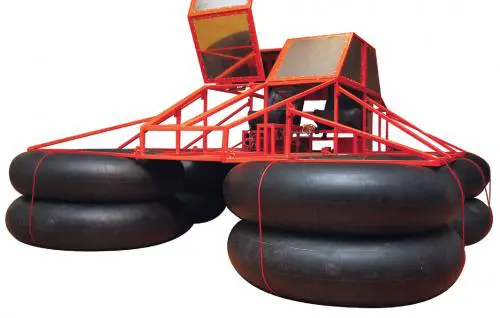
Porntaweesak, who hails from Udon Thani, fashioned an enormous paddleboat from bicycle chains, recycled fibre and metal and the giant inner tubes of harvester tyres. He’s already proved its practicality, using it to deliver relief supplies in Ayutthaya last month. You can watch it in action in a video.
“When there’s a crisis, humans and other living things will instinctively find a way to survive, any way they can,” he says. “Fear will always drive the urge to survive.”
In the area distressingly dubbed “No Food What to Do”, Manon Tasranurak gets our mind off eating altogether with an installation check-listing the dangers that lurk in the murk – cockroaches, crocodiles and parasites, all of them packaged as fast food and ready to deliver.
The next gallery is “Sickness … Wounds”, where visitors beginning to suffer physically and mentally will have plenty of company.
Performing artist Teerawat Mulvilai’s dramatic video installation “Dystopia” is about the trauma that flood victims undergo. He describes a “vision” of permeating unease, where there is “desperation, waiting for death to come, the deep depression generating a hallucination tracing itself back to a destruction of a place of remembrance.
“This place is empty and lifeless, as though it’s waiting in transit for a journey. It is a borderline between life and death.”
Teerawat and two women are seen performing a dance from Japanese butoh in an abandoned building while a storm rages. In one segment he battles the tempest, but is finally found dead at sea. In another, the other two dancers survive, but afterward their lives are isolated, their homes broken.
Kanoknuch Sillapawisawakul built a flock of butterflies with wings of metal, paper and glass, optimistic about the chance of flying away from danger. Unfortunately the insects’ wings are torn.
“If everyone had wings we could flee the sunken city,” Kanoknuch says, “but our wings might be too fragile and weak to save us.”
Greyhound fashion designer Jitsing Somboon has parked an old white car in the gallery with a big red cross on it. The surroundings are like a medical clinic in wartime, with a dozen white plastic doctors’ jackets hanging from plastic curtains. On one of the curtains, images of war are projected.
If you feel queasy, though, move briskly on to the section called “It Is Time … To Design a Future”.
Kitikoon Worrasorratorn has reinvented the three-legged milking stool as a toilet. That’s right, he cut a hole in the top. It’s covered with a removable ceramic lid.
Super Machine Factory’s model of a futuristic city with layers of skywalks is cunningly crafted from tree roots. They’re forecasting land use in ladders, the better to rise above our problems.
The Design for Disasters group (D4D) has a sidebar show called “Survive”, demonstrating how you can use everyday items like plastic tubs, ironing board, fibreglass door and newspapers to get through the crisis. That door, for example, makes a perfect raft.
“When you’re faced with the disaster,” says D4D founder Vibhavee Kunavichayanont, “please stay calm. If you aren’t panicking, you might get your own creative ideas for making survival tools out of simple objects.”
FLOAT ON OVER
The centre at the Pathumwan intersection is closed today and tomorrow as part of the flood-related public holiday. It reopens on Tuesday and the show continues until November 25.
Find out more at (02) 214 6630 or “baccpage” on Facebook.
START LEARNING
The Design for Disasters network’s “Survival!” station on the third floor links information related to any natural disaster occurring in Thailand, including places to donate, ways to volunteer and updated news.
There are also seminars every Saturday at 1.30pm:
November 5 – architect-D4D co-founder Chatpong Chuenrudeemol with Ayutthaya flood victim Preeyasri Promjinda
November 12: Thammasat University architecture professor Chutayaves Sinthuphan with Pongsakorn Pattanaphol of Thailand Survival
November 19: Rescue worker Thanathep Haitookha and a guest designer
