
God will need a bigger book


An ex-nun climbs into the ring with ‘the new atheists’ and loses every round
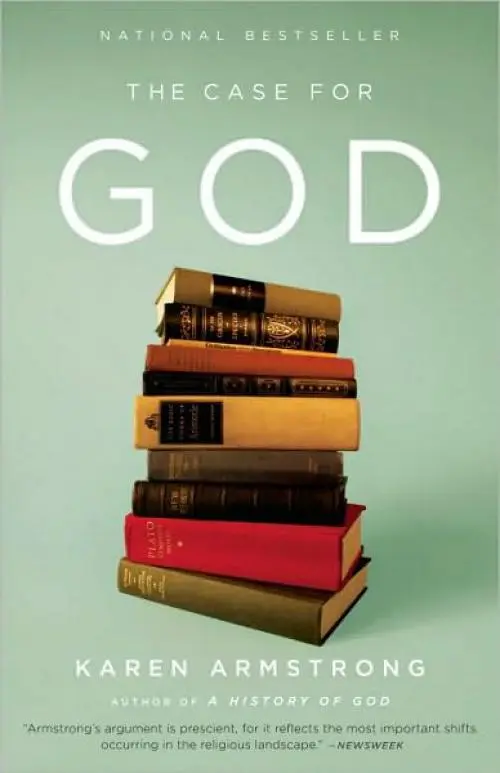
The Case for God: What Religion Really Means
By Karen Armstrong
Published by Vintage
Available at Asia Books, Bt450
Reviewed by William Page
Karen Armstrong is a historian of religions and former Roman Catholic nun. She made her name in 1993 with “A History of God, from Abraham to the Present”, a monumental survey of Judaism, Christianity and Islam.
Evidently she’s not averse to riding the trends: She responded to the rise of Jewish, Christian and Islamic fundamentalism in 2000 with “The Battle for God”. Now she takes on the “new atheism” of Richard Dawkins, Christopher Hitchens, Sam Harris, et al, in “The Case for God”.
She’s also written other books, notably biographies of the Buddha and Muhammad. In brief, this is a lady of formidable intellect and scholarship, bolstered by familiarity with Greek and Hebrew.
This book is divided into two parts: “The Unknown God”, which takes us from 30,000BCE to 1500CE, and “The Modern God”, from 1500 to the present.
Basically it’s another history of religions, but with emphasis on the ever-growing conflict between religion and science. Obviously it covers some of the same ground as her earlier books, but it is to Armstrong’s great credit that she never repeats herself – at least not in exactly the same words. Different emphasis dictates different treatment.
Readers will learn a lot from this book. Never having studied Catholic theology, I’ve never blamed St Augustine for the doctrine of Original Sin. I had always thought that Paul of Tarsus was responsible for that pernicious creed.
Well, Paul may have been the architect, but it turns out that Augustine was the builder. He fleshed out the dogma, dotted the i’s and crossed the t’s, and in doing so traumatised generations of innocent Christian children yet unborn. We can thank both of them for a worldview calculated to drive the human race to madness and despair.
Crunch time for Christianity came during the Enlightenment, when thinkers began to demand empirically verifiable evidence for the existence of God.
As Richard Dawkins points out in “The God Delusion”, God could easily provide irrefutable evidence of his existence if he wanted to. All he’d have to do is reveal himself to the world in a cosmic theophany: appear in the heavens with lightning flashing, trumpets blaring, and angels singing hosannas, and thunder, “Here I am, world! Bow down, ye doubters! Eat dirt, ye unbelievers!”
But he doesn’t do that. It’s too bad. It would make a great movie. With no theophany, and insufficient empirical evidence of his existence, there’s no compelling reason for us to believe in him – except for tradition, and habit and old books and our own needs.
Armstrong counters this argument by claiming that there are subtle truths that can’t be empirically verified. Maybe, but if you want to make sure that a religious proposition is true, empirical verification is a pretty good way to go.
The most interesting part of the book comes toward the end, when Armstrong takes on the “new atheists” and tries to make her case for God. Alas, she doesn’t do a very good job. Theists will be disappointed; atheists will rub their hands in glee; only agnostics are likely to give her a passing grade.
It’s been obvious for some time now that the onslaughts of science and secularism have driven religion into an ever-shrinking corner. Armstrong counters this trend mainly by giving ground – never a good tactic in either warfare or debate.
We mustn’t take the scriptures of the Abrahamic religions literally, she warns. She chides the ‘‘new atheists” for lack of theological sophistication. The very word “God”, she says, is naive and misleading, suggesting an anthropomorphic superman riding the clouds of heaven.
She dilutes this concept into a vague abstraction, a downsized deity so diffuse and indefinable that traditional theists wouldn’t call it God at all. God is a “transcendent reality”, “an inexpressible otherness”, “a divine meaning surpassing and enfolding our own”. To many, this will sound like mumbo-jumbo.
Traditional theists will object, and could do so with a flurry of mixed metaphors: Armstrong’s God is a little like non-alcoholic beer – it doesn’t taste bad, but it packs no punch. It’s an orange with all the juice squeezed out. There’s no beef in this burger.
In navigating the treacherous channel between the Scylla of superstition and the Charybdis of capitulation, Armstrong seems to have got sucked into the whirlpool of Charybdis – and capitulated.
She seems to favour impersonal concepts like the Tao of Taoism, the Brahman of Hinduism, and the Being of Heidegger – but even here there is the problem of empirical verifiability. How can you provide empirical evidence for what is essentially an abstraction? The position Armstrong finally takes approaches a pious agnosticism.
Throughout the book, she insists upon God’s essential unknowability. One of the most perverse faults of religionists is to admit that God is ultimately unknowable – but then to go on and try to tell us exactly what he’s like.
Armstrong doesn’t try to tell us what he’s like, but “unknowability” won’t satisfy those of us who want to know. Even so, in the absence of a conclusive theophany, in the absence of convincing empirical evidence, and considering our ignorance about the universe we live in, a hopeful (and humble!) agnosticism isn’t a bad way to go.
