
Never go hungry


Play
Thailand's first ready-to-ship 'crisis food' made its debut during the flooding - chilli paste included
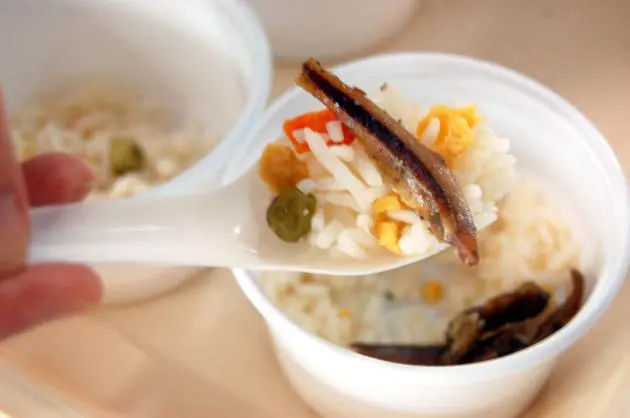
Among the many ingenious inventions that the flood crisis mothered, the nation’s hungry were treated to ready-to-eat meals of fried rice and bread courtesy of Prince of Songkhla University.
What made these staples special is that they stay fresh longer – they’re good for two months without refrigeration.
“We started this project earlier this year because our campus in Hat Yai has dealt with flood situations every year, and every time we have problems with food getting rancid quickly,” says Assistant Professor Saowakon Wattanachant of the school’s Faculty of Agro-industry Food Technology Department.
The Hat Yai campus itself is safe from inundation, but the university annually becomes a rescue and refugee centre. This year, anticipating more of the same, its faculty tackled the rotten-food problem.
Meals like this have been available in other countries for decades. The United States and Japan provide emergency food kits to disaster victims and ship them around the world in times of war, famine and other natural calamities. They also serve as backup rations for their soldiers.
Thailand’s perennial deluge finally supplied the spur to concoct a ready-to-eat meal of our own.
Professor Dr Pavinee Chinachoti, dean of the Agro-Industry Faculty, points out that Thailand harbours an ambition to be “the world’s kitchen”.
“But we have to think about what’s needed for our own sake too, since we’re likely to face disasters more frequently from now on. Food science will be a key survival strategy.”
Rather than a rigid, tricky-to-open tin, the fried rice is packed in a lightweight pouch that’s waterproof – and in fact floats in water. The bread comes in an even simpler transparent-plastic bag, not unlike the bread sold on grocery shelves, but it stays fresh for two months.
The meals stay good thanks to the same “basic” thermal processing used with canned food, says Saowakon, but it’s been adapted to lighter packaging for ease of transport.
“Neither dish requires electricity or even heat or water,” Pavinee points out. “And of course the bread is ready to eat without a spoon or fork.”
Not that people who’ve been neck-deep in floodwater for 30 straight days really care much, but these meals actually taste okay as well, courtesy of the small packet of crispy fish attached to the rice bag and the chilli paste that comes with the bread.
“Thais love a strong taste, so the fish and chilli paste make the meals more appetising than just plain, dry food,” says Saowakon.
The rice packet warns that the contents should be consumed within a month, but Saowakon says they’ll last longer. That one-month advisory is there because of food legislation and to encourage people to eat it quickly.
The bread is definitely okay for two months, and Pavinee is looking into ways to make it last for a year, as other countries have managed. She previously worked on food for emergencies while lecturing at the University of Massachusetts in the US, but she faces different challenges in Thailand in terms of ingredients, technology and funding.
In the US she was involved in creating meals for frontline troops in the Persian Gulf and was also on a USAid committee designing food for crises. Bread was invariably included, and Pavinee brought home some ideas to develop further.
Since the wheat available in Thailand is prohibitively expensive, she’s looking at locally grown grains, while at the same time bearing in mind the taste.
Pavinee says meals can be made that will last much longer – “we have the know-how” – but current funding is inadequate for the required technology.
The production cost for the bread is Bt15 per packet, and for the rice Bt45. The price is high because production is limited. If they could prepare the meals in greater volume, the cost would drop.
Meanwhile the faculty is grateful to Charoen Pokphand Food’s retailing-and-marketing division for making its bread factory in Hat Yai available for the university’s operation. The rice is prepared and packed right in the kitchen lab on campus.
Pavinee and Saowakon are the first to admit that the meals aren’t exactly gourmet fare, but they say the flavour will get better.
“I need to improve the fried rice, to make it more delicious and improve the overall quality,” says Saowakon. “The main problem is the smell because the rice is cooked in oil. We have to work out a better way to cook it.”
