
Getting away with Ai Weiwei


Play
Taiwan gives the dissident mainland artist a podium. Note the middle finger
There’s a black-and-white photo in Chinese artist Ai Weiwei’s exhibition “Absent” showing a man’s hand with the middle finger raised. It was taken in Tiananmen Square.
Because of his legal problems back home on the mainland, Ai can’t attend the show, which continues through January at the Taipei Fine Arts Museum. But despite that, and the show’s title, his presence is very much felt.
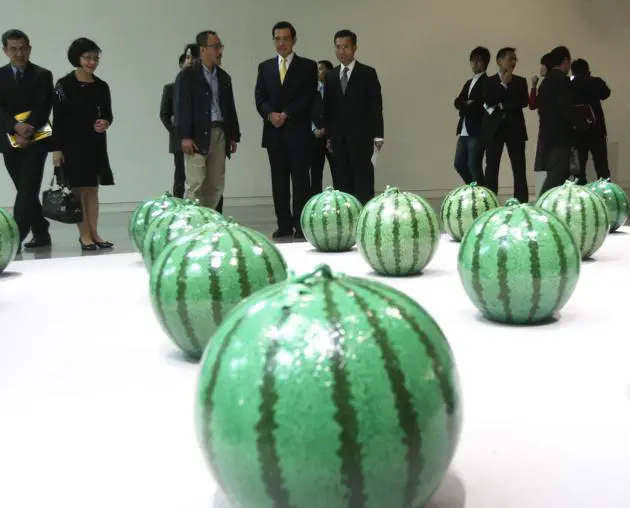
There are 21 pieces – photos, old furniture, marble sculpture, ceramics and wood – dating back to 1983. Curator Liu Yung-jen says choosing which to include was a tough job, taking up two years.
Liu went for the ones that “represented his work”.
“His work isn’t just about his art. It’s also about his personality,” Liu tells Asia News Network.
Ai helped with the selection and arrayed 1,200 two-wheelers in another piece just for the Taipei museum called “Forever Bicycles”.
Prior to the show’s opening, Liu did an e-mail interview with Ai in which he spoke about his arrest at Beijing’s airport last April. He was on his way to Taipei, in fact, to discuss this exhibition.
Chinese authorities placed him under house arrest, accusing him of tax evasion. He vanished from public view for a while, provoking concern around the world, and considerable outrage.
“My biggest emotion was a sense of helplessness,” Ai told Liu, “especially when you know you’re not allowed to have an attorney, and even your family doesn’t know where you’ve gone.
“Throughout those 81 days, both inside and later outside, I always hoped that the exhibition would be completed according to plan and on schedule. After all, this was my first major exhibition in the Chinese world. I never had the opportunity to do my own solo exhibition in Mainland China.”
Liu has kept politics out of the exhibition in Taiwan, although inferences can’t be avoided, especially when Taiwan President Ma Ying-jeou came to open the show last month.
“He’s an artist and should have the freedom to express his artistic views,” Ma told reporters. “This is also the core value of Taiwan.”
Observers noted, however, that Ma carefully avoided looking at “Study of Perspective: Tiananmen Square”, that 1995 photo of the raised middle finger. The vast public plaza in Beijing was where government troops killed hundreds of protesters in 1989.
Liu points out that the photo is part of Ai’s “middle finger” series on symbols of authority, which also includes the White House and the Eiffel Tower. He opposes authoritarianism, Liu explains. “He’s anti-system. Without this anti-system, there is no creative power. That’s where his art comes from.”
Ai claimed last month that the Chinese police are currently investigating him on suspicion of peddling pornography. The accusation is not new, he said, but now he was taking it seriously. He believes it stems from posed photographs circulating online of him seated naked with several nude women.
But the “middle finger” series, Ai told Liu, were simply his crude attempt to mock political, economic and cultural power, as symbolised by famous landmarks. There was no “elaborate meaning”.
“Only after many years had passed did I become aware of the special significance of this kind of confrontation as an ongoing endeavour – whether it be in relation to individual experiences or the present-day circumstances of global economic collectivisation.”
Nor, he said, did the 100 photographs featured in the exhibition have any specific significance at the time they were taken, including those chronicling his 12 years in New York City.
He said he took the photos out of boredom, without any purpose, and didn’t even bother getting the film developed. He did that after he returned to China, just to give his assistant something to do. The photos were first shown at the Three Shadows Photography Art Centre in Beijing.
“They seem to have preserved the atmosphere of a certain period of history, but mostly they express my own purposeless, hopeless state at the time,” Ai wrote.
“Table with Two Legs on the Wall” and “Table with Three Legs” both utilise Qing Dynasty furniture. “Through” features architectural remnants from a Chinese temple. They’re taken as Ai’s expression of the space of consciousness.
“It follows the process of construction to destruction to reconstruction,” Liu says. “His artworks are related to space and freedom. There are no restrictions, no rules.”
The concept extends to “Dropping a Han Dynasty Urn”, a trio of 1995 photographs showing Ai holding and then dropping the valuable ceramic vase. It’s performance art that’s bound to stir emotions, even shock some viewers.
By shattering history – or the perception of history’s great value – Ai appears to be pushing his personal envelope further. He is barred from leaving Beijing because of the tax-evasion charges, which fellow activists say are just a cover for the government’s discomfort over Ai’s criticism.
The exhibition also includes the surveillance camera that Ai fashioned from marble, as if Big Brother were the modern replacement for Michelangelo.
To be sure, Ai’s art activism – “critical aesthetics”, it’s been called – has put him on the government’s watch list, preventing him from attending the Taipei show.
And thus the title: “Absent”.
“Absence itself is the current status of my art and my person and a part of my cultural circumstance,” Ai said in a statement read out at the opening. “This status endows this exhibition with special significance.”
Asking for it
_ “Absent” continues until January 29 at the Taipei Fine Arts Museum.
_ Get the details at www.TFAM.museum.
