
Grab hold of 'Myself'
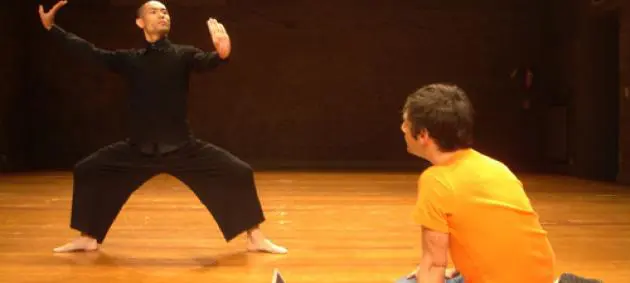


It's your last chance ever to see the remarkable dance duet by Pichet Klunchun and Jerome Bel
From Beirut to Zagreb, “Pichet Klunchun and Myself” has been staged in numerous locales since its premiere at the 2004 Bangkok Fringe Festival. Pichet Klunchun and Jerome Bel had never seen each other work before the festival’s Singaporean artistic director Tang Fu Kuen played matchmaker.
“Jerome was on his way to Singapore, so I invited him to spend two weeks in Bangkok and maybe start a new work,” Tang tells me.
Bel said he’d like to “make a portrait of a traditional Thai dancer” and Tang immediately thought of Pichet, the khon interpreter. He got them together despite Pichet also being quite busy with a commercial project.
“There were all kinds of disruptions, but they did well in the limited time they spent together working in my apartment.”
Seeing a kabuki play in Tokyo had piqued Bel’s interest in Asian dance and theatre. “It was a shock!” he says. “I suddenly realised how theatre was made of representative conventions. It helped me understand the conventions of Western theatre. And later I fell in love with South Indian classical dance.”
Although billed in the programme for La Fete as “khon/modern dance”, “Pichet Klunchun and Myself” is more widely referred to as a “dance dialogue”. The two actually talk more than they dance, in simple English terms since it is neither man’s mother tongue.
“It’s amazing to see parts of their first conversation reproduced in the performance,” Tang says. “The first performance at the Patravadi Theatre lasted more than two hours, but how natural they were, pausing, looking, questioning. This is one of Jerome’s methods, always allowing time to look deeply into something.”
The conversation entails personal stories from their art backgrounds and comments on classical and modern dance, among other topics. Thanks in part to the vast difference between the artists, the show is highly entertaining and thought-provoking.
“We’re talking about something that’s very difficult, like contemporary art or how to understand and appreciate classical Asian dance, but in very simple ways,” says Pichet, reckoning this is one reason the show has enjoyed such success and longevity.
Bel concurs. “The success comes from the explanations we both give about our practices. People might enjoy seeing dance, but they enjoy even more understanding the dance.”
Tang also credits the appeal of any Jerome Bel performance, and the revelatory cracking of theatrical codes, “and, of course, both artists are very charismatic. I myself have watched the show many times and I still smile every time.”
The dialogue has never been scripted and the sequence and content shifted often in the first few years before the definitive version was found. Bel and Pichet have shared the stage more than 120 times in seven years and yet still sound like they’re meeting for the first time.
“We rarely hang out after the show, so we know very little about each other’s personal lives,” Pichet explains.
“First I perform ‘Myself’, and myself is alive, changing and moving,” Bel adds. “Second, I don’t know my lines, so I always have to improvise.”
The show won the European Cultural Foundation’s Prix Routes Princesse Margriet for cultural diversity in 2008. The New York Times called it “funny, touching and provocative”. France’s Le Figaro praised “a performance of a rare intelligence with very little means”.
Heady stuff, but last year the dancers decided the show had served its purpose. Bel and La Fete artistic director Stephane Negrin agreed that the performance at the 2012 event – which coincides with the Fringe Festival underway in Hua Hin – would be the last.
“Its time is up,” Pichet says. “As a contemporary artwork, it was born, existed and then ceases.” There will be no sequel, he insists.
There is a film version, shot live in Brussels last year and currently screening at a Paris art gallery, and maybe it will be shown in Bangkok, but no movie has ever done full justice to a stage performance. Best to see “Pichet Klunchun and Myself” now, onstage, while you can.
Pichet promises non-Thai viewers that they will “understand classical Thai dance in another dimension, rather than merely beautiful movements and costumes, which also shows our national identity”.
And Thais, he says, will witness “the most beautiful classical Thai dance like you’ve never seen it before”.
It “unfolds many issues like globalisation, ethnocentrism, post-colonialism and cultural studies”, Bel has said.
For these and other reasons, the play has become one of the most-discussed recent works in academia. Scholars including Pornrat Damrhung and Parichat Jungwiwattanaporn have included it in their research papers and PhD thesis. University of California Professor Susan Leigh Foster featured it in her book “Choreographing Empathy: Kinesthesia in Performance” last year.
Despite the show’s authors and performers being male, Leigh Foster writes, “the feminine appears many times, cast … in highly traditional roles”, from mothers to sex workers.
“As mothers their labour is erased, for it is Bel who ‘has’ a child, and Klunchun who becomes the dancer. As sex workers, they are betraying their country’s standard of decency.”
Vienna Academy of Fine Arts Professor Marina Grzinic wrote an article about “Pichet Klunchun and Myself”, likening the performers to “two lovers who excite one another with their innermost fantasies about dance to such a degree that they reach full orgasm merely by talking”.
“The performance shows contemporary dance and its discourse at its purest,” Grzinic declared. “This is the true excess: Bel and Klunchun are not putting their innermost fantasies into practice, but precisely talking about them, allowing their fantasies to invade the medium of an almost untouched institution of contemporary, classical and traditional dance to such an extent that one can literally dance with words.”
COUNTING DOWN
>>> La Fete presents “Pichet Klunchun and Myself” at Chulalongkorn University’s Sodsai Pantoomkomol Centre for Dramatic Arts on Monday and Tuesday at 8pm, with a discussion after Tuesday’s show.
>>> Seats cost Bt400 (Bt100 for students) at www.ThaiTicketMajor.com and (081) 559 7252.
>>> Learn more on the “La Fete Bangkok” and “Drama Arts Chula” pages on Facebook.
>>> The Fringe Festival presents the final performance at the Vic Hua Hin on February 25 at 7.30pm. Tickets cost Bt500 to Bt900 (half price for students). Call (032) 827 814-5. Get the details at www.VicHuaHin.com.
