
Hilarity for the home


And oddities for the office: If your surroundings bore you, try being 'Somewhat Different'
Rules are meant to be broken, say people who enjoy breaking rules, and there’s a very effective way of doing so if you want to shake up the contents of your home or workplace.
The exhibition “Somewhat Different” currently on view at the Crystal Design Centre features more than 100 ideas that will rattle people’s perceptions, most of them from Europe with a half-dozen Thai pieces included.
The wobbly bookshelf is going to need some explaining, for example. It looks as if it could fall over anytime.
“They turn our notions of furniture and furnishing upside down,” says German designer Volker Albus, the exhibition’s curator. “While these products challenge our expectations, they’re actually functional. About 30 per cent of these pieces have been successfully marketed.”
For the great outdoors, Andreas Bergmann’s “Swords into Ploughshares” is a portable steel-web fence that you can sit on. Moritz Willborn’s light post might make any city street feel cosier – it’s just like a living room floor lamp, complete with a shade, except it’s giant size.
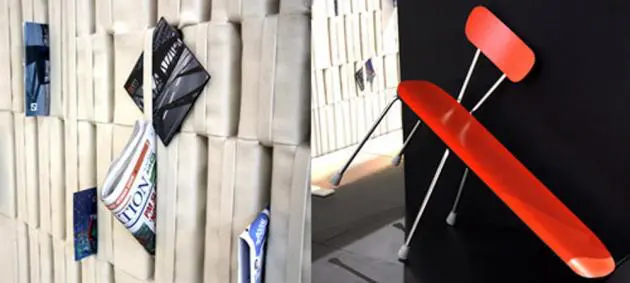
Moving inside, Carsten Gerhards and Andreas Glucker’s “Soft Wall” is a sculpture-like room divider that’s made of flexible foam on a metal frame. The wall has pockets for magazines and whatever else you usually stow on a shelf or under the table.
Ah, here’s that tottering bookshelf. Bookshelves ought to be rock solid, common sense tells us, but Konstantin Grcic’s “Es” free-standing stack of beech-wood shelves rely on a flexible support structure and can take a great deal of weight. You can peruse the books from any side as well.
Tom Pawlofsky’s “Zinfandel” has another bash at shelving – and anyone who moves home a lot should take note. You have a soft, polyurethane-foam grid into which identical boxes loosely fit. Store stuff in the boxes on the shelves until it’s time to move again, and then the boxes become carriers and the lightweight grid can be rolled or folded up.
For an upholstered lounging chair called “Soft”, Werner Aisslinger uses the transparent Technogel pads that usually cushion wheelchairs and hospital beds. The pads are attached to a fibreglass lattice and perfectly fit the shape of any bum that happens to land on them.
“The advantage of the Technogel is obvious,” says Albus. “Whereas you normally need cushion material about five centimetres in thickness to achieve the desired softness, one centimetre of Technogel is sufficient.”
The curator has his own idea on display, the hand-tufted, pure-wool “Genuine Nepalese Rug”. In place of the intricate pictorial pattern you’d expect on a Himalayan handicraft, though, he’s covered it in discount-price tags. The quality is high, to be sure, but the tongue is also firmly in cheek.
Jurgen Bey’s long “Do-add#2” chair is quite a balancing act. In fact it doesn’t stand up by itself – it needs you sitting on it plus a few books or magazines as a counterweight.
Patrick Frey and Markus Boge’s “Kant” desk has a groove at the back for storing books and folders. Andreas Boebel’s “Frontline” looks like a document file. Keep it on a shelf at your office, and when fatigue sets in, unfold it and have a snooze. It’s a leather-covered foam cushion that’s modular and quite flexible.
Karl Emilio Pircher and Fidel Peugeot’s “Ping Meets Pong” conference table might be fun after it’s hosted an all-too-serious business meeting. Lose the neckties and attach the provided net to the table for a game of table tennis.
Babysitting becomes more interesting with the gently rocking “Re-babe” cradle by the design collective e27. Once Junior is too big for lullabies, the cradle turns into a rocking horse – a saddle is included. The cradle’s woven bassinet can then be used for storage. And the “Re-tire” rocking chair can be attached to the “Re-babe” so Mum and Dad can bobble along with baby.
Kanarak Isarankura Na Ayudhya is one of seven Thai designers participating in the exhibition’s Bangkok stop. She’s come up with a T-shirt and blouse that can be easily adjusted to fit any wearer from size 34 to 44. Scalable buttons extend or reduce the dimensions.
“You might fit into a size 36 in one store and then need a 38 in another,” notes Kanarak, who graduated from the Design Academy Eindhoven in the Netherlands. “This so-called ‘vanity sizing’ in ready-to-wear fashion is intended to please shoppers by making them appear thinner, but it actually leads to a false understanding of our bodies.
“The retail size system is determined by the bust size, but women have various shapes in different parts of their bodies. A woman with small bust can be a size 34, but she might have a hip size of 38. With my design, women can adjust the buttons to fit any part!”
NOT THE USUAL
<< The Goethe Institut and the German Institute of Foreign Cultural Relations arranged the travelling exhibition “Somewhat Different”, which continues until March 13 at the Crystal Design Centre on Ekkamai-Ram Indra Road.
<< It’s open daily from 10am to 8pm.
<< Get more details at (02) 101 5999.
