
Words with the poet
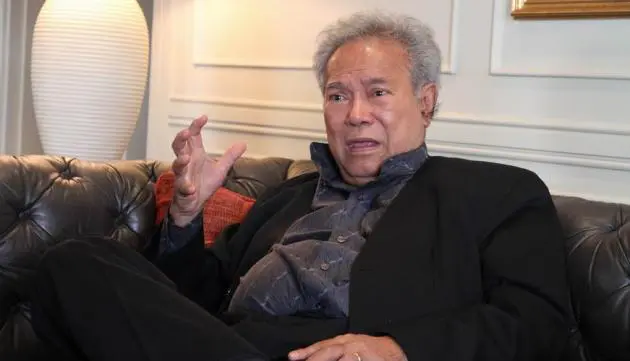


Singaporean SEA Write laureate Edwin Thumboo remembers the inspiration Bangkok gave him 60 years ago
A conversation with Dr Edwin Thumboo – the poet who in 1979 became the first Singaporean to win the Southeast Asian Writers Award – tends to veer off into memory lane. It’s a fascinating
detour.
When he was just starting out as a writer in the 1950s, Thumboo was part of a generation caught between two worlds – one not yet dead and the other not yet fully alive.
Born in 1933, Thumboo grew up in what was still a British colony. He was half-Indian, half-Chinese, speaking Tae Chiew and, by age nine, some English.
Thumboo graduated in English from the University of Malaya in 1956. He worked in the civil service for nine years and then returned to his alma mater, renamed the University of Singapore when the island gained its independence.
He earned a PhD in 1970 and became a full professor in the Department of English Language and Literature, ultimately heading the faculty from 1977 to 1993.
After the University of Singapore merged with Nanyang University in 1980 to form the National University of Singapore, he was Dean of Arts and Social Sciences from 1980 to 1991, the longest anyone has ever served in that capacity.
The same year he won the inaugural SEA Write Award, Thumboo also received the first Cultural Medallion for Literature. Then in 1987 he was given the Association of Southeast Asian Nations Cultural and Communication Award in Literature.
Thumboo lived through the years when the erstwhile British possession was fumbling with its independence and grappling with the multiracial character that has since come to define Singapore.
Its transition from colony to independent state amazed the poet, but the post-colonial chaos was often cause for alarm. He’s always seen it as his duty as a poet to explain his country’s birthing pains.
“I grew up while Singapore was nudging towards independence,” he says. “My generation is deeply touched by national themes, the construction and reconstruction of society. Singapore is unusual in the sense that it was a colonial creation by Raffles.”
When the Governor General of Java, Sir Thomas Stamford Raffles, arrived in Singapore in 1819, there were about 1,000 people living on the island, mostly Malays and some Chinese. Raffles brought in labourers from neighbouring territories to build a new city.
“Raffles had the tremendous vision of making it into a major port city,” Thumboo says. “He brought the first Indian bricklayers from Penang, Arab traders from Sumatra and merchants from Malacca.”
Independence in 1963 was a deeply moving event for Thumboo and compatriots.
“There were real challenges: how to maintainunity, how to mobilise people of different ethnic backgrounds, how to create a multiracial society, how to make a multiracial country a single ethnicity.
“How might we all be called simply Singaporean, regardless of whether we’re Malay, Chinese or Indian?”
These themes inspired his early poetry in a decade that witnessed frenzied nation-building. He looked around for inspiration, and found some on a trip to Bangkok in 1954. “What struck me immediately was the difference between our psyches – ours burdened by colonialism and the Thais’ free-spirited. They were confident yet modest, friendly without condescension, helpful
without motive. They were fully themselves, not diminished in any way by that subtle defence mechanism, the survival strategy that colonial peoples tend to develop.
“We saw and entered their gracious, relaxed hospitality when we visited their homes.
“While there were depressed areas where life must have been hard, I saw love and compassion in action, notably in the temples and shrines. I saw dignity in the face and bearing. I saw a larger, earlier history whose doors were kept open with the flow of tradition. I stood before the
glory of Wat Arun.
Thoughts and feelings merged, expanded, coalesced, jumped from arithmetic to calculus.”
Thumboo decided that Singaporeans could emulate Thais, to the point of sharing their sense of a single ethnicity. “We just wanted to look plain Singaporean,” he cries.
In his poetry, Thumboo has sung the praises of social integration, national development, unity, progress and nationalism. He always believed Singapore was heading in the right direction, despite the chaos that boiled into racial riots.
“You make poetry out of life – out of discontent, out of celebration,” he says. “Poetry arises from strong feelings. Sometimes dissatisfaction is a strong feeling, you know.
“I write as I please. You’re not conscious of when you’re writing poetry. It’s only in retro spect that you realise what you were trying to do. But poetry has a way of coming to you.
When the first line comes to you, it’s like scaffolding, or a rocket booster. Once it serves its function, it drops away.”
Thumboo has also found inspiration in flowers, beautiful ladies and life’s magical moments, like the one he enjoyed on his visit to Bangkok’s Temple of the Dawn:
I peel within
For heart, a stupa temple-graced,
Cleansed by the ash of Kings,
Grew a memory large,
Yielded the secret of its doing.
You my fathers made –
Left wheat and incense.
I, vestigial of that line,
Despite the buffeting of days,
Still quicken in your gaze.
Lord Buddha, shaman with the Wheel
Was in the loaves of Christ.
Thumboo was back in Bangkok again recently to speak at the presentation of the SEA Write Awards for 2011 at the Mandarin Oriental. The ceremony had been set for November but was postponed until last month because of the flooding.
The award adds to a writer’s standing and recognition, he acknowledges. In Singapore it’s helped broaden the use of English in general, and in literature in particular. Still, Thumboo joins the welter of word craftsmen who lament the simplification of English in the age of Facebook and Twitter.
“It’s so simplified that it’s worrying,” he says. “What happens when it’s simplified is you lose the subtlety. True or not, the limits of thinking are dictated by the limits of our vocabulary.”
What concerns him especially right now is how Singaporeans develop their use of bahasa English, as opposed to the more common “Singlish” dialect.
“We need to internalise the language so that it reflects the inflections of our culture, our mind. You make it speak with your voice,” he says.
“And it’s a poet’s job to use the best words in the best order, to bring the highest moment in language into the highest moment of experience. We don’t choose poems – they choose us. When a poem wants to come, we can’t stop it. When it doesn’t want to come, we can’t get it to come.”
