
MAHLER'S CHILDHOOD TERRORS


Play
The Sinfonietta youth orchestra takes on a challenge for Mozart and More
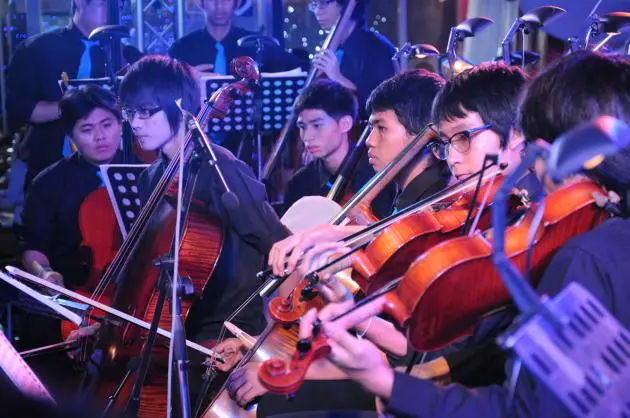
A week from today the Sinfonietta – the youth orchestra I founded two years ago – will do a very daring thing: it will play its first Mahler symphony.
It’s daring because no group of 12- to 23-year-olds in this country has ever attempted such a feat. The closest was the Silpakorn Music Camp’s recent performance of Mahler’s First, but that was a performance by kids and faculty, with section leaders all being professionals, including a former concertmaster of the London Philharmonic.
There will only be two “seasoned professionals” in this performance: myself and Nancy Yuen, one of Asia’s leading sopranos, who will sing the solo in the final movement, which represents a child’s vision of heaven.
Mahlerians always say his Fourth Symphony is “about childhood”, but I think when people hear that it evokes idyllic and pastoral images – sort of like a Ray Bradbury short story, or like the blandishments of Loretta Lynn’s “Coal Miner’s Daughter” – “we were poor but we had love” and all that.
Such visions may sustain a short story or a song, but an entire symphony must dig deeper into the raw material, because a symphony more like a novel than a short story. It’s a journey you must take, with characters you must empathise and identify with, that must lead to some of resolution and denouement.
I’ve been talking to the kids a lot about this raw material because you can’t really play this music without understanding the nature of the journey. When I play a classical work with them, I can talk about tonal relationships, about harmonic tension, and so on. Of course, I do talk about those things in Mahler, but one can’t get away from Mahler himself or from the autobiographical view of art.
This “child’s-eye view” of the universe in Mahler’s Fourth is neither simple nor innocent. It’s reality and fantasy, seen through the eyes of excessively bright child who doesn’t miss a thing, and who never looks away, no matter how great the anguish.
Children believe themselves to be immortal but, even in this most pastoral of Mahler’s symphonies, death lurks in every corner. Of Mahler’s many siblings, six died when they were children.
You must imagine the pub where Mahler grew up. The town of Jihlava was a German-speaking island in a Czech-speaking ocean. The language spoken in Mahler’s house was Yiddish, so it was an island inside an island. And from this island, with its beer hall full of drunken soldiers, every so often emerges the coffin of a small child. This is Gustl’s childhood – one in which the solemnity of death plays out against crazed klezmer music.
It was a home in which Mahler’s father abused his mother and slept with the help, a home from which the boy would sometimes flee in tears, only to run into the raucous blare of a military band.
Next to this cacophonous world stood a forest, and it was in this forest that Mahler discovered a silence so profound that it seemed to contain the moment before creation.
It is out of this silence that the First Symphony begins. It’s from this silence that the eight horns of the Third Symphony burst, with a roar like the Big Bang. It is into this silence that the Ninth Symphony dissolves as Mahler finally comes to terms with what St Francis called “our sister, bodily death”.
So Mahler’s home was no utopia. Beauty and terror dwelt side by side. In its fairytales, people really died. In one song a boy faces the hangman, not knowing why. In the song that closes this symphony a child dreams about what Heaven must be like – it’s all about food, and not just manna raining down. King Herod stands ready to slaughter the lambs.
So, although this symphony is “about” being a child, it is far from “childish”. In fact, one wonders whether the young can really comprehend its complexities. I think it’s very important, though, for young people to have a go at such multilayered masterpieces. If indeed it takes a lifetime to understand any work of genius, then they’re never too young to start trying.
TALENT IN BUD
- The seventh Mozart and More Mini-Festival takes place on Tuesday and next Thursday at Mahisorn Hall in SCB Park and on April 22 at the Siam Society. Show times are at 8pm.
- On Tuesday, Trisdee na Patalung will demonstrate his famed interpretation of Mozart piano sonatas, showing why London’s Opera magazine calls him a genius.
- The Siam Sinfonietta performs Mahler’s Fourth Symphony next Thursday.
- The Shounen-Thai Quartet and friends perform piano music by Haydn and Mozart on April 22.
- Tickets are Bt500 (Bt300 for students) at ThaiTicketMajor. Get a three-for-two deal if you buy tickets for all three days.
