
Toughest in the game
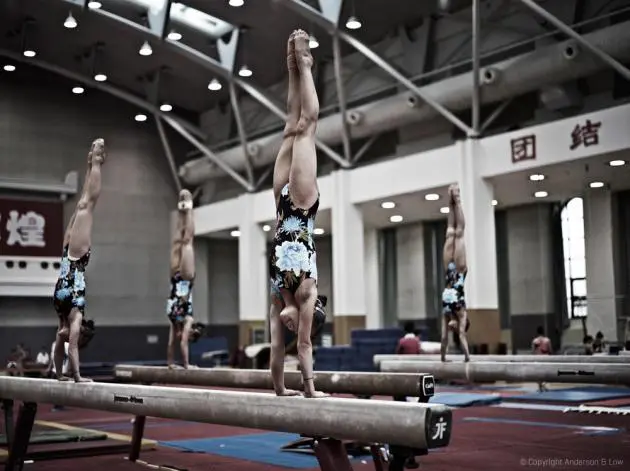


A Bangkok gallery offers a rare glimpse of China's gymnasts training for fresh glory
With the London Olympics in mind, the Serindia Gallery is hosting an exhibition of photos of China’s gymnasts, the much-envied serial gold medallists.
Anderson and Low’s “Endure: An Intimate Journey with the Chinese Gymnasts” stems from the American photography duo’s exclusive access to the team’s training facility, a place few Beijing citizens are allowed to visit, let alone foreign artists.
Access was no doubt granted in part because Jonathan Anderson and Edwin Low earned much acclaim with a similar tribute to US Olympic athletes in 2001.
Anderson and Low’s images were featured at last year’s Venice Biennale and appear in museums around the world. They’re the “official artists” for the London Cultural Olympiad Festival and will display their pictures of Britain’s Olympic and Paralympic contenders in an exhibition opening on July 19, the fruits of a National Portrait Gallery commission.
The Nation quizzed them about their work via e-mail. Fittingly enough, they answered as a team.
How do you connect art with sport?
We first started working with sport when we received an invitation from the National Art Gallery of Malaysia to create an exhibition for the 1998 Commonwealth Games Cultural Festival. We decided to concentrate on the reason for the cultural festival existing, namely the athletes and sports themselves.
But how does sport fit in with art?
The connection goes right back to antiquity, to ancient Greece and Rome. It’s not a modern subject but one oldest and most depicted. The classical ideal of the sporting body inspired art from Michelanglo to paintings of the 1930s to current sports iconography.
We are looking to express the tension between that ideal and the reality of training and show the character of these individuals and the paradoxes they express.
Sports people are simultaneously the most ordinary and the most extraordinary people you can ever meet. They’re just like everyone else, and yet they attempt things every day that ought to be impossible.
So we’re trying to show something of that extraordinary process, what kind of person does it and how the process changes them. If you look at sport photos in newspapers you see mostly the critical moments of success or failure. What we’re trying to do is the exact opposite – bringing a sense of stillness to that exertion and laying bare their souls in the process.
How did you get permission to shoot the Chinese gymnasts in training?
We’re quite well known for using sport as a muse in creating art projects. They’d seen our earlier projects and really liked them, so they invited us in. They were very trusting, believing we could capture the essence and depth of who they are. We think they’re ready to show themselves with confidence to the West.
What’s the exhibition’s chief message?
We’re always using sport as a window into the human condition – hopes, dreams and the wish to push limitations of what people can achieve. And we want to capture something of the diversity of these individuals and show how amazing they are.
n Continued on 2B
Chinese gymnasts ‘Endure’
n Continued from 1B
The relationship between identity and the character projected, and the costumes and environment are recurrent themes in our work. The Chinese gymnasts are all so individual in their character and even their body forms, as well as their talents – pretty much the exact opposite of the robotic creatures that the Western media likes to portray.
Did you focus on a particular aspect of the training regimen?
Training for gymnastics is at least as hard as for any other sport. There can be few other pursuits, apart from classical dance, that require such a combination of strength, stamina, complete spatial awareness and training every single muscle in your body.
With gymnastics, when one is successful, it’s in some ways as close to flight as any human can get, truly superhuman moments of amazing power, grace and beauty. But gymnastics is also completely unforgiving. The great British journalist Simon Barnes summarised it well when he wrote that you’re either a god or a fool. He said the line between success and failure is so narrow, and the precipitous and very physical fall from grace is harsh, really brutal. If you fall you instantly become nothing more than a clown in the spectator’s eye. Or even worse, you get injured – a permanent risk at any level of the sport.
Also, no matter how much talent they have, no matter how hard they train, no matter how much you may try to make someone into a champion, it can only happen if they truly want it more than anything else in the world. It’s not ruthless aggression. It’s an inner sense that this is what you were born to do. For as long as you continue training, life without at least trying to perform these impossibly difficult disciplines would be unthinkable.
Were your subjects all award-winning sportsmen?
The exhibition and the book that will be published in a few weeks encompass the full range, from 2008 gold medallists, world champions, junior champions and medallists from the 2010 Youth Olympics, to many very talented hopefuls at all levels and young novices.
What’s your take on the children forced to stretch, being subject to extreme manoeuvres that look rather painful?
The stretching, the endless repetition, the strength training, spatial-awareness training, agility training, endurance training – these are the tools of the trade and you see this anywhere in the world. Truly we have never seen people train in any sport as hard as these ones do in Beijing, but please don’t think it’s “too hard”. If the athletes weren’t Chinese, you probably wouldn’t even ask this question – you’d just say, “Wow!”
An American gymnast, a good friend of ours, said after seeing some of the images, “I used to think I trained as hard as possible, but after seeing this I now realise I was just playing.” But, honestly, in all our visits there we never saw anything we felt was wrong or excessive, and we were there long enough that they could not have altered their practice just because of us.
Tell us about some of the memorable moments during the shoot.
Of all our encounters with sport over the years, this felt the most complete, the most moving of all. Perhaps the most amazing thing was the impact of the very first visit, when we stood on the balcony watching 400 people training at once. By chance it was a day when many regional groups were there.
The experience was overwhelming, really setting the tone for how we would approach the project. We just stood there almost in tears, bathing in this incredible atmosphere. That’s what we want to convey in the prints – how we feel watching them.
These images aren’t naturalistic. Nothing has been taken out or put in, but we worked obsessively to bring out the truth of each image. That’s why the project is called “Endure”. We’re not using the word in a negative sense – it’s a celebration of what these people do and the way they do it.
NOW ON VIEW
n Anderson and Low’s “Endure” continues until August 19 at the Serindia Gallery at OP Garden on Charoen Krung Soi 36.
n Find out more at www.SerindiaGallery.com.
