
Ready for the deluge


Play
Cameras that watch the flood creep, a better floating toilet - it's about being prepared
One of the frequent complaints during last autumn’s flooding was that people under threat had no idea where the water was – still kilometres off, in the next district, lapping at the front door?
Well, a monitoring system conceived by computer engineers in Chiang Mai University’s OASYS Research Group might be in place for the next deluge, which many people believe may come soon.
It’s one of seven winning ideas unveiled last week in the Thailand Creative and Design Centre’s “Design for Flood” competition, all of which will be developed as prototypes. Hopefully we won’t need these brainstorms for rainstorms, but it’s nice to know they’re handy.
The OASYS scheme promises to provide people in areas at risk what they were missing last time – accurate information.
Sensors would watch the level and speed of floodwater and estimate how many days it will take to reach specific neighbourhoods. Cameras and devices to measure rainfall and temperature would be installed in every zone.
Presumably the authorities would thus have solid reasons for hitting the panic button – or for reassuring us that we’re still entirely safe. The contest, with its motto “Design Thinking”, injects some reassuring creativity into the chaos of natural disaster.
The flooding that swept through 64 provinces during the last half of 2011 and into this year sparked the competition, which drew entries from private firms, design studios and universities.
“The flood damaged a vast area of the country and a million people had to suffer the hardships,” said Kittiarttana Pitipanich, a design centre adviser. “We spent four months doing research in collaboration with King Mongkut’s University of Technology in Thonburi and Lad Krabang, FIF Design Studios, Cerebrum Design, KLS and Redek.
“All of the winning ideas will be developed as prototypes and offered ‘open source’ to the public on our website.”
The team from Tanakul Workgroup addressed another problem that kept recurring last year and was partly resolved with toilets that could float on their own rafts. Tanakul’s mobile Public Toilet also floats, and it adds wastebaskets, life belts and easy cleaning.
The same group came up with the contest’s best emergency signage. One type of sign carries information about the current situation in a given area, including possible dangers such as sewage, slippery surfaces, submerged obstacles like speed bumps, strong water flow and loose electrical wires.
Another is a standardised template with which people in remote areas can indicate their location by GPS and appeal for food, drugs or drinking water. It’s designed as a map that can be simply marked and e-mailed or posted on one of the social media.
Flat 6 Studio’s iridescent Floating Furniture for Schools is mildew-resistant, made from lightweight PE plastic and so vividly coloured that it can be spotted from far away. Plus, the furniture can carry belongings and food and even be piled up to form a flood barrier when sandbags are unavailable.
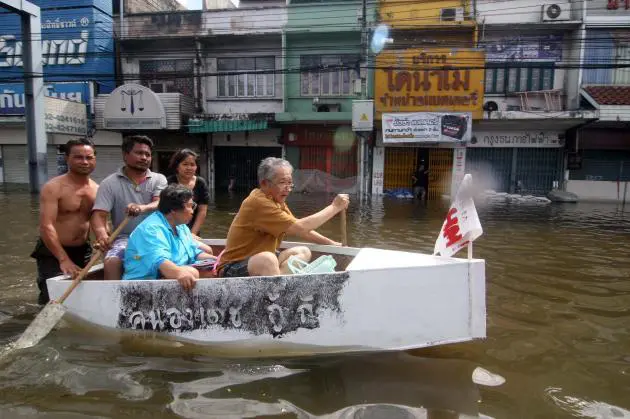
Nuttapong Thammaruksasit sketched out the Private Vehicle for Travelling during Floods, with office workers primarily in mind. No excuse for failing to show up for work when you’ve got this lightweight contraption and its paddle. When not carrying employees, it could be used as a tote bag for office clothing and accessories.
For those refusing to leave home, Yotsawadee Luetrakulset – a fourth-year architecture student at King Monkut’s U in Thonburi – offers the Sufficient Vegetables Gardening Kit. It comes with a handbook that includes a weekly planting schedule and a list of vegetables that require little sunlight, just soil and, well, lots of water.
“Bean sprouts, water morning glory, coriander, scallions, bok choy, basil and Chinese cabbage and kale have short roots, about 10 centimetres, so they don’t need much space to grow and are thus suitable for residential areas,” says Yotsawadee. “They grow fast, too – anywhere from three days to a month and a half.”
The diseases that floodwater carries became a major concern last time. Vatcharanont Kongchatthai’s Disease Diagnosis Kit could save lives by helping people record any symptoms that appear – early, common and distinctive symptoms – and compare them on a chart to those associated with five common flood-borne diseases.
It explains the potential for infection and how to apply basic treatment while tracking the symptoms’ progress as an aid for the doctor you eventually get to see.
WHAT’S NEXT
<< You can get more details at www.TCDC.or.th.
<< The Thailand Creative and Design Centre plans to work up the winning designs into prototypes in August and will also, on its own, further develop three design briefs that did not win.
