
A TOAST IN TEA
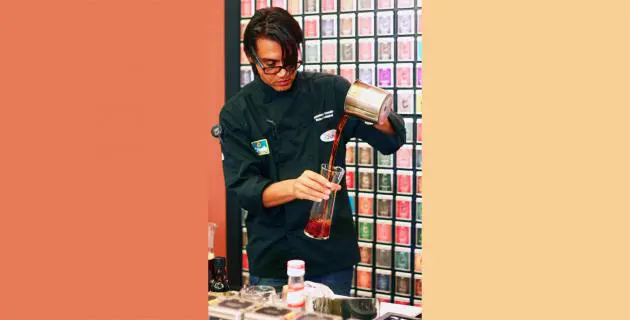


Sri Lanka's favourite leaf makes it into the cocktail glass thanks to some great ideas from Dilmah mixologist Robert Schinkel
Dilmah tea’s brand ambassador and mixologist Robert Schinkel has made four visits to Thailand in recent years to whip up his tea-based cocktails. He was here again earlier this month taking part in 13th World Gourmet Festival at the Four Seasons Bangkok where he conducted a tea mixology masterclass and excitement levels were as high as ever.
Participants were amazed that the story of tea making was being told by someone not of Indian, Sri Lankan, Chinese or English origin and not even a teamaker to boot. Schinkel is actually half Indonesian and half Dutch and perhaps that’s why he makes such as a skilled mixologist.
“I don’t function well if I don’t have a cup of earl grey in the morning,” he deadpans.
Four years ago, Schinkel won the Dilmah Tea Sommelier Competition in Europe, and was invited to visit Dilmah’s tea plantations in Sri Lanka to learn about tea tasting and grading. There he discovered tea was a great cocktail ingredient.
Keen to spread its wings, Dilmah named Schinkel brand ambassador of tea mixology and he’s been travelling all over the place to flaunt Dilmah tea cocktails.
After a similar session with Schinkel in a fine hotel on Koh Samui two years ago, this reporter found his latest masterclass brimming with confidence and sophistication.
In the masterclass, Schinkel’s table was loaded with fruit juices and alcoholic drinks: Bacardi, Martini, Jack Daniel's Whisky, vodka and dry gin.
“Mixology, the first true American art form, is the fine art of mixing drinks,” he says, adding: “The term cocktail was first described at the beginning the nineteenth century as stimulating liquor composed of spirits of any kind, sugar, water and bitters.
“There are the endless possibilities for tea as a cocktail ingredient. In this definition, water is easily replaced by tea, and for every recipe there’s a different tea that will complete, uplift or at least pleasantly alter your cocktail.”
Tea can be used in a hot or cold drink, fresh, brewed or pre-chilled. It’s possible to use the infusion or just infused leaves, or as a syrup or as a bitter. Light tea, for instance, blends well with light spirits (jasmine green tea and gin, or Ceylon Silvertips and vodka). Heavier teas match with dark spirits (Ceylon Souchon and whisky, or Ceylon Supreme and cognac).
“Mixology is all about experimenting and finding out what works best for you. But before you can use the tea in your cocktail, you’ll have to brew the tea.”
Black tea, oolong tea and green tea are all very suitable for a great range of cocktails. In general, black tea can be mixed with almost every kind of spirit, while green tea should mainly be used with white spirits like gin, vodka or tequila. The delicacy of green tea is easily overpowered by a dark spirit.
Good cocktails depend on proper brewing. The best water must be used.
Check for low amounts of calcium on the bottles of water available. Calcium will cover up the aroma and make the colour of the infusion look rather dull.
“Spring water from a mountainous area usually contains more calcium than spring water from an area on the sea level,” he explains.
Go for the lowest possible amount of dry residue (minerals that do not evaporate after boiling the water) in the bottled water, which is good for tea.
“Mineral waters are famous for their taste and health benefits, but because of the minerality, they are unfit for brewing tea. In general, the clearest water, with the least minerals is the water one wants for tea,” he said.
Using hot tea for a cold drink, the mixologist usually prepares a strong brew to make sure it will not be diluted by ice cubes.
“For all the teas used in the cocktail recipes, I’ve measured two grams of tea per 200 ml of water for strong tea, and 2.5 grams of tea per 200 ml of water for lighter teas.”
There’s also cold brewing that involves white, green and oolong tea. Instead of using boiled water to brew the tea, the mixologist uses the clearest, chilled spring water.
Robert Schinkel’s two notable recipes
EARL GREY MARTINI
Glass type: Martini
Ingredients
90 ml Dilmah Earl Grey
10 ml apple juice
10 ml lavender syrup
Fresh lime squeezed
Method
Add all ingredients to an ice-filled cocktail shaker
Shake vigorously for 12 seconds
Strain into a pre-chilled martini glass
Garnish with an apple fan
CEYLON OLD FASHIONED
Glass type: Old fashioned
Ingredients
40 ml Dilmah First Ceylon Souchon
40 ml Remy Martin VSOP
15 ml orange & cinnamon syrup
1 dash of angostura bitters
Zest of orange
Method
Add two ice cubes, 1 dash of angostura bitters and the syrup to the glass and stir for 20 seconds
Add two ice cubes, 10 m of tea and 10 ml of cognac and stir for 20 seconds
Repeat previous step three times more
Garnish with an orange zest
