
Barbarians in the trousers


Play
The story of George Scott is the story of Burma's tribulations under the British heel
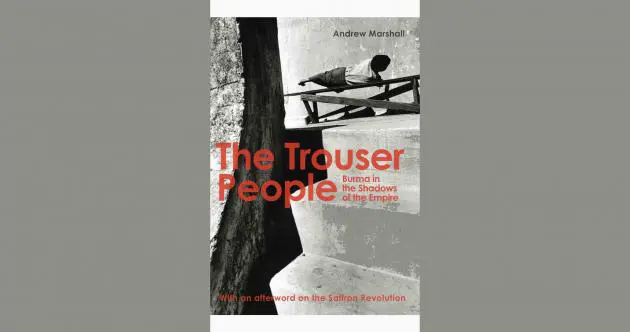
The Trouser People
By Andrew Marshall
Published by River Books,
Revised, 2012
Available at leading bookstores
The British conquest of Burma in 1885 and the fall of the Konbaung Dynasty have long been a source of interest for historians of British imperial expansion. This watershed in Burmese history spawned such notable characters as Shan saophas, Thibaw, Lord Randolph Churchill, General Prendergast and the like. But not George Scott, the subject of Andrew Marshall’s “The Trouser People”, just out in this revised and updated edition published by Bangkok-based River Books.
Which seems strange when you consider that Scott was the man who introduced football to Burma via the bumpy game field of St John College in Rangoon. With this book, Marshall sets out to rescue him from the forgotten intellectual jungle of Burma’s colonial history.
This diminutive Scot was instrumental to establishing British colonial rule in Burma in 1885. The story of how he did so is recounted in this assiduously researched, engaging book by the Reuters news correspondent.
While reading this book, I sought to answer the following questions: What drove British policy towards Burma? To what extent did British colonial rule contribute to the political instability of post-independence Burma? How did Scott view King Thibaw?
The first question is not addressed, the second is but only in passing, while the third is explained in vivid detail.
“The Trouser People” is less about football, more about Scott’s imperial adventures, absorption of Burma into the empire and the fall of King Thibaw. The rest is about the tribes and traditions of the wild frontiers. The title refers to the name the sarong-clad natives gave the white colonialists.
The story of Scott is told in vigorous, riveting prose that reads like a travelogue with political observations. The author contextualises what happened in the nineteenth century by skilfully directing the past and present to run in parallel, through his own journey to retrace mostly Scott’s expedition. This dual narrative shows just how little things have changed on the ground, and how stark contrasts can be in cultural, social and intellectual areas. It sometimes feels a little like British nostalgia for the post-Raj era, or perhaps a quest for the lost British heritage and the vanished colonial order.
Marshall manages to salvage the last vestiges of those fervent days on these pages, which is fortunate for us. (The research involved deciphering Scott’s largely illegible documents at the British Library.)
Scott was an “unsung” Victorian adventurer, war correspondent, photographer, linguist, jungle diplomat and sportsman. He was also a gifted writer who authored masterpieces including “The Burman” (1882), which made him the first European to study the Wild War in depth. He served briefly in Bangkok in 1893 as charge d’affaires at the British embassy.
The book covers the period from Scott’s arrival in Rangoon in the mid-1870s as a war correspondent for London papers to his death in 1935. In between was a life as colourfully lived as any fictitious A-list swashbuckler.
He introduced football while teaching at St John College. The game caught on, drawing thousands of spectators to the missionary school.
Scott’s 1887 expedition to the Shan States to pacify and map the highlands in the wild frontier bordering China defined his long colonial career in Burma, a country he described as “a sort of recess, a blind alley, a back reach”, not a far cry from “a recluse in a region of breakneck changes” as Marshall observes today. That mission involved torching and plundering villages. “We simply wipe out villages and shot everyone we saw,” Scott wrote in his diaries.
In the Shan mountains, he plunged into the bizarre worlds inhabited by the head-hunting Wa, over-amorous Kachin girls, and “giraffe” women. The Wa are today regarded as Asia’s most dangerous drug traffickers.
It’s hard to like Thibaw, whose 1879 massacre of 80 royals including eight of his brothers at Mandalay Palace inspired a famous painting. This happened as an orchestra played to drown out the screams. Scott was in Mandalay one year after the palace tragedy. Marshall’s report of the event is slightly different from Thai accounts by the likes of the late MR Kukrit Pramoj.
“Effete and decadent”, Thibaw was a “gin-soaked tyrant” and Supayalat an “evil queen”. The true evil in Kukrit’s account was Thibaw’s power-hungry mother-in-law who plotted the massacre, not him. The naive inexperienced king followed her advice blindly. To other scholars, he was pious.
It’s true that the victims were clubbed to death in velvet bags. Why this was so is not explained. Burmese tradition dictated royal blood cannot touch the ground, a practice also observed in old Siam.
It’s true too that the king had elephants trample the trenches full of corpses on the palace’s grounds. Why he did that is also not reasoned by the author.
Kukrit and other Thai historians described the bulging lawn inside the palace walls being pushed up by the pressure from the gaseous decomposed mass of corpses. Ultimately the ground kept bulging until the stench broke out. The king had the corpses dug out and buried elsewhere. That’s when his subjects learned of the king’s killing spree. Ghosts haunted the palace, Kukrit believed.
Scott met this “inhuman” monarch in a mirrored pavilion of the palace over a cup of brandy. Marshall interviewed the king’s grandson Taw Paya, a jade businessman.
The book is not all serious, though. He explains some funny Burmese idioms like “to play a harp for a water buffalo” (also a Thai idiom). The funniest must be: “I see your department store is open even on weekends.” That could be the caption for the photo of Marilyn Monroe standing astride a sidewalk grate, her skirt flying up.
Marshall doesn’t dissent from the widely accepted proposition that the British quest for territorial and economic gains in Burma triggered a process of state deconstruction that swept away traditions and institutions and compounded the turbulent political times following Burma’s independence.
The trouser people went off with their silver. Marshall shows quite a few haven’t.
