
MONK WITH A MISSION


Play
In his short life, Vivekananda did more than anyone else to show that we all have a claim to divinity
On September 9, 1893, a young Hindu monk awoke on the floor of an empty freight car in a Chicago railway yard.
This was not the kind of place where a Hindu monk would ordinarily sleep – but Swami Vivekananda (1863-1902) was no ordinary Hindu monk.
He was a disciple of the great 19th-century mystic Sri Ramakrishna Paramahamsa, who taught that the purpose of life is to experience God and that all religions can lead to that end. After his master’s death, Vivekananda had wandered all over India as a mendicant monk. Well-educated in both the Indian and English traditions, he was ideally equipped to serve as a bridge between East and West.
At the urging of disciples, he had travelled to the United States to represent Hinduism at the World’s Parliament of Religions in Chicago.
And now, on this brisk September morning, unwashed, unshaven, dishevelled, and rapidly running out of money, he climbed out of the freight car to begin his mission.
The omens were not favourable. As he would have done in India, he went from door to door begging for his breakfast. But Chicago is not India, and many doors were slammed in his face before he finally gave up, exhausted, and sat down on a kerb in an upscale residential neighbourhood to await the will of God.
And somebody up there must have been watching, because soon the door of a mansion behind him opened, and the lady of the house called to him. Was he by any chance a delegate to the Parliament of Religions? His Indian garb, and especially his turban, suggested as much. The lady had some connections with the Parliament, so she invited him inside to clean up and have breakfast, then took him there to register.
Little could Vivekananda have imagined, at that low point in his career when he was sitting alone, friendless and exhausted on the kerb, that two days later the applause of thousands would be wafting over him and he would be lionised by American society.
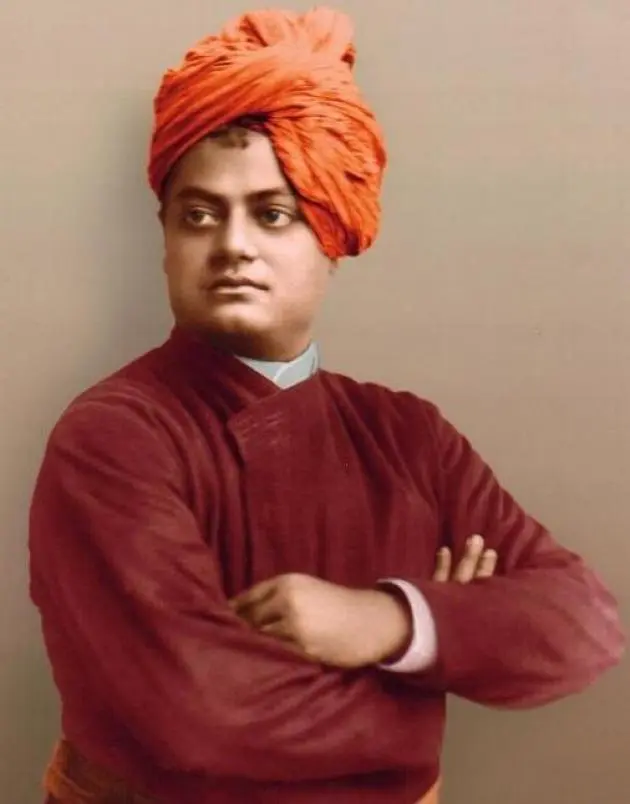
The Parliament of Religions made Vivekananda instantly famous. Strikingly handsome, though somewhat stout, he cut a dashing figure in his maroon robe and golden turban. He also proved to be a dynamic and charismatic speaker.
His first speech, which was largely extemporaneous, extolled his native land as a cradle not just of religious tolerance, but of active acceptance of every faith. He quoted a hymn from his boyhood: “As different streams, having their sources in different places, all mingle their waters in the sea, so, O Lord, the different paths which men take … all lead to Thee.” He also quoted from the Bhagavad Gita: “Whosoever comes to Me, through whatever form, I reach him.”
His subsequent speeches developed this idea. Religion to Vivekananda was not doctrines, churches and rituals. It was realisation – mystical experience, direct intuitive perception of the Divine – and God was omnipresent Spirit, both immanent and transcendent. “Realise religion – no talking will do,” he declared in one lecture. “He has hidden Himself inside the atom, this Ancient One who resides in the inmost recess of every human heart.”
He believed that each soul is potentially divine, that the goal of religion is to bring forth and manifest that latent divinity, and that every religion is a path to that end.
After the Parliament he went on a lecture tour, travelled around the country, and founded the Vedanta society – named after one of the six major philosophies of India – in New York. He moved in lofty social circles, attracted disciples, was offered a chair in philosophy at Harvard, met notables like Sarah Bernhardt, Nikola Tesla, John D Rockefeller, Josiah Royce and Robert Ingersoll. William James mentioned him in his “Varieties of Religious Experience” and came to call him “Master”.
Eventually Vivekananda returned to India to build up the order of monks he belonged to. Today the Ramakrishna Order and its twin organisation, the Ramakrishna Mission, have 176 centres around the world.
Vivekananda died suddenly at the youthful age of 39. During his lifetime he had fulfilled a twofold role as prophet and patriot, established Indian thought in the West, forged a new interpretation of the ancient Vedanta philosophy, and roused the Indian nation to stand up and be proud of its heritage.
His teachings fill nine volumes, and he left behind a movement that continues to make an impact on India and the world. Its twofold motto, “For the liberation of the self and the welfare of the world,” emphasises individual spiritual growth and selfless social service.
Vivekananda’s life and message assume a special relevance on Saturday, the 150th anniversary of his birth. The event is being celebrated with great eclat throughout India and in the centres of the Ramakrishna movement around the globe. Swami Vivekananda’s influence on the world has come a long way since that chilly September morning long ago when, friendless and unknown, he woke up in a freight car in a Chicago railway yard.
JOIN IN
- A free programme commemorating Swami Vivekananda’s 150th birthday will be held at Silpakorn University’s Sanskrit Studies Centre on February 9.
- To find out more, e-mail the Ramakrishna Vedanta Society at [email protected] or call Sathit at (081) 869 6209.
- On the Web, check www.Belurmath.org, www.RKMDelhi.org, www.Vedanta.org and www.VedantaThai.org
