
Women of substance


The Nation marks International Women Day today by profiling three women whose professions are dominated by men
The three women in this article all made very different career choices. Now at the top of their various fields, they talk about their success.
Oranuch Apisaksirikul
Gender is no hurdle to prospering as a banker or as a leader in other fields, insists Oranuch Apisaksirikul, chief executive officer of Tisco Financial Group, the holding company of Tisco Bank.
“By nature, men are more focused and they are also bigger risk takers, while women tend to care more about details and sometimes lose direction at the end. Yet, women can be focused.
Once you rise to the top job, there’s little time for the tiny details,” says the 50-year-old banker.
“In the banking business, there are no barriers to women rising to the top. Indeed, when it comes to money, women’s natural instincts are a plus.”
Oranuch recalls that most of her university classmates were male, an imbalance that she says can be attributed to a time when sons were given first priority when it came to education. But being in the minority wasn’t a deterrent, with Oranuch aiming for academic excellence as she followed her dream to become a chief financial officer.
The banker is pleased at the changes that have taken place for Thai women, pointing out that they are now entitled to better education and overseas experience, which encourages them to express their opinions.
Evidence of these improvements can be seen in the growing number of top female executives. In addition to Oranuch, three of Thailand’s 13 commercial banks are now run by women – Siam Commercial Bank, LH Bank and Bank of Ayudhya.
Life as a bank chief is tough, not because of the hard work as Oranuch loves taking on a challenge.
She is careful not to neglect her family though, using modern communication methods to chat with family members, ensuring that they dine together at least once a week and spend at least a week together at an agreed destination. She is always around to help her children.
“There is less free time because of the many dinners with clients and others. But you make family time quality time,” she explains. “Even men need to keep balance in their lives. As an executive, I’m leading the organisation forward but I’m still a wife and a mother.”
- Achara Deboonmee
Dr Punnama Siriphannon
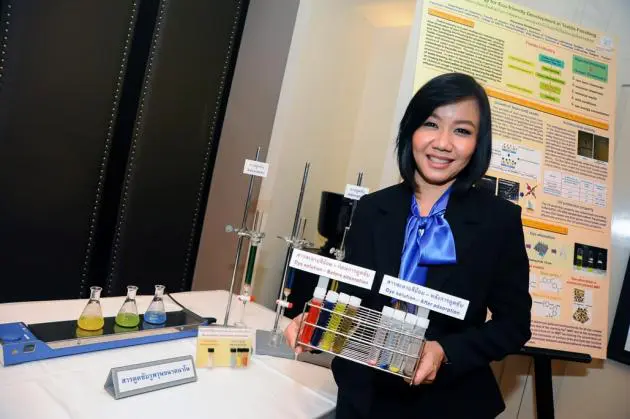
Recognised for her research into nanotechnology in the development of eco-friendly textile finishing, Assistant Professor Dr Punnama Siriphannon notes that that chemical science seems to draw more women than men. Numbers are deceptive though, as she says many of women in her class at the Department of Chemistry in King Mongkut’s Institute of Technology Ladkrabang’s science faculty go on to assume supporting roles in the science or chemical industries rather than strike out on their own.
“Male scientists tend to receive more funds for research and become better known than their female peers,” she says. “That’s partly because if a woman becomes pregnant, her studies will take longer. Even if they have excellent skills, women scientists tend to hold laboratory rather than supervisory roles,”
The 40-year old researcher is an expert in biomedical materials, a discipline that involves, among others, the testing of ceramic-polymer hybrid composites for medical applications. Her recent research into nanotechnology is helping to create value-added products, enhancing the efficiency of chemical usage in textile finishing, and eliminating effluent contaminants.
Training in logical thinking, she says, allows women to adapt to many other different roles and situations. “Using logic instead of emotions helps clear up problems whether related to family or work. As a lecturer, I let my students learn things systematically and encourage problem solving skills.”
Punnama stresses women scientists must prepare a more active role if they are to make major inroads in their field.
“We have to be confident in our competence and push ourselves forward so that we can be in the front row and receive better career opportunities,” she says.
Kupluthai Pungkanon
Sudarat Keyuraphan
Thailand may have its first female prime minister but veteran politician Khunying Sudarat Keyuraphan can’t help feeling that a woman needs to work twice as hard as a man to build a solid political career.
“You need to prove yourself a lot,” she says, pointing out that women are usually stereotyped as being indecisive, weak and lacking in leadership skills. And when a woman does well in her career, there’ll usually be a rumour that she’s having an affair with a powerful man.
“When I became secretary general of the Palang Dharma Party, rumour mongers said I was embroiled in a secret affair with the party’s founder, Chamlong Srimuang,” Sudarat recalls.
Sudarat, who was born in 1961, made her political debut under the banner of the Palang Dharma. “I was elected as an MP. That was 21 years ago,” says the mother of three.
Her political star shone the brightest during her years with the Thai Rak Thai (TRT) Party, which saw her
appointment to deputy government spokeswoman, deputy transport minister and public health minister.
“Then, of course, I was accused of having an affair with [TRT founder] Thaksin [Shinawatra].”
Sudarat, who has long admired former British prime minister Margaret Thatcher for her professional toughness and personal tenderness, learned to shrug off the labels “Beautiful but bitchy” and “Bangkok mafia”. “You have to be bitchy sometimes,” she points out.
She feels fortunate that her husband, with whom she has three children, has always been very supportive and very understanding.
Only when the TRT was dissolved and its executives, Sudarat among them, were slapped with a five-year political ban, did her family get more of her time.
Today, even though the ban has expired, Sudarat has largely turned her back on politics, preferring to devote her time and efforts to renovating the Lord Buddha's birthplace in Nepal. “Sometimes it is better just to stand still,” she says.
While acknowledging that the attitude of male politicians towards women has hardly changed, she would like to see more women in the political arena, saying the country’s politics would develop faster if there were more female parliamentarians.
“Women have a motherly instinct. That’s a good thing,” she says,
Chularat Saengpassa
A call heard round the world
Musical muses in China, Costa Rica, Mali and Malaysia and around the world have come together to spread a message of unity and solidarity on International Women’s Day with the song “One Woman”.
Indian sitarist Anoushka Shankar (daughter of the late maestro Ravi), pop sensations Jane Zhang of China and Bebel Gilberto of Brazil, Olivier Award-winning British actress Maria Friedman, and singers Yuna of Malaysia and Rokia Traore in war-torn Mali are among the more than 20 artists singing the UN Women’s theme song.
We are one woman,
Your victories lift us all.
We are one woman,
You rise and I stand tall.
We are one woman,
Your world is mine,
And we shall shine,
Shine, shine, shine,
We shall shine,
Shine, shine, shine,
We shall shine,
Shine, shine, shine.
Available starting today from iTunes and Amazon, “One Woman: A Song for UN Women” calls for change and celebrates acts of courage and determination by ordinary women who daily make extraordinary contributions.
Graham Lyle (who also wrote Tina Turner’s “What’s Love Got to Do With It” among other hits) and British-Somali singer Fahan Hassan wrote the melody. Jerry Boys produced the song, together with lyricist and executive producer Beth Blatt and her organisation, Hope Sings.
The song is a rallying cry that inspires listeners to join the drive for women’s rights and gender equality. “One Woman” was written for UN Women, the global champion of women and girls, to celebrate its mission and work to improve women’s lives around the world. This year’s International Women’s Day focuses on ending violence against women — a gross human-rights violation that affects up to seven in every 10 women and a top priority for UN Women. As people everywhere prepare their commemorations, “One Woman” reminds us that, together, we can overcome violence and discrimination: “We Shall Shine!”
Thanks to Microsoft, as UN Women’s corporate partner for “One Woman” has sponsored the song and music video production.
Download the song from iTunes or Amazon for 99 US cents (Bt30). All proceeds go directly to UN Women in support of its programmes to empower women. Or, listen ot it here: Song.UNWomen.org.
THE NATION
