
Keen to keep on playing
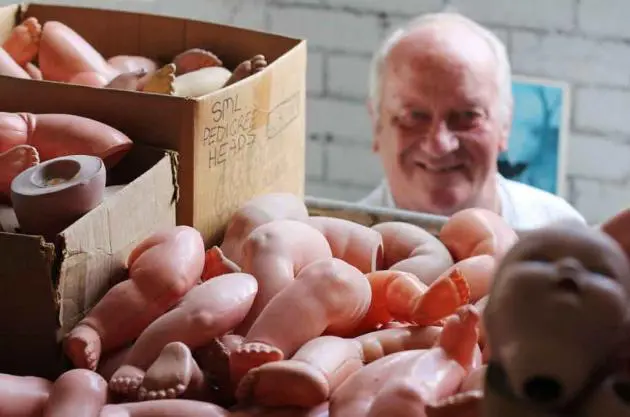


Toytown paramedics in Australia give new life and |limbs to old dolls
Medical miracles are worked at Sydney’s Famous Original Doll’s Hospital. A patient in on Monday can be out by Friday with a new pair of eyes, a double hip replacement and a fresh head of hair.
The extreme makeover can be all too drastic for a child picking up a treasured doll or teddy bear.
“I’ve had them burst into tears,” hospital owner Geoff Chapman says. “They say. ‘That’s not my doll!’ and you have to explain to them it’s been completely repainted and it looks like it did when you first got it. But that’s not what they want. They want it like they last saw it.”
Geoff’s grandfather started the family business 100 years ago and since 1913 nearly three million toys have been in for repairs. When Geoff was a boy, his father had 70 staff. Now the payroll is down to six.
A stencilled code on the inside of a celluloid leg can reveal that some patients have already been tended by two generations of Chapmans and are in the hands of a third.
Some past procedures are beyond the present team. Originally, new hair was sewn into the scalp with a special machine, but now the balding have to make do with a wig.
David Short, one of the last doll restorers in Melbourne, agrees that times are tough and the golden age is gone. He can’t see a future for the profession he’s been in for 30 years.
“It’s because people can’t afford to repair them,” he says. “There’s a certain sentimentality there, but lots of people will walk away and say, ‘Forget it.’”
Short, who works alone and at home, is among the last in Australia able to reset new glass eyes in their old plaster sockets, giving dollies back what he calls their “sleep eyes”.
Modern dolls have their obsolescence built in. “BabyBorns – the arms break off and you can’t fix them,” Short says. “Anything electronic, mechanical – you can’t fix them. They’re rubbish. They’ve had it.”
Chapman is more sanguine. Dolls, teddies and other toys are often the only surviving artefact from childhood, and those who are themselves now parents, or even grandparents, are desperate to see them cuddled by a new generation.
“Yes. a new wig, new clothes, that sort of thing,” says Chapman, 65. “But they don’t want you to change the look of it. They want it exactly the same.”
Gail Grainger has been restoring limbs at the hospital for 13 years. “You get a feel for it,” she says. “I’ve picked up the skills as I’ve gone along. We can usually do it.”
Sometimes they can’t. “If a teddy’s threadbare, you can’t stitch it,” Chapman says. “You’ve got to say to them that the only thing we can do is remake the whole thing. And then they say it’s not the same.”
Some customers, regardless of cost, ask for an exact copy of a lifelong companion. A bit of remnant stuffing, an eye or a limb can keeps the heritage going, providing a link between the original and the pretender.
