
Found in China


Play
The Thai Embassy brings six of the Kingdom's films to Beijing
Buoyed by the wave of Chinese tourists heading to the kingdom in the wake of this year’s blockbuster comedy “Lost in Thailand”, the Thai Embassy in Beijing has set itself the goal of popularising Thailand by hosting the first ever Thai film festival in the Chinese capital.
“We’ve selected six popular movies that we think will have particular appeal for the Chinese public,” says the embassy’s minister Ureerat Ratanaprukse, adding that the festival is part of an overall campaign to promote the country.
Taking part in the April 18 to 23 festival are the romantic comedies “My Name is Love” (“Kao Riak Pom Wa Kwam Rak”) and “Chob Kod Like, Chai Kod Love”, GTH’s three-segment comedy-drama “Seven Something” (“Rak Jed Pee, Dee Jed Hon”), the action flick “Fighting Fish” (“Du Duan Dib”), the horror omnibus “3AM” (“Tee Sam 3D”) and the Tibetan road-trip drama “Shambala”. Ureerat adds a number of Thai stars will be in attendance and meet fans.
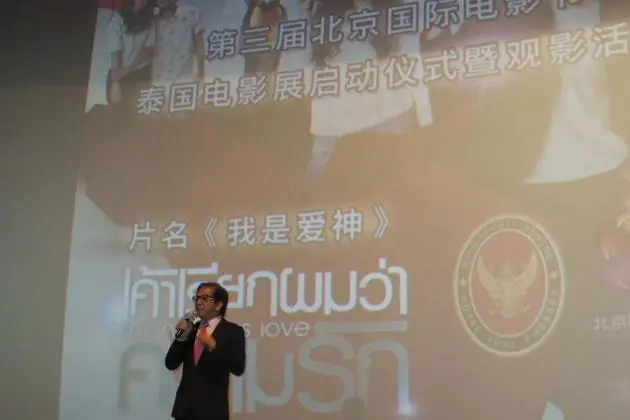
The embassy tested the waters last month with a preview of “My Name is Love” at Megabox theatre’s Sanlitun Village branch, offering free tickets on Weibo, China’s answer to Twitter. The response was overwhelming – all 400 seats were quickly snapped up for the romantic comedy starring Arak “Pe” Amornsupasiri and Thunyasupan “Bo” Jirapreechanon.
Thai Ambassador Wiboon Kusakul is well pleased with the reaction. He reckons the Chinese find Thai movie stars more attractive than their Asian peers.
“We know from the success of ‘Lost in Thailand’ that the Chinese love comedies and the Thai film industry is known for its expertise in producing quality comedies. The audience laughed a lot in ‘My Name is Love’ even though some of the subtitles were not translated correctly. The screening has helped us understand the kind of films they want to see,” says Wiboon, who is fluent in Chinese.
However, the Thai film industry has encountered problems in exporting its films to China as the law allows a mere 35 foreign movies to be shown annually, meaning that Thai oeuvres have to compete with Hollywood mega-hits like “X-Men” and “Titanic”.
Wiboon says that discussions are being held with the about the possibility of China re-categorising its foreign film allocation into Asian and non-Asian movies. If authorities agree to the proposal, Thai movies will stand a better chance of reaching a far wider Chinese audience.
“One possible way around the foreign movie quota would be for Thai studios to enter into joint ventures with a Chinese company and produce selected movies under a partnership,” he says.
With Chinese viewers already familiar with Thai stars and soap operas from the Internet – current estimates put at 600 million the number of Chinese owning smart phones – the market potential for the industry is considerable.
Watson Homsangpradit, marketing director of M Pictures, is also well aware of the popularity of Thai movie stars and says the industry would like nothing more than to tap into this sizeable market.
“Even Hollywood is interested in the Chinese market. They come here to shoot movies using Chinese stars,” he says, pointing to the rapid growth in movie theatres and the fact that Chinese film fans are increasingly able to afford the relatively expensive tickets.
“Right now the quota system forces us to compete with Hollywood blockbusters like ‘Iron Man’ and ‘Superman’. If the problem could be solved, it would be perfect,” he adds, calling on the Thai government to extend its full support to the industry in the same way as South Korean government has supported its culture, music and movies industries.
“I’ve had many dealings with Korean film studios, actors and pop stars. They all say that their government financially supports them in promoting their work overseas. Because of that, they didn’t charge any fees for their initial screenings or appearances in Thailand. Now, of course, with their popularity continuing to peak, the fees are very high.
“With help from the Thai government, I believe Thai films would be able to reach a far great number of Chinese. We know they already like and favour Thai culture more than that of other Asian countries. We should not have to emulate Hollywood to achieve success,” he says.
While Watson is pleased at the influx of Chinese tourists generated by “Lost in Thailand”, he feels the Thai film industry can do a better job. “Frankly speaking, the movie isn’t better than our own productions. In fact, the gags in the Thai films are much funnier than those in ‘Lost in Thailand’ and our stars are better looking. The problem is that Thai films do not receive enough support from the government.
“The Chinese already watching trailers of Thai movies on the Internet, so it might be easier to disseminate our films online without any fees. In the past, we’ve had to ship film reels to theatres, which is a time-consuming and expensive process. Now we can put them through the Internet and the movie houses just download it and show it. While this saves time and money, it’s also necessary to rent a special lab with sophisticated broadband for the downloads. I would estimate that in the near future, possibly by the end of next year, all movies will be digital.”
The production company of “Lost in Thailand”, which has grossed more than US$200 million at the Chinese box office, recently announced that it would soon start work on a sequel but has apparently yet to decide where to shoot the film.
