
When classical goes contemporary


Two works from Beijing show how to make classical works relevant today
One of the reasons why audiences shy away from watching classical theatre is simply that they don’t want to sit through a play they’ve already seen, no matter how good the performance. But at the recent Hong Kong Arts Festival, the China National Peking Opera Company demonstrated that there’s more to the millennia-old performing arts tradition than often meet the eye. The first presentation of “The Artistry of Lao Dan”, four episodes of Peking Opera involving middle-aged to old ladies, was staged with English surtitles.
Accompanied by live music passionately performed by the company’s ensemble, the four episodes revealed the wide range of performance skills required for the role – vocal, emotional and physical – and offered spectators a variety of dramatic situations. And as the selected scenes were from different periods, they also reflected many facets of Chinese women as mothers and wives throughout history.
Sitting among the audience at the Hong Kong City Hall, I was reminded of how our National Theatre presents the masked dance performance known as khon. While “Man Sue Chue Phiphek” and “Hanuman Chan Samon” presented the life stories of two major characters in a way that allowed us to follow them individually, there has no attempt to present characters from the same types – phra (male), nang (female), yak (demon) and ling (monkey) – side by side, as in “The Artistry of Lao Dan”. Such a move would perhaps provoke the audience into thinking in a different way rather than just enjoying beautiful physical movements.
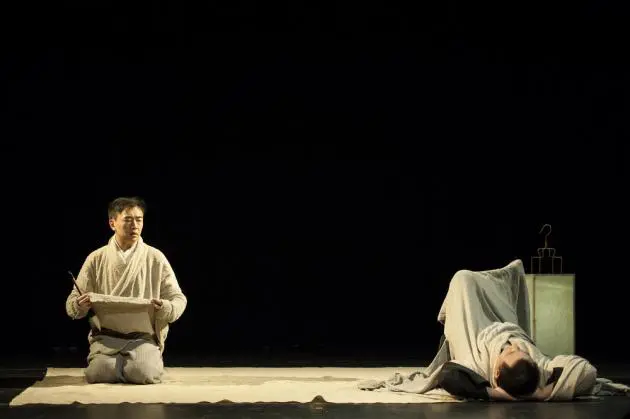
Another Beijing-based, smaller and private, theatre company, Full Lane Show Studio, has been working on contemporary interpretation of Peking opera by integrating the storytelling techniques of modern theatre. Their work “Cooking a Dream”, presented at the Huayi: Festival of Chinese Arts at the Esplanade in Singapore, was an example of how the subject matter, or the philosophy, of a traditional story can be analysed for the contemporary audience.
Adapted from Tang Dynasty novel “A Story of a Dream”, this short play tells the story of Lu, a dissatisfied young scholar who is offered a pillow by a priest he meets at a tavern. The ups and downs of his past and future life reappear magically in his dream and when he wakes, he realises that the millet the tavern keeper has been cooking is not even ready. And as he learns this significant life lesson, so does the audience.
Exiting the Esplanade Theatre Studio, audiences were invited to taste the newly cooked millet in a small paper bowl. This was not a gimmick, though but a reminder of how we’ve missed the unique taste of this traditional cooking in the same way we do classical theatre. A downside for this work was that there was so much information and play analysis in both the house programme and the performance itself that, having finished reading the programme before the performance, my brain didn’t have to work while watching it. The narrator, with the help of the English surtitles, thus sounded more like a Chinese philosophy professor. The fact that “Cooking a Dream” was previously staged, for audiences less familiar with Chinese philosophy, at the Le Off festival in Avignon, France might be a reason.
Again, “Cooking a Dream” brought home that there are many social, political and cultural themes in the Ramakien epic, which are relevant in the here and now. Yet we have been trained to watch khon simply as our national heritage, or to just enjoy the beauty and grandeur of it.
Now I’m dreaming of more contemporary experiments in our classical theatre.
ASIAN STAGES
- For more on the fests, visit www.HK.ArtsFestival.org and www.HuayiFestival.com.sg.
