
The singer, not the song


Play
Two business executives open up about why they are taking voice lessons
Can everyone sing or is a good singing voice something you are born with? Those who’ve been tortured by off-key karaoke sessions will probably opt for the second option but in fact singing is the one talent virtually everybody possesses. Sounding good, though, takes a little more practice.
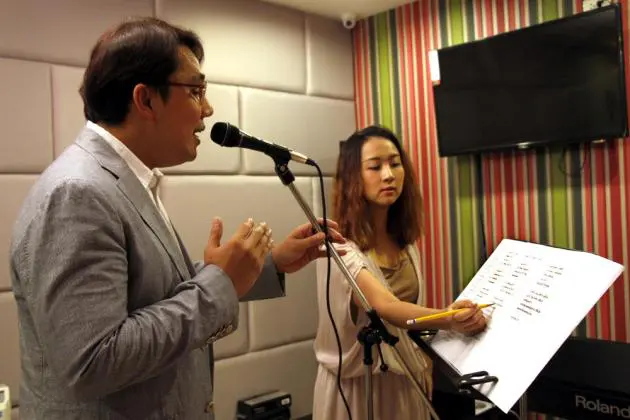
Just ask Kritapas Kusmith, 43, the first vice president of Kasikornbank’s integrated marketing communication department. He’s taking voice lessons and piano classes at Len Penn Music Academy in Bangkok’s Soi Langsuan and says music helps his powers of concentration.
“If you can’t multi task, you can’t compete with others. The problem is that I also want to multi task at home. Now, thanks to the classes, I am more focused,” says Kritapas.
Supaporn Kietisirikajorn, 39, executive assistant to the chief operations officer at Chia Tai, signed up for singing lessons at Star Maker Voice Academy, Siam Paragon to help her career.
“I noticed while I was working in Japan that employers and employees relaxed together after work usually by going out to a karaoke bar,” she says. “We went to a karaoke place one evening and the Japanese boss and his staff sang and danced. I just sat there and smiled.
“When I was promoted to a middle management position at Chia Tai, my boss told me I would be playing a greater role in looking after clients. That’s when I decided to take singing lessons. When I joined a party in Bali, I was urged to sing Barbra Streisand’s ‘Woman in Love’ and everyone applauded when I’d finished.”
“Most people who sign up for voice lessons enjoy singing but they have little time to learn because of family and work commitments. Learning to sing and play an instrument requires lots of practice,” says Piranun “Kita” Chonpantarak, a singing instructor at Len Penn and a contestant on “The Voice”.
“It’s especially difficult for adults, who need more time to work on pronunciation. Our executive music director Chatchawan Pukahuta often says that music today, just like life itself, is so fast paced that adults can find it hard to cope. When they’re singing, they have to think of the lyrics, how to breathe and how to emote. Kids on the other hand simply sing.
“I’ve worked with a mother who took a singing class while her daughter was learning the piano. Because she had a naturally deep tone, she was unable to pitch her voice to the right key. An older man wanted to sing only golden oldies, which didn’t really suit his voice. The first priority is discovering the problems and then working to fix them.”
Kritapas, who sang in the choir at Assumption high school and later with the Thammasat University Band, also had firm ideas about what he wanted to sing – jazzy numbers recorded by Sarah Vaughan plus “That’s All I Ask of You” from “Phantom of the Opera”.
Kita was quick to set him right, telling him he first needed to work on his breathing techniques and delivery before tackling any of his preferred tracks.
“He doesn’t listen to a variety of songs, just his favourites from his younger days. But by singing numbers by younger artists, which have a quicker rhythm, he’ll be better able to project his voice to a distance of at least two metres,” she says.
“The instructor told me I needed to move away from the singing style of the ’80s. She helped me work on the more modern vowel sounds,” says the bank officer, who is now practising Stamp’s “Man Khong Pen Khwam Rak” and Autobahn’s “Khwam Rak”. He spends an hour on his singing lessons and another hour in piano class.
During his voice class, Kritapas receives compliments for his clear articulation of the lyrics but is told he needs to put more emotion into the delivery.
“I’m using Waai’s song ‘Sia Jai Tae Mai Khae’ so he understands about putting feelings into words,: Kita says later. “There are four factors involved in singing well: quality of voice, melody or rhythm, technique, and feeling or emotion. The fifth factor I can’t teach and that’s making an impression through the song.”
Supaporn meanwhile is working hard on her delivery at Star Maker, as she prepares to welcome client groups both professionally and socially next month.
While she admits it’s not easy, having avoided all activities related to singing for so many years, she says she is slowly gaining in confidence.
Right now, she’s taking a 20-hour private course of social singing and performance and will then enrol in the voice coaching course taught by academy founder Maneenuch “Uan” Smerasut. Her husband and children are lending support by taking private classes too.
“The first song my teacher selected was Diana Ross’ ‘If We Hold On Together’, which she said would help me breathe correctly and project my voice.
“After I’d mastered that, I found I was able to project my voice more powerfully. It’s definitely opening up my personality and giving me more confidence in myself.”
