
A slice of Bacon


Play
Japan gets to taste the raw power of Britain's modern-art master
A person frantically shouting in a transparent box. A lump of flesh placed in a semicircular space that looks like a bullring. These are among intense but oddly appealing pieces on display at the exhibition of paintings by Francis Bacon (1909-’92) at the National Museum of Modern Art in Tokyo.
The exhibition, titled “Francis Bacon”, is designed to shed light on the artist’s mysterious career. It is the first such show in Japan since 1983 and the first retrospective in Asia since the artist’s death. The show features 33 works created between the mid-1940s and 1991.
Bacon’s visions are often shocking – human faces from which expression has been scraped away sprout from grotesquely deformed bodies. The paint’s coarse textures also give viewers a feeling of tension.
Bacon was born in Ireland but active mainly in London. His obsession with fleshy bodies and the violence and pain they are subjected to seems to stem from his background.
He suffered asthma as a child. Into adolescence, his homosexuality sparked a harsh reaction from his father. The political strife in his homeland and the two world wars he lived through are also keys to understanding his style.
Bacon also explored the possibilities of painting by studying art history and the 20th century’s obseesion with the moving image.
His works based on Velazquez’s “Portrait of Pope Innocent X” have depth given by lines drawn in their background. Bacon was also inspired by Eadweard Muybridge’s pioneering photo series of bodies in motion.
Materials found in his studio after his death revealed that careful planning was an important part of Bacon’s artistic process.
Many of his pieces have a common feature – red-raw bodies writhing in an abstract space. These pieces convey feelings of solitude in a closed-off world.
The Tokyo exhibition focuses not only on the relations between bodies and space but also the way in which his pieces reached out to the real world. Bacon described his methodology as “a tightrope between figurative painting and abstraction”.
Kenjiro Hosaka, curator at the museum, says: “Abstract paintings often bring about one-sided views. Bacon drew bodies in space with no specific purpose in order to give his paintings multifaceted elements.”
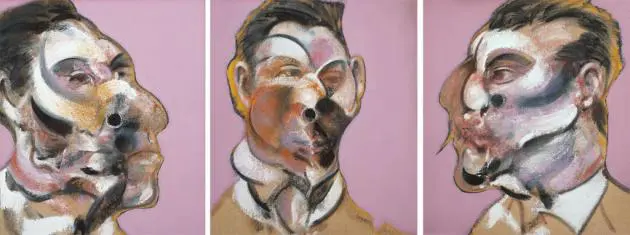
The stance is obvious in “Three Studies of George Dyer”, a 1969 work in which Bacon drew his lover – who would commit suicide in 1971 – from the front, right and left sides. It’s also obvious in triptychs, or sets of three images – an arrangement that was typical of Bacon’s style to the very end of his career.
The concepts in his triptychs tend to defy easy interpretation.
The last section at the exhibition reveals the influence of Bacon’s pieces on dance, a form of expression that has been inspired by the artist’s fluid rendering of the human body.
In a moving image created by artist Peter Welz and choreographer William Forsythe, projected onto three large screens, Forsythe performs a writhing dance with graphite on his feet and hands to leave a record of his movements on the floor.
Additionally, materials associated with a performance of contemporary dancer Tatsumi Hijikata in 1972 tell Bacon’s influence on Japan.
“Francis Bacon” is at the National Museum of Modern Art, Tokyo, near Takebashi Station, until May 26. The exhibition moves on to the Toyota Municipal Museum of Art in Toyota, Aichi Prefecture, from June 8 to September 1.
More meat?
For the virtual tour visit www.Momat.go.jp/english
