
It could have been, and is


Play
The art that Montien Boonma never got to make is revealed in his sketches, just as valid
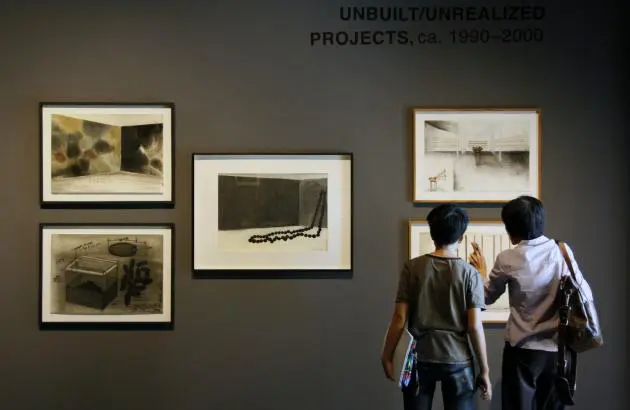
The huge art installations infused with the scent of herbal pigments that were the late Montien Boonma’s trademark are absent from the exhibition “[Montien Boonma]: Unbuilt/Rare Works” at the Jim Thompson Art Centre through July. Instead, as the show’s title implies, the focus is on unfinished pieces, but they do shed light on his creative processes.
Classic Montien icons are there, like beads, bells and alms bowls, along with some 60 drawings rarely or never seen in public until now, and sketchbooks, photographs and video recently brought to light by the Thompson Centre, the Thai Art Archives and the artist’s estate.
Montien would have been 60 this year if cancer hadn’t claimed him in 2000. He owns a place in history’s heart for showing Thai installation art to the world and for pioneering interactive art that could lure in the viewer and make the work come alive, rather than being passively observed. Foreign buyers, including museums in America, Japan, Australia, Greece and Singapore, snapped up most of his pieces – or in some cases never returned the ones loaned for exhibition.
But Montien had plenty of art, so much so that he once told me 30 per cent of his wooden installations had deteriorated over time due to inadequate storage space. Most of his pieces are massive, if fragile, but easily restored. Like an architect, he made detailed sketches to guide their assembly, as the current exhibition shows.
“We worked closely with his only son Jumpong, who’s now 25 and studying media arts in Tokyo, to bring out Montien’s sketchbooks and other such documentation to better understand his creative process,” says Thompson Art Centre director Gridthiya Gaweewong. “Many of the sketches are signed, dated and as copiously annotated as an engineer’s plans.”
The sketchbooks are full of question marks and exclamation points, clipped from other sources and pasted in and “finished” with ink and correction fluid. Along with numerous images of bells, these punctuate his studies for the sculptures he made in the 1990s.
When Montien’s wife Chancham was dying from breast cancer in the early 1990s he turned away from social issues to delve into Buddhist teachings, building on an aesthetic interest in religious imagery and architecture that was evident in his work a decade earlier.
“During my wife’s illness a lot of my work reflected the individualism that was gradually developing inside me,” he explained. “They pointed to my perpetual struggle for self-understanding and condolence.”
Enter the question and exclamation marks – confusion followed by determination and resolution. His installation “Black Question” is three tiers of aluminium cylinders perched precariously on spindly steel legs, the cylinders covered in interrogatives.
While living briefly in Stuttgart, Germany, in 1998, Montien was deeply impressed by the towering steeples of the Christian churches and the ringing of their bells. This was the inspiration for a subsequent sculpture series. He made many sketches that are on display alongside two of his six metal “Zodiac House” sculptures loaned by Petch Osatanugrah.
Each of these six figures is a different chapel standing on pointed, steel-pipe legs. Inside you can gaze at the “stars” – tiny holes in the roof – and enjoy the sense of serenity that Montien intended while pondering humankind’s small place in the universe.
Swiss art curator Hans Ulrich Obrist invited Montien in mid-2000 – just weeks before he died – to participate in an exhibition based on Obrist’s book “Unbuilt Roads”, which argued that the projects artists never complete nevertheless have artistic merit and should be shared with the public.
Obrist and Montien’s e-mail correspondence has been printed out for the exhibition, listing five projects that Montien doubted would ever come to fruition. He was right, as it turned out, but there next to the pessimistic text are recently rediscovered sketches of these projects.
One of them was inspired in part by a portion of perimeter wall at Wat Bowonniwet Vihara that can only be seen through sharp-angled holes. “Most of my work is in between – presented and unpresented,” he wrote Obrist. “I like something that doesn’t tell too much and then something happens.”
Before he became more fully engaged with Buddhist themes, Montien’s works from 1983 to 1989 reflected his concern for the rural poor and the environmental damage resulting from the country’s rapid economic growth. He conveyed his disapproval subtly yet effectively, using such common materials as a bamboo chicken cage, a feather duster, terracotta pots and even soil. These appear in his drawings and videotape of his exhibition “Story from the Farms”.
Montien’s wife Chancham, who was also an artist, has her own place in the exhibition. They were classmates at Silpakorn University, but ultimately Chancham’s cancer prevented her from creating art, and instead she taught graphic arts at King Mongkut’s University of Technology in North Bangkok.
What we see is her photo-etching series “Suppression”, which formed the thesis for her master’s degree at Silpakorn in 1987. The form, pattern and structure of clothes, mattresses and cushions are distorted and reconstructed to suggest the ways in which the mind is suppressed.
And, to complete the picture, the exhibition features a crayon drawing that their son did as a child. Jumpong was only five when he lost his mother and just seven when his father died. Raised by his grandmother, he followed in his parents’ footsteps, and recently graduated from their alma mater.
CLEARER VISION
<< “[Montien Boonma]: Unbuilt/Rare Works” continues until July 31 at the Jim Thompson Art Centre on Soi Kasemsan 2 near the National Stadium BTS station. It’s open daily from 9am to 5pm.
<< Hear a talk on “Montien Boonma: Other Dimensions, Life and Work” on Thursday at 2pm.
<< Call (02) 612 6741 or visit www.TheJimThompsonArtCenter.org.
