
Stranger in a strange land


Play
Albert Camus' hometown of Algiers has all-but forgotten its existentialist son
Spring in the Algiers is capricious – after a stormy night the day brings clouds of dust and temperatures topping 20 C as a wave of cold weather from Europe does battle with the sand and heat of the Sahara.
This harsh environment, which can seem at times as though it were trying to ward off mankind, also gave birth to Albert Camus’ literature of the absurd.
Camus’ father, an immigrant French labourer in French Algeria, was killed in World War I. The young Camus was brought up by his mother, a cleaning lady who was hard of hearing, in the residential Belcourt district of Algiers. The family was poor.
Their white-walled apartment with blue bay windows in the Belcourt district remains much as it was when Camus was a boy, though a mobile-phone shop now occupies the first floor. When asked, the shop’s young clerk says, “Camus? Who’s he?”
Although the immigrants are gone and the former Rue de Lyon was given an Arabic name after Algeria gained its independence, the sweet aroma of fresh-baked bread still pervades the street. People here still eat croissants for breakfast.
“My 75-year-old brother told me Camus was well-mannered and would even say ‘Bonjour’ to Arabs,” said Mohammed Mansour, the 49-year-old owner of a clothing store on the road, adding that he has not read any of the author’s novels.
“He was one of the Frenchmen who oppressed us,” Mansour said, making his dislike clear.
In fact, Camus, who was a member of the Communist Party, worked to improve the lives of Arabs, though he never entirely shed his colonialist viewpoint.
In “The Outsider”, which is set in Algiers, we never learn the name of the Arab man killed by the main character Meursault, nor does his family appear. He is left as a blank slate.
Camus did not take a position on Algeria’s war of independence (1954-62) and was criticised by fellow French intellectual Jean-Paul Sartre for his rejection of revolutionary violence.
Sartre severed relations after Camus denounced Russian communism. Though he still considered himself from the political left, Camus was increasingly at odds with Paris’s 1950s, Left Bank intellectual scene.
There was, however, one Camus fan to be found on the street in Algiers.
Mourad Tounsi, a dentist, said, “In my 20s, when I was trying to figure out life, I completely immersed myself in ‘The Stranger’ and ‘The Plague’.”
As a young man, Tounsi, 64, once had a dog set on him by a French colonialist, who shouted, “Get out of here, Arab!”
During Algeria’s war of independence, his family had to flee to the suburbs of Algiers because of attacks by extremist French forces. He said he still feels anger toward the colonial rulers. Regardless, “Camus is a hometown author,” he says.
Throughout its history, Algeria has been ruled by the Roman and Ottoman empires, the Spanish and the French. “[Camus] is an author born of Algeria’s history, which has absorbed many different cultures. We should be proud of him,” says Tounsi.
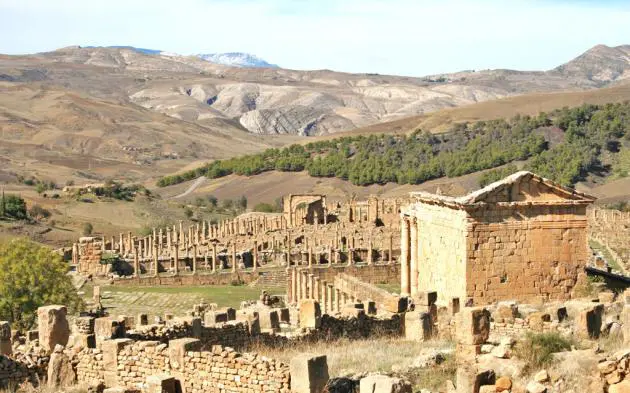
Camus was fond of the ancient ruins of Tipaza, a town about 70 kilometres west of Algiers.
Originally built by the Phoenicians in the sixth century BC, the town flourished as a Roman colony, though trees and shrubs now grow among the stones.
Camus wrote that he sketched out the plots of his novels while gazing at the ruins.
A quote by Camus inscribed on a stone monument overlooking the blue sea reads, “Here, I understand what they call glory: the right to love without limits.”
With the sea breeze on his face, was he thinking of the strangers who come and go on this Earth? France lies across the sea.
A life of absurdity
French Nobel Prize-winning author Albert Camus was born in 1913 in what was then the town of Mondovi in French Algeria. He graduated from the University of Algiers, became a newspaper reporter and eventually emigrated to France. He is known for such works as “The Outsider” (1942), “The Myth of Sisyphus” (1942) and “The Plague” (1947). In 1957, Camus was awarded the Nobel Prize in Literature. In an echo of his absurdist philosophy, he died suddenly in France in 1960 when the powerful sports car in which he was travelling left the road and hit a tree. He was 46. In his coat pocket was an unused train ticket. He had planned to travel by train with his wife and children, but at the last minute he accepted his publisher’s proposal to travel with him.
