
Guess who's coming for dinner


Play
A new exhibition at Museum Siam relates the human condition to the life of the cockroach
They scurry while we sleep, criss-crossing the floor as they forage for dinner. During the day, they prefer to snooze in dark places – under the fridge, in cupboards and around the stove. Cockroaches are such common visitors to just about every Thai kitchen and bathroom that even daily spraying with unpleasant and often-harmful insecticide fails to dislodge them.
While associated with dirt and disease and distinctively unattractive, roaches do deserve some respect. The pest is one of the very few species to have survived more than 300 million years and its ability to adapt to changing environments is currently the subject of a new exhibition at Museum Siam.
Fascinated by these dinosaurs of the insect world, students Thanakorn Leeramas, Pitch Amnuayporn and Anurak Chandam from King Mongkut’s University of Technology Thonburi look at roach behaviour and use the insects’ invulnerability and adaptability to harsh circumstances to mock our lives in a way that’s fun, sarcastic and ironic.
Their idea won the first prize in the third Young Muse Project, a competition organised by Museum Siam to seek out creative talent in the young generation and stimulate them to have more interest in learning through museums. The Bt300,000 prize allowed the students to turn their idea into reality and the result is the exhibition “CO(me) (che)CK ROACHES: check out cockroaches to reflect yourself”.
“The Aruba team came up with the idea of presenting the human way of life and the problems they face in a world where things are getting harder to come by comparing it to the cockroach’s way of life. Visitors will obtain a new perception of how to live more happily from the insects that make us shudder with disgust,” says Rames Promyen, director of Museum Siam.
The squeamish will be pleased to know that the exhibition doesn’t feature any real roaches. Instead, in the first room, visitors encounter white walls hung with colourful vehicle stickers printed with phrases about the problems that make living today more difficult. They include: “fed up…mom’s cooking is bad”, entrance exam…which programme?”, “tired…whiny boss”, “weary…girl is not interested”.
The next room offers a timeline of roach life through such critical changes as the Hiroshima bomb and the 2011 floods in Bangkok.
“The concept of the third Young Muse Project is ‘save the world’. In our view, saving the world is not just about preventing global warming, reducing disasters or growing more trees, but rethinking the way we live and perhaps changing our way of life,” says Thanakorn, 21.
Given the insects’ determination to share our intimate lives, the team consulted Kasin Suphapathom, a medical scientist attached to Department of Medical Science, Ministry of Public Health, and learned that the makers of insecticide products are constantly rejigging their formulas in an attempt to get rid of these well-adapted pests.
“They can flatten themselves to fit into the crevices between floorboards and walls. They prefer leftover food and starches and eat what is available to them while humans, on the other hand, live to eat. It is a philosophical comparison that lends itself to satire,” says Pitch.
“We don’t provide scientific facts in our show but use the roaches as a way of asking people to look more closely at themselves,” adds Anurak.
A third dim room is designed to resemble the living conditions of roaches with huge props portraying smelly trash, slimy drains and other preferred roach habitats to give visitors the chance to conjure up what it feels like to be a pest.
“A cockroach can live almost a month without food,” says medical scientist Kasin. “They live in humid, dark and dirty areas close to food and water like under sinks and drains. They love to stay in homes because the majority of us don’t worry too much about hygiene, leaving crumbs or foods out in the open, thus helping the roaches enjoy a happy life.
“Female cockroaches carry egg cases holding about 20 to 30 eggs. The female may produce up to eight egg cases in a lifetime, meaning she can produce 200 to 300 offspring. The roaches can live up to a year,” he adds.
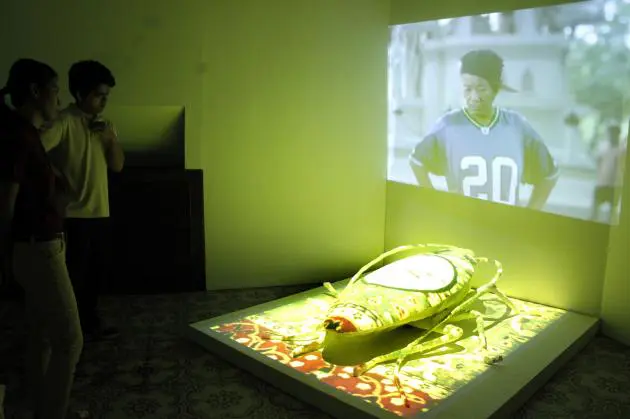
Presented through 3-D mapping and video clips, the next room features a gigantic roach made from foam and plaster. Above it is a video screening of people complaining their problems. A boy mutters that the food cooked by his mum is not tempting, and the three students offer a solution by comparing the way the roaches eat everything and anything to survive.
In another clip, an old man complains that he can’t adapt himself to the advance of modern technology. Roaches, however, are resilient and their extraordinary longevity as a species indicates how successful they have been in adapting to changes.
Then comes a clip of a dirty-looking guy saying no girl loves him. While the roaches live in dirty environments, they ironically constantly groom themselves.
“They regularly clean their antenna by grabbing one with a front leg and drawing it through their mouth to improve their sense of smell,” says Kasin. “The insect antenna is full of sensory structures that are essential for their survival.”
Reflecting the end of all the problems raised throughout the exhibition, the final room is plain white with marks remaining where stickers have been peeled off. A rubbish bin for the pieces of stickers stands in the middle of the room.
While the philosophical comparison is satirical, seeing roaches crawl through dirt then walk around our homes tracking in bacteria and germs is not a pleasant experience.
“Try to keep cooking, eating and food storage areas clean and dry. One good way of getting rid of them is to mix half a tablespoon of detergent powder with water in a spray. Shake the soapy solution well and spray into the drain or the sink where the roaches live and when they emerge, spray the solution directly on them. They should start dying out,” says Kasin.
At least until they decide to adapt …
ROACH ON THE ROAD
>> “CO(me) (che)CK ROACHES: check out cockroaches to reflect yourself” continues until June 30 and is open daily except Monday from 10am to 6pm. Museum Siam is on Sanam Chai Road in Bangkok. Call (02) 225 2777 extension 411 or visit www.MuseumSiam.org.
>> The application for the fourth Young Muse Project is currently open for interested persons aged from 18 to 25 until August 18. The project’s concept is “Siam 2020: What’s next?”. The applicants must submit into a team - three persons for each team. Visit the website to download the application form.
