
How do you shoe a cat?


Play
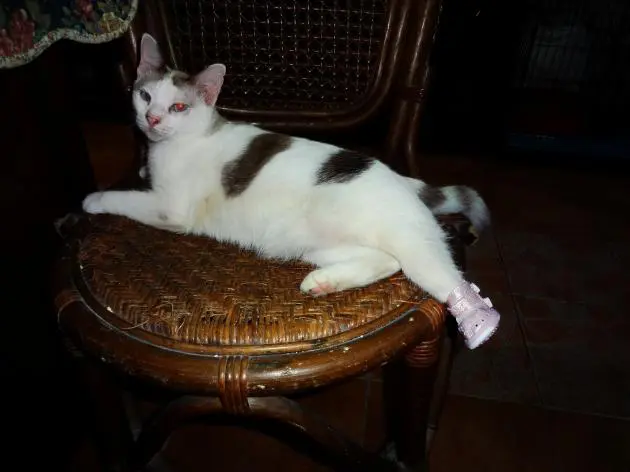
As Varee rejects her new pink boot, cat and owner decide that nature is probably the better option
What do Oscar Pistorius and my cat Varee have in common? Well, not much. Varee is not a South African runner, nor has she ever won an Olympic or Paralympic medal.
Nor, I’m happy to say, has she ever been accused of killing a girlfriend, or anyone else.
Like Pistorius, however, Varee is an amputee. Her left back paw, up to her ankle, is missing. I don’t know what happened. The woman who owned her before me told me about a car accident, but I suspect Varee was mistreated.
In my home, Varee uses three paws to dash across the floor, her stump waving wildly. Stairs are no problem, and she can reach any chair in the house.
She does have problems scratching her ear on her left side, and even grooming herself. I’m also worried that her spine might be affected, since she tends to curve it as she hobbles along.
As soon as she joined our household, I began thinking of prosthetics. After all, Pistorius has fake legs, closets full of them. If modern science can develop state-of-the-art prosthetics for athletes, why not for cats and dogs?
Fake feet are difficult to construct, no matter what species you are. Wheels for cats would be even more difficult, I assume, since most like to climb.
Compared to a fake foot, wheels for handicapped animals, although still difficult to fit, are much easier to make. I’ve seen such wheels liberate cats and dogs with paralysed back legs. I even found a photo on the Internet of a little pig with such back-end support.
Wheels aren’t a permanent solution, though, and Varee doesn’t need them, anyway.
Then I find a company in the US that specialises in prosthetics for animals. On their website is a photo of a cat with exactly Varee’s amputation.
I ask my veterinary surgeon about the possibility of a prosthetic for Varee, but he shakes his head sadly.
First, he says, Western breeds of cats and dogs might accept a prosthetic, but Thai breeds usually don’t, no matter how well it fits. “It’s their nature. Varee will never forget that the prosthetic is not herself,” he says.
Second, Varee is already happy in herself. A prosthetic will not make her happier. “Why put her in a stressful situation that won't do her any good?” he says.
I do try an alternative, however. I find little shoes made to protect dogs’ paws, and put one on Varee's stump.
The surgeon is right. Varee immediately figures out how well it works for scratching an ear. Then she tries to groom it, and you can see horror all over her face. The shoe is not part of her body.
Less than a minute later, she’s shaken the shoe off her stump. She will not allow me to try again.
Perhaps, in the end, Varee has no problem with what she is. The only one with a problem is me.
