
Nurturing the Big Blue
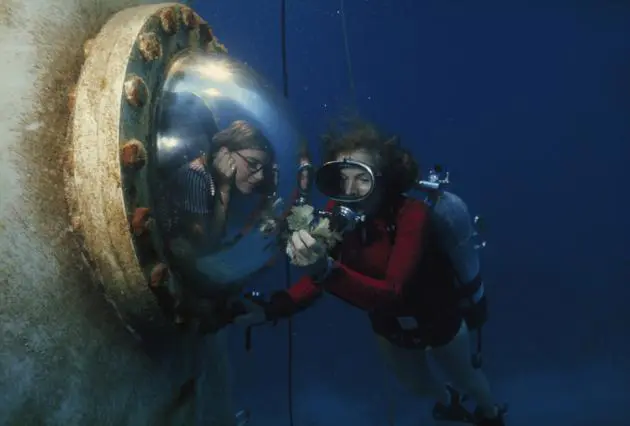


An oceanographer urges the world to stop polluting |and take better care of the waters that give us life
Cosmetic brand La Mer, which is known for its strong support for ocean conservation and actions that help recover the sea’s delicate habitats and wildlife, recently celebrated “World Oceans Day 2013” with an event on the theme “Born from a Passion for the Sea”.
Hosted by W Hotel, Bangkok, the event featured the premiere of a short film featuring ocean preservation through the stance of a prominent ocean explorer, Dr Sylvia Earle, as well as an exhibition of photographs taken by celebrities Tipanan Srifuengfung, Tirawan Taechaubol, Peter Corp Dyrendal, Manasnan Panlertwongskul, Janesuda Parnto, Geraldine McIntosh and Sirinya Bishop as well as professional lensmen Jirayu Ekkul, Nat Sumanatemeya and Hansa Tangmanpoowadol.
In an interview with National Geographic journalist Lisa Ling, which La Mer shared with The Nation, Earle addressed actionable change for future preservation.
How much do we really know about our oceans?
Over the past few decades, more has been learned about the ocean than during all preceding history. The pace is picking up and this has to do with access to the sea. It's easy to get around on the surface, relatively speaking, but getting to the depths below has been a real challenge. And the deeper we go, the less we know.
People have actually been to full ocean depth, 11 kilometres down, and they’ve found life.
We’re just beginning to get our minds around how important the ocean is to every breath we take and every drop of water we drink. Yet only 5 per cent of the oceans have really been explored.
How would you say the ocean keeps us alive?
Where does water come from? Where does food come from? What regulates temperature? The natural systems have given us everything, everything: the ingredients for our civilisations, ingredients for life. And now we have to give back.
Do you think the reason why there hasn’t been more engagement about the oceans is because of the unknown?
I think the biggest concern about the ocean is people don’t know why it matters to them. There’s also this illusion that the ocean is too big to fail. Today, people are beginning to understand the importance of natural systems.
How would you assess the state of our oceans today?
Scientists from around the world, over the last 10 years, have been doing several things. The Census of Marine Life group is trying to find out who lives on Earth with us. What we’ve found is that life in the ocean is more diverse in terms of the big wedges of diversity than anything on the land.
Now we are beginning to understand not only the diversity of life in the sea but also the health of the ocean on a scale of 0 to 100. Scientists have measured the score at about 60, which means the ocean is in trouble.
How can we be more responsible with respect to our oceans?
People must realise, first of all, that the ocean matters to humankind and that our lives are totally linked to not just the ocean but to its health and condition. We need to think about what we can do individually, as countries, as people of the world, to take care of the systems that take care of us.
All nations have a vested interest in trying to take care of it.
