
Honouring The Departed


Play
Progression and succession in noh, the traditional Japanese stage art
People involved in traditional culture often mark anniversaries important to their genres by holding events that remind everyone of the art’s founding spirit while urging them to think about its future.
Noh, the 600-year-old traditional stage art, is marking two important anniversaries this year with the presentation of a new play in easy-to-understand modern Japanese and the publication of a series of books that shed new light on the art.
This year is the 650th anniversary of the birth of Zeami, who brought noh to the zenith of its form, and the 680th anniversary of the birth of his father Kanami, a talented noh actor.
Zeami wrote many noh scripts and books on dramatic theory. His Fushi Kaden and other dramatic treatises have been translated into foreign languages and continue to influence many people involved in theatre worldwide.
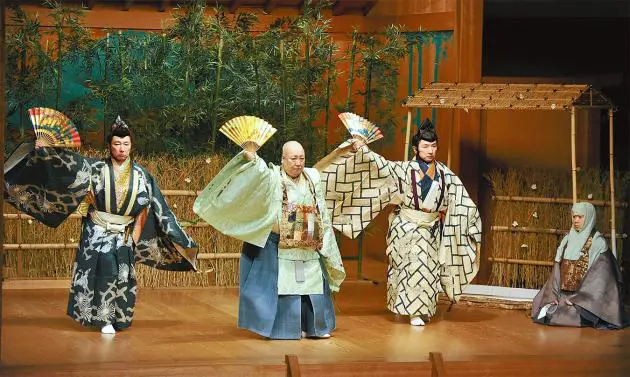
On April 19, a new noh piece highlighting the late years of Zeami’s life was staged at the National Noh Theatre in Tokyo. Titled “Super Noh: Zeami,” its script was written by noted philosopher Takeshi Umehara, who also wrote scripts for Super Kabuki and Super Kyogen pieces, which blended many innovative elements with traditional styles.
The theme of the new play is artists affected by politics, explored through the separation of Zeami and his son Motomasa, also a noh actor. The father-son tragedy, performed by Gensho Umewaka and Kurouemon Katayama, respectively, was enhanced by modern visual effects such as illumination and interesting sets.
Unlike ordinary noh pieces, its lines are mostly written in modern Japanese and are thus more accessible to modern audiences. Umewaka and other performers’ elaborate chants and spoken passages keep noh’s inherent classical atmosphere intact throughout the portrayal of Zeami’s sense of failure and desire for creation for the future.
“I wanted to make a world distinct from classical noh pieces,” Umehara says. “I used modern Japanese, as with my successful Super Kabuki pieces. No matter how much we value existing classical pieces, the art will dwindle if no new pieces are created. For its development, both new and classical pieces are necessary.”
The event was sold out and many members of the audience seemed pleased with the performance.
“Compared to kabuki, there are far fewer noh spectators. If young noh actors actively make and perform new pieces, I believe they can attract new fans,” Umehara says. “Zeami was great because he created art that could entertain a wide range of people from his time, from shoguns to ordinary people. He was a genius by global standards. Japanese people should know more about him.”
Kadokawa Gakugei Shuppan Publishers began publishing a four-volume series on noh in January. The series includes the scripts of 128 noh pieces translated into modern Japanese from their original classical Japanese and well as interviews with first-class actors, such as Gensho Umewaka and Yusetsu Katayama, both known for noh leading roles.
“We did the translation because we wanted to provide a chance for a wide range of readers to freely interpret them,” says Shinpei Matsuoka, a professor of The University of Tokyo, who was on the book’s editing team. “There are many academic studies on noh, but few books for ordinary people. This series is rare because it includes many performer interviews. People can read whatever sections they like and use it as a gateway to noh.”
Kanami was a noh actor and creator of many masterworks who founded the Kanze school of noh, which now has the largest number of members among the five noh schools. His son Zeami perfected noh under the patronage of Ashikaga Yoshimitsu (1358-1408), the third shogun of the Muromachi period (1336-1573).
“Noh extends back nearly 700 years. This year I can celebrate as a member of the Kanze family. I’m very happy. I’m also very thankful to Kanami, Zeami and my other predecessors for the prosperity of noh today,” says Kiyokazu Kanze, the current grand master of the Kanze school of noh.
From late December to early January, the school held an exhibition in Tokyo showcasing noh masks, costumes, accessories, documents and other materials that have been handed down in the grand master’s family. The event attracted about 70,000 people.
“I felt noh is a subject people can be interested in. I want to attract these people to noh theatres,” Kanze notes, adding that when he performs Zeami’s noh pieces, he becomes aware that noh creators of that time strove to depict humans through various themes and old stories. Noh, he explains, consists of works of art that are filled with the gentle feelings of people from medieval times towards the departed souls of the dead.
As this is an important anniversary year, he is taking the initiative to give noh chanting classes for amateurs at noh theatres rather than sitting back and enjoying the festive atmosphere.
“I want people to perform noh chanting and dancing personally, in addition to watching noh performances,” Kanze says.
