
The living kernel of a dying art


Play
Delicate fingers fight a battle with brute machines over a thousand-year-old tradition
In a refined kernel-carving shop in Guangfu town just outside Shanghai, Xu Zhongying is busy receiving customers from home and abroad. Some are ready to pay hundreds of thousands dollars for her work, but few know that a penniless Xu almost gave up the art in her 20s.
“As a worker in a local kernel-carving factory I could barely make a living with the meagre salary, as few people would buy such ‘a bauble’ in the 1970s,” recalls Xu, now 57.
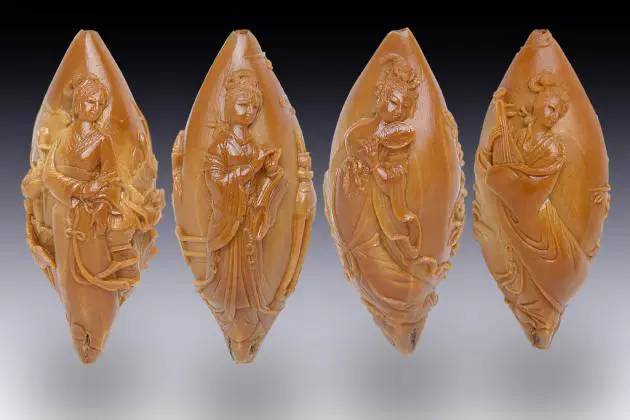
Known as hediao in Chinese, the traditional miniature sculptures are made from the kernel of an olive, peach or walnut. Guangfu, a town in East China’s Jiangsu province, is famous for the graceful, meticulous art.
“I was always confident about my skills. Fortunately, more and more people have begun to appreciate this folk art,” Xu says.
The tradition of carving kernels was first recorded in the Song Dynasty (960-1279) and it flourished in the Ming Dynasty (1368-1644). The craftsmen of that era displayed their consummate skills on kernels less than 5 centimetres long, carving them with detailed human figures, animals, landscapes and lines of poetry.
After falling out of favour, kernel carving began to regain its popularity around 2008, when it was listed as National Intangible Cultural Heritage. Artists now mull innovations in the art and how to keep the town’s speciality from disappearing.
Lu Xiaoqin, 37, another kernel-carver in Guangfu, is famous for exploring new subjects, beyond the traditional figures of Buddhism that have been a staple of the art.
“Customers’ tastes are increasingly varied now, and some of them are tired of the usually simple and sometimes rough lines depicting Arhats on kernels. They want to see something different,” she says.
Lu spent around two months carving her latest work, “Liang Shanbo and Zhu Yingtat” – China’s Romeo and Juliet. The two household lovers had never appeared on a kernel carving before, but Lu says “it presents a folk story on a work of folk art”. Judges of a national prize agreed, awarding her first place for the piece recently.
For Lu, carving is difficult as each piece of raw material is different in texture and rigidity. She majored in painting and often draws a blueprint on a kernel’s surface first. She says the whole carving process requires constant reappraisal, and there is no established pattern to follow.
As the mother of a 15-year-old, Lu hopes more of the younger generation will take up the craft and breathe new life into it with their “solid cultural knowledge and colourful imagination”.
She currently teaches a class at Suzhou Tourism and Finance Institute and expects to have more students in the future.
“I am glad to see that some of them, including my child, are both interested and talented. For instance, if they can use their three-dimensional design skills in carving, there may be more surprising innovations,” she says.
But Gu Xiaodong, the owner of another kernel-carving shop in Guangfu, worries about technology’s impact on the folk handicraft. “Computers can’t replace human beings with regard to the genuine traditional skills,” says Gu.
These days, more than 50 per cent of carvings are made by machines on an assembly line.
“I think the country and people should have a natural desire to protect and support traditional folk art,” Gu says.
