
Iron lady with a tuneful note


Play
US composer turns the Eiffel Tower into a musical instrument
American composer Joseph Bertolozzi has transformed the Eiffel Tower into a giant musical instrument by recording the 324-metre tower’s resonances with microphones placed on its surfaces.
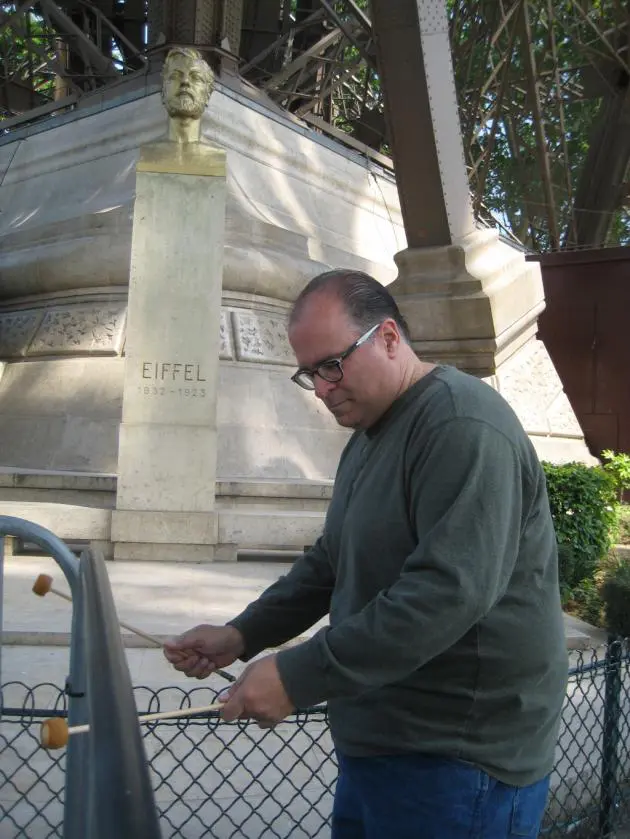
Bertolozzi’s work entitled “Musique de la Tour” (“Tower Music”) turned the Paris landmark into a giant percussive instrument by sampling 2,000 sounds that were struck using latex mallets and drumsticks.
The 54-year-old came up with the idea of recording the natural sounds of the Eiffel Tower in 2004 when sitting at home in New York with his wife, who was mimicking the way he played with his percussion.
“She was near a poster of the Eiffel Tower, took a swing at it and she went ‘Bong!’,” he says.
“I don’t speak French, I immediately thought, and I also don’t have any links to Paris.”
Instead, the composer looked closer to home and created a composition for New York state’s mid-Hudson suspension bridge. He called it “Bridge Music”.
“I needed the bridge to show that the concept could work,” he explains.
The resulting composition generated significant public interest, reaching number 18 on the Billboard Classical Crossover Music Chart in 2009.
Bertolozzi then went to his computer to find out who owned the Eiffel Tower and quickly found out that the mayor of Paris is responsible for everything.
Six letters of correspondence and several months later, the composer got the go ahead from the French authorities to spend two weeks recording sounds on the Tower for his project.
“I examined the entire Eiffel Tower with the chief engineer. We walked around the whole structure. They wanted to see what we were planning so I brought a recorder and couple of drumsticks.”
The eight-man team of composer, producer, sound technicians, cameraman and photographer then set about the hard work of recording the structure’s sounds.
“Each day, we spent eight or nine hours on the Tower,” says Bertolozzi.
Although Paris enjoyed a relatively mild spring, temperatures were low and the wind was still very strong near the top.
Bertolozzi’s team used contact microphones that recorded oscillations directly to collect nearly 2,000 samples from the iron structure’s railings, panels and girders for the album, which is due out next year.
“In this way we were able to reduce the effect of external sounds,” explains the composer.
The digital recordings will now be catalogued and analysed by the composer at his home in New York.
“I will spend two to three months in the studio going through the thousands of tones and sounds, characterising them by frequency, sound and intensity.”
The project involves more than just sifting through the recordings looking for different notes on the musical scale, as the Tower only has a limited number. Some sounds are simply percussion and Bertolozzi also does not know how many octaves are hidden within the Tower.
Many of the octaves are in the tenor range but there are also alto and soprano ones.
“I want to keep an open mind about it, and see what each instrument says to me.”
The Musique de la Tour composition could become a suite but Bertolozzi admits that due to his lack of experience with the Tower as an instrument, all options remain open.
“One piece could be more experimental than the other,” he says.
Bertolozzi does not intend to stop with a studio recording of his work. The composer also wants between 30 and 50 musicians to perform the composition in situ in 2014 when the Eiffel Tower celebrates its 125th anniversary.
