
Pedalling to perfection


Play
From wooden bikes to saddlebags, Thailand's products designers are coming up with a wealth of eco-friendly accessories for the bike lover
WITH AN EVER-INCREASING number of Thais trading in four wheels for two, the country’s retailers are courting bike lovers by tapping into the cycling lifestyle. From boutiques that carry clothing lines featuring water and odour-resistant jeans with reflective tape on the interior cuffs to oil-stained repair shops, stylish commuter-friendly hangouts are popping up at every corner.
Product and graphic designers, many of them cyclists themselves, are rising up to the challenge and returning to the drawing board to come up with products that are functional as well as ecologically friendly.
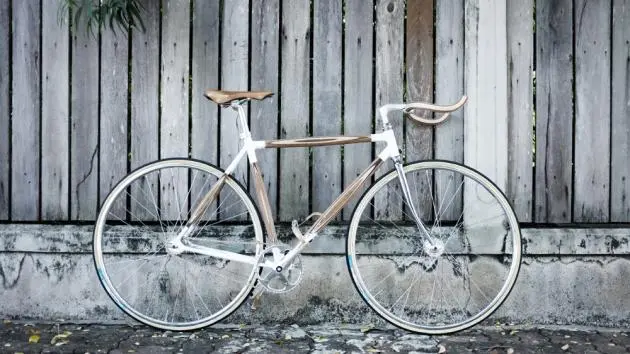
Among them is the designer team of Dots Design Studio who has temporarily moved away from furniture and interior designs to experiment with a one-of-a-kind urban bike that incorporates a layered wood veneer frame and refined metal with other standard bike parts.
“We’ve worked closely with a veneer factory to produce furniture and the plywood bike is a side project. We’ve been working on it for three years and are constantly challenging our designers to explore more uses for this material,” says design director Krit Phutpim.
The bike is an amalgam of wood and steel and a triumph of old-school design and craftsmanship. It comes with two styles of wooden handlebars – vintage and bullhorn – and a leather Brooks seat. The other components such as the wheels, stem, chain, and pedal have been carefully chosen to come up with a bike that is safe, durable and attractive.
“Functionality and aesthetics are the key concepts. Like clothes that you mix and match to define yourself, a bike is also a statement of your lifestyle and personality. Our vintage-style bike will fill the needs of a particular group of bikers,” he says.
All bikes are custom-made, meaning that you can choose the size for an optimal ride. As they’re all made by hand, it takes about one month from order to delivery. A completed bike costs Bt45,000 while the wooden frame goes Bt15,000. Handlebars, also crafted from wood, are priced from Bt1,600 to Bt1,800. A wooden wall-mounted bike rack is also available.
And just like more conventional bikes, the wooden cycles sport an easy-to-maintain configuration, meaning they can be repaired at any shop.
“It’s a road bike designed for commuting over short distances on smooth and paved surfaces. It’s not suitable for off-road riding,” says Krit.
Oggi is another furniture brand that has seen the potential for expansion into the bike market. Known for its minimalist designs that adapt to serve a variety of functions, it recently launched a new line of products for city bike enthusiasts.
Owner/designer Phanomsook Meelugsana has come up with a square wooden stool that doubles as a bike stand though a slit on the top into which you can slide the rear wheel. He’s also offering a wooden wall-mounted rack that can hold your bike in both vertical and horizontal positions and can take up to 25 kilograms in weight.
“Making pieces that are multifunctional is important when designing for urbanites living in compact spaces. A cyclist may have more than one bike and the wall-mounted rack allows for considerable space saving. A beautiful bike also functions as a sort of home decorative item,” says Phanomsook.
He uses the small pieces of wood that can’t be turned into furniture by fashioning them into a handlebar. In his hands, leftover leather upholstery becomes a functional bag that attaches to the top tube and has space to hold accessories like a wallet, a camera or a repair kit.
The leather scraps also become handgrips and pads that help protect the top tube from getting dinged when locking the bike to a pole. Phanomsook has equally come up with a small pocket – perfect to hold a key - to loop around the seat tube. Once parked and locked, the pocket can be strapped around your wrist to ensure you don’t lose the key.
“I always try to buy less material and concentrate on the maximum use of the leftovers,” he says.
Pipat “Top” Apiruktanakorn, the brains behind the Eco Shop has also launched a collection of bike accessories using leftovers.
His “88” is a pair of leather straps made from industrial factory toss outs. You can strap them on a water bottle, an umbrella, a newspaper or just about anything narrow and attach them to the top tube.
To reduce the use of the tail light battery, Top has come up with a rear reflector made from recyclable polypropylene that’s both lightweight and long lasting. Like Phanomsook, he turns into leather scraps into scratch-protecting top tube pads.
Samatcha Apaisuwan, creative director of the PR and graphic design agency FYI, is a big fan of the randonneur touring bicycle and is the proud owner of a 1975 model. He’s been searching for years for the right kind of handlebar bag but without success.
“The Japanese make one that matches perfectly the front rack of the randonneur bike but it costs around US$300 (Bt9,000) and both the straps and trim are nylon,” he says.
Samatcha put on his thinking cap and worked with a leather craftsman to produce his own handlebar bag. He’s now selling them under the brand Tourisme and most of them are being snapped up by biking pals.
The bag, priced at Bt3,000, is made from water-repellent canvas with a leather trim and comes with a leather shoulder strap that make it easy to take it with you where you’re commuting. It features a clear map pocket on top and two side and two rear pockets with plated buckles and straps that attach to the handlebar and front rack. An elastic cord acts as the closure closes and black plastic side and bottom stiffeners are also provided.
“The design follows the classic model dating back to the 1940s, which was the golden age of bicycle in France. This bag was perfect to carry a bottle of wine, bread and a change of clothes for an overnight trip,” he says.
Samatcha also offers a saddlebag for Bt2,000, which is attached under the saddle with straps and has room for a tool kit, spare inner tube, first-aid kit, wallet, cellphone and camera.
These custom-made bags require two weeks to complete. Customers can choose their own shade of canvas though Samatcha recommends mustard, khaki, olive, grey and navy blue as he believes they are more in the spirit of a vintage bike.
KITTED OUT FOR THE ROAD
>>The plywood bikes made by Dots Design Studio can be viewed and ordered at “Dots Design Studio” Facebook page or by calling |(02) 279 1790.
>>Oggi can be reached by visiting www.Oggi-living.com.
>>Eco shop is on the ground floor of Digital Gateway, Siam Square. Visit www.Ecoshop.in.th.
>>>Tourisme’s bags can be ordered by calling (089) 449 5619.
