
Stalking the wild Thai politician


Play
Unsurprisingly, a gallant effort to explain the inexplicable to foreigners gets a little blurry
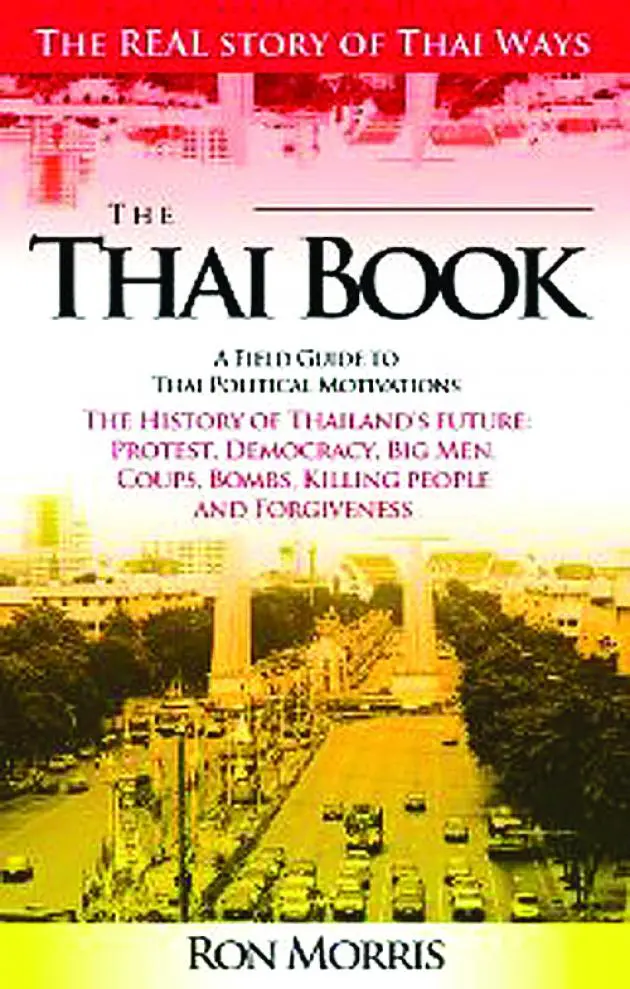
RON MORRIS, who runs the popular news-and-commentary aggregate site 2Bangkok.com, earnestly attempts to defy the odds with this book, not only in trying to explain Thai politics to foreigners, but also in believing he can do so in just 200 pages.
Mission impossible even in 200 volumes, I maintain, but there are enough well-considered insights in The Thai Book to make it a worthwhile read, even for foreign long-time residents who witness the befuddling bobbing and weaving on a daily basis.
Morris’s central premise, from which all else is extrapolated, is that several different and diverse bodies politic each holds one of the reins of power – the monarchy, the military, the governing party, big business, the bureaucracy and academia. It’s a turbulent dynamic of constant pushing and shoving, but all are content as long as no one group presumes to grab the others’ reins.
“It would be an absurdity,” Morris writes, “to assume that a prime minister, an army chief, or the Privy Council is able to simply enforce its will on its own. There are no monolithic forces in the Thai system.”
But the boom of the 1980s, “when Thailand rapidly went from a basket case of civil unrest surrounded by communist dominoes to one of the junior Asian tigers”, threatened traditions and morals and fomented “disdain for the overreach of greedy and hypocritical capitalists”. This disdain is what Thaksin Shinawatra tapped into (despite being wealthy himself).
He wanted to be the monolith. He wanted to modernise and democratise his nation – an ambition that Morris seems to admire, though he maintains stoic neutrality on the politics involved – and the only way to do so would be to centralise power. Thaksin reached for all the reins.
When it comes down to explaining the nuts and bolts of what happened next, however, Morris stumbles as he leads us beyond the opaque looking glass that Thailand often seems to be.
It begins with repeated references to “the Thai world”, as though this is some strange planet indeed, which does nothing to improve on the odd choice of language on the cover. “The Thai Book” sounds like a working title accidentally left unchanged, and the “field guide” of the subtitle a promise of observing a lesser species in the wild.
“Arrogance” is not the proper charge here – Morris is too respectful to his host country for that, and he ends the book with an Obama-style speech about hope and peace. Another Obama byword, “audacity”, is the term we’re looking for. It certainly fits passages like this: “Rest assured that if a political situation finally emerges and as a Westerner you feel it is completely unfair and outrageous, then it is likely that a Thai-style reconciliation has finally been reached.”
It’s unfortunate, then, that Morris ultimately decides he has to constrain what might have been a useful audacity. His bold assessments fall prey to caution, culminating astonishingly in two chapters of pages that are blank except for the words “Redacted by the author”.
“Understanding the Role of the Monarchy” is understandably devoid of text – apart from the opening paragraph, which ironically says a lack of this knowledge would be “an egregious omission”. And so it is. Sharing that understanding is illegal in Thailand.
It’s not so apparent why “Historical Certainties that Shape the New Era” suffered the same whiteout of self-censorship. I e-mailed Morris and asked what was up.
Admitting that such glaring gaps midway through the book are hardly “ideal”, he said the chapters remain in place, with titles and introductory paragraphs, to at least “acknowledge the monarchy does have an important role”.
“At the same time, redacting the chapters ensures that neither the book nor its conclusions could be exposed to accusations from those who might want to demonise the assertions the book makes overall.
“Times have conspired,” he continued, “to ensure that, at present, a frank examination of the institution, even if innocuous and even-handed, is probably not wise.”
It seems like a peculiarly Thai way of handling the situation, but Morris deserves the benefit of the doubt on this. Not so on the book’s other flaws.
Morris rails against foreigners’ tendency to generalise (as I’ve just done), but then does so himself, at one point referring to “the Thai trait of not being able to see themselves from any other perspective”.
Add to this his reluctance to list examples of the behaviour he discusses. He devotes five pages to explaining why small bombs occasionally explode around Bangkok without naming a specific incident. The same vagueness clouds the comment that foreign news media (unnamed) “spun” the truth of the 2010 red-shirt mayhem. What is a reader overseas to make of this lack of clarity, especially when no sources are cited either that might take him to further explanation elsewhere?
Morris emphasised to me that these are his opinions, drawn on the basis of careful monitoring of the news, discussions with Thai acquaintances and personal observation, and together they create a context from which events are not only explicable but predictable. The author’s jacket blurb says he “advises worldwide on geopolitical issues using his methodology of applying cultural motivations to explain the real context and intent of political actions”.
Surely his clients, though, would want to know the source of his information on, for example, Thaksin persuading advertisers to shun any “media firms” that were critical of his government. Morris does not mention The Nation among the media outlets thus harassed, but it supposedly happened here, and yet I’ve never heard confirmation of it. I would love to see Morris prove it to be true.
