
Giving the heave-ho to Helicobater Pylori


Play
The gram-negative bacteria that live in the stomach are responsible for peptic ulcers, gastritis and more besides
Research indicates that up to half the world’s population is infected with Helicobacter pylori, a bacterium that grows in the stomach and which in many carriers will lead to ulcers or gastritis.
Considered as one of the world’s critical public health issue, H pylori was declared as a Type 1 carcinogen or definite cause of stomach cancer in humans back in 1994 and is also associated with MALT lymphoma. The infection is more prevalent in developing countries and recent surveys indicate that the incidence is decreasing in Western countries.
According to Thailand’s National Gastric Cancer and Helicobacter pylori Research Centre (NGCH), more than a third of Thais are infected with the bacteria yet knowledge and understanding of the condition is so limited that only a small number of 20 million Thai sufferers will consult a doctor before their symptoms become severe.
And that’s a shame because with early diagnosis and appropriate treatment, H pylori can be cured.
In an attempt to raise awareness about this nasty infection, a primary cause of stomach cancer, the NGCH recently hosted a discussion titled “H. pylori Infection and Chronic Gastritis – Diagnosis, Treatment & Prevention”.
NGCH chairman Professor Varocha Mahachai points to today’s busy and dynamic lifestyles as well as the increase in coffee drinking, smoking and drinking alcohol among the younger generation for the increase in cases of gastritis or peptic ulcers, the most common ulcer of the stomach and duodenal area.
As many as 80 per cent of these ulcers are the intermittent type and associated with H. pylori, which was previously known as Campylobacter pyloridis. It was identified in 1982 by Australian pathologists Barry J. Marshall and J Robin Warren and won them the Nobel Prize in Physiology or Medicine in 2005.
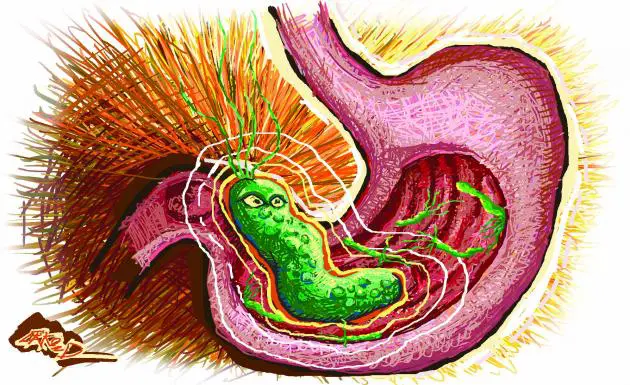
The bacteria, which are helix-shaped and have a flagella at one end, prefer to avoid the acidic environment of the interior of the stomach. H pylori uses its flagella to burrow into the mucus lining the stomach to reach the epithelial cells underneath.
Here they secrete toxins to damage the cells of stomach, causing inflammation and transforming the cells.
It is assumed that person-to-person transmission by either the oral-oral or faecal-oral route is most likely route of H.pylori transmission. The transmission occurs mainly within families as well as in crowded communities such as slums. Research indicates that between 75 and 90 per cent of stomach and duodenal ulcer developed because of H. pylori infection increase the risk of stomach cancer by 3 to 6 times.
But the news is not all bad.
“Gastric ulcer from H pylori infection can be treated and mostly cured,” says Associate Professor Ratha-korn Vilaichone, the Centre’s secretary-general. “Anyone who has are signs or symptoms of developing a gastric ulcer or H pylori infection, such as vomiting blood, tarry or black stool, burning or gnawing stomach pain for more than a month, weight loss or loss of appetite, should not waste time in consulting a doctor.”
Testing for H pylori will be carried out if the patient is suffering from peptic ulcer disease, low-grade gastric MALT lymphoma and in certain cases of dyspepsia.
There are several non-invasive tests including a blood antibody test, stool antigen test and the carbon urea breath test, where a tablet containing urea (a chemical made of nitrogen and a minimally radioactive carbon) is swallowed and the amount of exhaled carbon dioxide is measured .
However, the most reliable method for detecting H pylori infection is a biopsy check during endoscopy with a rapid urease test, histological examination, and microbial culture.
The patient will also be advised to avoid hot and spicy food, to establish regular mealtimes and stick to them, and avoid alcohol and smoking, as well as aspirin, and other non-steroidal anti-inflammatory drugs (NSAIDs). Sufficient rest and avoid pressure and stress is also recommended to effectively prevent gastric ulcer.
If the tests are positive for H pylori, eradicating the bacteria is vital. This is achieved through one to two weeks of antibiotic treatment. This has shown to be more than 90 per cent effective in eradication, with no recurrence four weeks after completion of the treatment and the chance of peptic ulcer re-occurrence greatly reduced.
However, rising resistance to antibiotics has increased the need to search for new therapeutic strategies with scientists in the West currently looking at a vaccine, though none is available at this present time.
- The NGCH discussion was supported by Abbott Laboratories Thailand.
-For more about the NGCH, visit http://thaigastriccancer.com.
