
The man and his mobiles


Alexander Calder gets a major retrospective in Seoul
Alexader Calder had always liked toys and games, he said in an unpublished autobiographical manuscript from 1955-56. In fact, he was briefly involved in designing children’s toys for commercial production. And he enjoyed playing billiards – a game that involves vectors and velocities – engineering concepts that Calder kept in mind in developing his art.
The American artist, who died in 1976, is hailed for liberating sculpture from the pedestal and constantly proposing new visions of art beyond conventional forms.
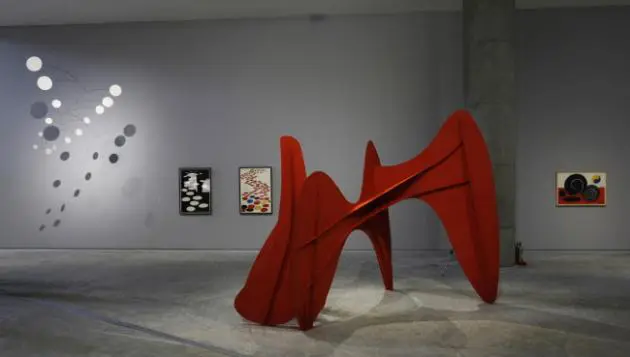
Calder’s quest to reset the boundaries of traditional sculpture can be seen at a glance at his first major retrospective in Seoul, at the Leeum Samsung Museum of Art.
The exhibition showcases 118 items, including Calder’s signature mobiles, stabiles, paintings and jewellery pieces on loan from the Calder Foundation. Among the highlights is 1971’s “Grand Crinkly”, installed in the museum’s outdoor garden, which is considered one of his most innovative works, with the angular, geometric figures of the upper section mobile and the lower part crinkled and static.
With his background in mechanical engineering and art, Calder focused on engineering concepts like volume, vector and density. Yet he stated in an 1962 interview that the source of his art was not machines but nature.
“I haven’t really touched machinery except for a few elementary mechanisms like levers and balances,” he said. “You see nature and then you try to emulate it. But, of course, when I met [Dutch artist Piet] Mondrian I went home and tried to paint.
“The basis of everything for me is the universe. The simplest forms in the universe are the sphere and the circle. I represent them by discs and then I vary them. My whole theory about art is the disparity that exists between form, masses and movement.”
An account of how the artist’s best-known form, the mobile, was created is important in understanding the exhibition. In 1930 Calder, then 32, visited the Mondrian’s studio. Instantly amazed his abstract work, Calder spent two weeks painting abstracts, including 1930’s “Untitled”, featuring some of the basic components of his mobile forms such as coloured circles, linear shapes and lines.
Calder returned to making sculptures, incorporating the elements he saw in abstract paintings to eventually create moving sculptures.
The works of the exhibition date back to early 1920, when Calder started taking classes at the Art Students League after graduating from college in mechanical engineering. The Black Box exhibition hall at the Leeum features his earlier works created during his student days, including paintings, animal sketches and wire sculptures, and works from his early phase of mobile construction.
The Ground Gallery features works from the 1940s and monumental sculptures for public spaces that he created in his later years.
SEE IT
The exhibition runs through October 20 at the Leeum Samsung Art Museum in Seoul.
It’s is open from 10.30 to 6 daily except Monday.
Admission is 8,000 won (Bt223) (5,000 won for students).
English-language guided tours are available on Saturday and Sunday afternoons.
