
Dharma in the park


Play
A new Buddhist learning centre is scheduled to open in October in Nakhon Ratchasima
A DHARMA park initiated by Luang Poh Koon Parisutho or Phra Thep Wittayakom of Wat Baan Rai in Nakhon Ratchasima is slated for completion in October with the opening scheduled to mark the revered monk’s 90th birthday.
Work on Baan Rai Dharma Park, a centre for learning built on the site of a lake, was started in 2011. Its centrepiece is a ceramic shrine called Thep Wittayakom depicting the Tripitaka, Buddhism’s sacred texts. The Park is designed to educate people about Buddhist teachings through the universal language of arts – architecture, paintings, and sculptures.
“Asia’s largest ceramic mosaic shrine has been hand-made by Thai people. The faithful villagers have carefully and mindfully put together more than 20 million pieces of mosaic. One person can attach no more than one-square-metre of ceramic per day. This shrine is not just a place that Buddhists can visit to truly appreciate dharma, but also where the villagers of Dan Khun Tod can rightfully earn a living. The construction came about thanks to the determination of Luang Poh Koon who said ‘I will do it for the people who give me food and water everyday’,” says Kriengkrai Jarutawee, vice president of the Wat Baan Rai committee.
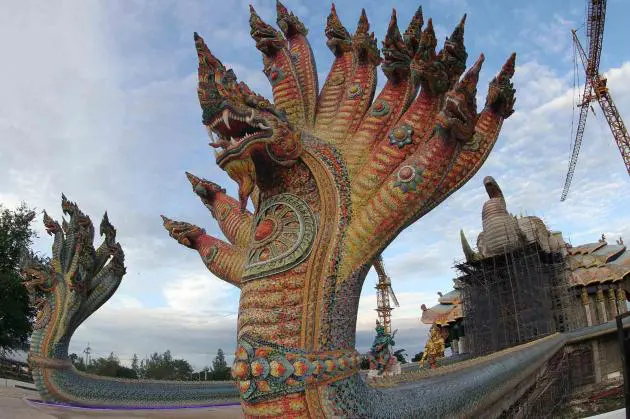
The extravagant and beautiful exterior of the Thep Wittayakom Shrine starts with the Naga bridge, which serves as the bridge of faith. This is where visitors cross from the human world to the world of dharma. Two naga sculptures decorated with mosaic form the rails. Each has 19 heads, representing the 38 steps towards enlightened living. The naga coil around the shrine and the tails of both naga meet and coil three times to cover the ever-glowing wishing crystal, which symbolises the “three practices” – sila (virtue), samadhi (concentration) and panya (discernment).
Passing through the wishing crystal, visitors come to the Maha Baramee arch. The four lintels or pillars are dedicated to the keepers of the world. The Indra arch represents the powerful god; the Phra Yom arch is named for the god of justice who decides who one can go to heaven; the Phra Piroon arch honours the god of water, abundance and tranquillity; and the Phra Kuvane arch (Tao Vessuwan), represents the god of fortune who protects the Buddhism and the earth.
Pillars around the building support the Erawan roof and are each illustrated with one of 523 previous lives of Lord Buddha. The mural drawing on the exterior wall of the building presents 10 Jataka tales and was painted on ceramic before bein fired at high temperatures. Paramat Luang-On, Sampan Sararak and Jintana Piemsiri are the artists behind each of the wonderful pictures.
Stepping into the first floor of shrine, visitors learn about the life of Lord Buddha from his birth to his Parinirvana (death). Six mural drawings are meticulously painted by six artists, with the lotus symbolising Lord Buddha. In the hall, the Wishing Bodhi tree represents the meaning of Buddha - the enlightened, awakened and brightened one – and people are invited to make a wish.
The second floor presents the Vinaya Pitaka (discipline) and the evolution of Buddhism after the Parinirvana of Lord Buddha, such as the 227 precepts and the history of different sects. The third floor features Dharma Pitaka where the dharma of Lord Buddha is divided into 84,000 categories based on the listeners’ behaviour. The display takes turns exhibiting these categories. The roof enshrines the seven-metre-tall Buddha image in walking posture and the five-metre tall metal statue of Luang Poh Koon Parisutho. This symbolises Lord Buddha teaching the dharma to Luang Poh Koon so that he can teach other Buddhists.
The basement is home to the souvenir and amulet zone.
ART OF WORSHIP
>>Wat Baan Rai Dharma Park is expected to open in October. Admission is free.
>>Find out more by calling Pavida at(081) 828 7616 or visit www.WatBaanRai.com.
