
Mooing with joy


Play
Real Kobe beef finnaly arrives in Bangkok
SOME COWS have it really easy. Take the Wagyu cattle: at their homes in Tajima, they’re massaged with sake by attractive Japanese milkmaids during the day while in the evening, they – the cows, not the milkmaids - sip beer and listen to classical music.
They do, however, eventually end up at the slaughterhouse, which is good news for beef lovers, as a happy cow makes delicious and juicy beef.
Of course, all that pampering doesn’t come cheap, with the result that one kilogram of authentic Kobe beef costs about the same as an air ticket from Bangkok to Tokyo.
The myths surrounding this exotic species were laid to rest last week by Sowa Yoshihiko of the Kobe Beef Marketing & Distribution Promotion Association during the official launch of Kobe beef in Bangkok. The best Japanese beef is now available at number of supermarkets in Bangkok.
“No. We don’t feed the cattle with beer nor do we make them listen to Mozart,” an amused Yoshihiko told us. “But Japanese farmers do take good care of their cattle. We bathe the cows and groom them from time to time.”
Kobe beef traditionally comes from Wagyu – the Japanese word for cattle – and only from cows born and bred in Hyogo Prefecture in Central Japan. The name Kobe is derived from Kobe, the capital city of the Hyogo prefecture.
Just as the French class their fine wine according to terroir, the Japanese grade their beef according to the region, with Kobe, Kagoshima and Matsuzaka all known for their premium marbled meat.
Kobe beef, which enjoys considerable commercial success in Japan’s domestic market, is considered a delicacy, famous for its flavour, tenderness and fatty, well-marbled texture.
“Kobe beef is more unique than the others,” adds Yoshihiko. “The cattle have been pure-bred for at least 400 years in the Tajima area. To be certified, Kobe beef must come from cattle that have been born, raised and slaughtered in Tajima.”
Because of their marbled texture, the term Kobe beef and Wagyu beefs are often used interchangeably so it comes as a surprise to learn that true Kobe beef isn’t exported. In short, not all cuts with marbled texture are Kobe beef – let alone premium Wagyu. Many, if not most, of the marbled-texture beef on the Thai market is dominated by Kobe-style beef taken from domestically raised Wagyu crossbred with Angus cattle in the farms in North America and Australia.
“Before last year, Kobe beef was not exported,” says Yoshihiko. “Bangkok is the fifth place to get Kobe beef outside Japan, following Macao, Hong Kong, USA and Singapore.”
The sought after beef is brought to Bangkok by reputable local supplier Jagota and is available at Gourmet Market (Emporium and Siam Paragon, Villa Market (Sukhumvit 33 and Soi Thonglor) and Central Chidlom’s Food Court.
For the official launch of Kobe beef, Jagota left it to Nami, a Japanese restaurant at JW Marriott Bangkok, to showcase the tender meat with a menu that included Kobe Beef Lover Roll, Kobe Beef Tartar and Kobe Beef Striploin Teppanyaki
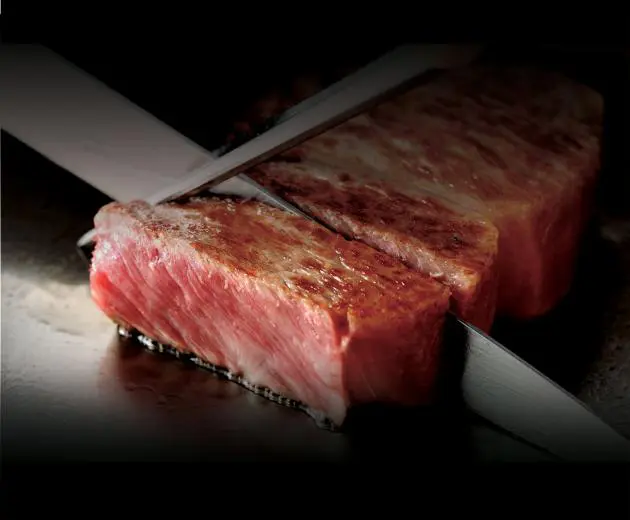
“The beef can be prepared as steak, sukiyaki, shabu shabu, sashimi, teppanyaki and more,” says Nami chef, as he shows us a rosy cut of Kobe beef on the iron griddle.
I wanted my Kobe Beef Striploin Teppanyaki medium while the Korean gentleman sitting next to me asked for medium-rare. The sought-after beef was simply grilled with just salt and pepper and as the Korean enthusiastically tuck in to his pink slices, I savoured my dryer pieces, too. They were juicy and tender without a trace of odour. I’m not a beef lover myself, but I wanted to eat more than my share.
The myth around the price is true: one kilogram of Kobe beef costs around Bt15,000 – equivalent to a one-way ticket from Bangkok to Osaka, the gateway to Kobe.
And the milkmaids? The Japanese expert grins but chooses to remain silent. Lucky cows!
