
Most sacred in the South
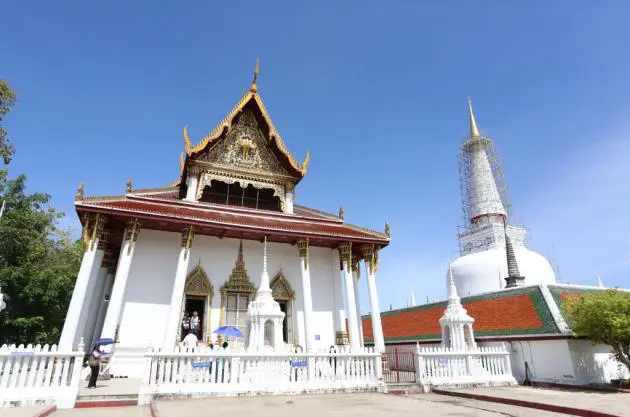


A beloved Nakhon Si Thammarat temple seeks recognition as a World Heritage Site
The Culture Ministry is pushing hard for Wat Mahathat Woramahawihan in Nakhon Si Thammarat to be recognised by the United Nations as part of Thailand’s living heritage – and so it should. The temple and grounds are beautifully preserved and of enduring benefit to the community.
The wat is a more popular destination as well among both foreign tourists and area residents since the ministry applied for its recognition as a World Heritage Site at a Unesco meeting in Phnom Penh in June.
It has been shown to meet three out of the 10 criteria for recognition, enough to warrant its consideration. It’s a masterpiece of human ingenuity, it entails influential architecture and setting of artistic significance, and – as a repository if documents pertaining to the spread of Buddhism – it’s an historical structure.
The Culture Ministry treated a group of Bangkok-based foreign diplomats to a tour of the site late last month. Vice Minister Adisak Benjasiriwan served as host for diplomats and their spouses from 22 countries, including ambassadors Shigekazu Sato of Japan, Jeon Jaeman of South Korea, Jorge Chen of Mexico, You Ay of Cambodia, Philip Calvert of Canada and Hossein Kamalian of Iran.
They also visited the city museum, an arts-and-crafts centre and the Shadow Puppet Museum run by National Artist Suchart Subsin.
“We want you to see the living heritage based around the temple, the environment and the people,” Adisak told his guests. “The concept of ‘living heritage’ highlights the special connection among heritage sites, the surrounding natural environment and communities. It’s about appreciating and creating harmony among those three elements, which support each other in unique yet symbolic ways.
“Understanding the relationship among temple, environment and people is the only way we can preserve the authenticity and integrity of our heritage.”
The ministry says Wat Phra Mahathat Woramahawihan became the province’s principal temple during the time Tambralinga existed as a sovereign state, in the early 13th to mid-14th centuries.
The temple’s main stupa, the Phra Borommathat Chedi, dates to the early 13th century. “This gigantic bell-shaped stupa is the outstanding structure here,” former ministry permanent secretary MR Chakrarot Chitrabongs explained as he guided the tour.
“Since it is claimed that the Buddha’s relics are contained inside, it became a sacred place for Buddhists and marks the site as one of the most important seats of Theravada Buddhism.”
The temple continued to draw millions of worshippers throughout the Ayutthaya Period, from 1350 to 1767.
Built in classic style – rectangular and enclosed by brick walls with four gates – the temple covers 5.14 hectares. Its two sectors accord with the traditional zoning of Buddhist temples – the Buddha-avasa for religious activities and the residential Sanghaavasa for the monks.
The former holds the chief monuments, with the Phra Borommathat Chedi containing the Great Noble Relics at its heart. Twenty-two elephants, sculpted in stone and covered in stucco, ring the chedi’s base, which is square with a low brick wall enclosing the space in which the faithful make their clockwise rounds of obeisance. Four much smaller bell-shaped stupas sit at each corner.
The remarkable main chedi has an umbrella-like spire formed by 52 rings. The square platform above the top of the bell-shaped body is separated from the spire by a row of walking Buddha images in relief. The 11-metre-high spire is covered with gold leaf, estimated to weigh 600 kilograms, and studded with precious stones. All around is an immense cloister of coloured tiles and a gallery of many Buddha images.
The oldest depiction of the Buddha is a Sukhothai-style standing Buddha also dating to the 13th or 14th century. Near at hand are 158 minor chedis holding the remains of devotees, the Wihan Khian and Wihan Phra Ma with wonderful stucco reliefs showing scenes from the Buddha’s life, and a bodhi tree under a roof.
Just outside is the main assembly hall, the Wihan Luang, with columns leaning inward in the Ayutthaya style that were indeed erected in the 15th or 16th century. The ceiling is richly decorated.
There is another chapel where an image of the eminent monk Kaccayana is enshrined, and a museum filled with historical and auspicious objects and offerings.
The compound was so well laid out that all of its buildings continue to function admirably as part of the whole. It’s still a place of learning as well as worship, preserving and promoting the Buddha’s concept of an ideal society built on universal values.
The religious rites of old are still practised here as well, including the long procession to bring the painted Phra Bot robes to wrap around the principle stupa, a “living” ceremony that is rather unique in the world. It’s repeated every year for Makha-puja and Visakha-puja.
While Unesco mulls the temple’s designation as a World Heritage Site, the government has lots of time to raise public awareness about its importance. The United Nations agency next meets in two years, in The Hague, and an announcement is not expected before then.
“We hope the temple will be listed,” said Jongkolnee Sukmak, a 13-year-old volunteer guide at the wat. “It would be great for both tourism and Buddhism.”
And Sujin Auaklin, a guide in the museum, said he’s happy it’s being considered, “but even if it doesn’t become a World Heritage Site, the temple is always the core of Buddhism here. I hope everyone supports Buddhism in the right way.”
