
Stamped in brick and stone


Play
European Union members mark their architectural presence in Bangkok and Ayutthaya with the launch of a heritage map
THE BRITISH heritage in Myanmar is immediately evident in the Raj-era colonial buildings that dot the streets of Yangon. Likewise, France’s former presence in Cambodia and Vietnam shines through in the glorious mansions and administrative buildings, at least those that haven’t crumbled from age and lack of maintenance.
Of course, Thailand escaped foreign colonisation so the architecture in its capital should be Siamese, right?
Actually no. Look carefully around Bangkok and it’s easy to spot the British, French, Italian and other European influences. In fact, the “old continent” has contributed so much to Thai heritage that the European Union and European Union National Institutes for Culture in Thailand (EUNIC Thailand) are introducing a European Heritage Map for Bangkok and Ayutthaya. The map highlights 60 sites in Bangkok and five sites in Ayutthaya that underscore the rich and centuries-long relationship between Europe and Thailand.
The map is a joint initiative of the embassies of Belgium, Denmark, France, Germany, Italy, the Netherlands, Poland, Portugal and the United Kingdom, with support from the Delegation of the European Union.
“When you talk about European heritage, most people immediately assume you mean colonisation but in fact the connections go back much further than colonial times.” says Luc Citrinot, a French journalist and researcher of European Heritage-linked-destinations in Southeast Asia.
The relationship between Thailand and Europe can be traced back to the Ayutthaya era. The Portuguese diplomat Duarte Fernandes became the first European Ambassador to the Siamese court in 1511 when King Ramathibodhi II was on the throne.
Almost a century later, in 1608, the VOC (Dutch East Indies Company) from the Netherlands received permission to establish a trading post in Ayutthaya.
Trade between Europe and Ayutthaya flourished throughout the 17th century. King Narai the Great of Ayutthaya, on the advice from his Greek counsellor Constantine Phaulkon, developed strong bonds with France, granting the country an exclusive concession for the spice trade in Siam and, in 1685, King Louis XIV sent the first French ambassador to Ayutthaya.
When Ayutthaya fell to the Burmese in 1767, Siam’s capital moved to Thonburi and then to Bangkok. King Rama II of Rattanakosin Kingdom re-established relations with the West in the early 19th century.
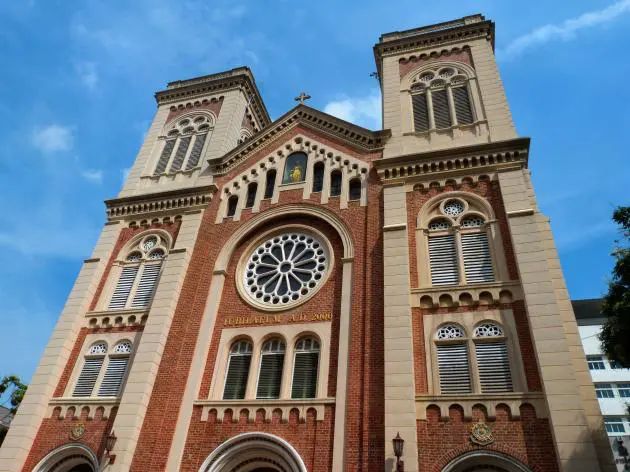
“Assumption cathedral is around 100 metres from the Mandarin Oriental Hotel and the French Embassy. They are all in The European Heritage Map. The cathedral was created by French missionary Father Pascal in 1809 and designed by a French architect. It was completed in 1821 during the reign of King Rama II.
“This is a typical Romanesque church. All materials for the original building were imported from France and Italy. Apart from the cathedral, there was also a school, printing house and bishop house. The current cathedral was reconstructed in 1909. While its exterior style is distinctively gothic, its interior is pure medieval Roman style with frescoes on the ceiling,” says Citrinot.
Portugal became the first European nation to build a diplomatic residence, on land gifted by King Rama II in 1820. Historical buildings at the embassy consist of a former warehouse and the current residence. The latter replaced a former structure made of bamboo and wood. Inspired by houses in Phuket, the new consulate general was built in classical Sino-Portuguese style.
When King Rama IV came to the throne, he was determined to save Siam from colonial domination. The king signed a treaty with England in 1855 –the Bowring Treaty – which restricted import duties to three per cent, abolished royal trade monopolies and granted extraterritorial privileges to the British. Treaties with most of Europe's largest nations followed.
The diplomatic skills of Thailand’s monarchs and the modernisation of its government helped Siam to remain the only country in Southeast Asia to avoid outright colonisation. King Rama IV later built the first paved road called Charoen Krung, meaning modernised city, which became the main settlement for foreigners in Bangkok.
“Thailand has an amazing history. Hundreds of years ago, Europe was the benchmark of modernism and King of Siam at that time was keen to show the world that Siam was a very progressive and modern country. The first empowerment of European businessmen was during King Rama IV’s reign. He was the first one to ask Italian architects to come to Thailand,” Citrinot explains.
“Italy has always been considered the leader in architecture in Europe. And the country had the biggest influence in Thailand because there were around 20 Italian architects working here.”
King Rama V or King Chulalongkorn transformed Bangkok into a modern metropolis. Roads, canals, railways, schools and universities were constructed in his reign.
“Many European businessmen, architects designers and engineers came to Thailand at the time of King Rama V. Many of the European-style buildings in Bangkok were constructed during his reign. European architects also worked in Siam throughout the reigns of Rama VI until Rama VII. Dorman Long, the British steel company that built Sydney Harbour Bridge, built the Memorial Bridge and it was officially opened by King Rama VII in 1932. European architects only stopped working on projects like these when absolute monarchy was replaced by constitutional monarchy,” Citrinot says.
“This embracing of European styles was made easier by the fact that Siam’s monarchs were able to select European architects from different nations to come here. And this is what makes Bangkok unique. Instead of seeing only one style, as you do in Hanoi where the style is 100-per-cent French or in Yangon, where it’s 100-per-cent British, Bangkok boasts Italian, French, German, Belgian, Portuguese and British architecture as well as some extraordinary blends of styles.”
Buildings that offer a mix of Thai and Western styles include the Faculty of Arts at Chulalongkorn University, which was constructed in 1914 by Briton Edward Healey, and Wat Benjamabophit, which was built with Carrara marble from Italy.
“This blend makes the city more vibrant. Many people say, ‘the colonial style is not ours’. My reply is that while it’s true that it is not ‘your culture’, it is ‘your history’.
“We would like to show Bangkok in a different way so that visitors see it as a travel destination that sparkles with the beauty of European heritage,” Citrinot concludes.
ON THE MAP!
>>The president of the EU National Institutes of Culture (EUNIC) Thailand, French ambassador Thierry Viteau, will present Bangkok Governor MR Sukhumbhand Paribatra with the European Heritage Map of Bangkok and Ayutthaya today. The presentation will take place at the French Ambassador's Residence, which is also open to the public from 10am as part of the celebrations marking European Heritage Day 2013 in Bangkok.
>>The European Heritage Map of Bangkok and Ayutthaya will be available for free at selected venues of cultural and touristic interest around Bangkok and Ayutthaya, and at Embassies of the European Union in Bangkok from tomorrow.
