
Sensitive perfectionist


Play
Staying focused pays off with Cannes win for Singaporean director Anthony Chen and his debut feature "Ilo Ilo"
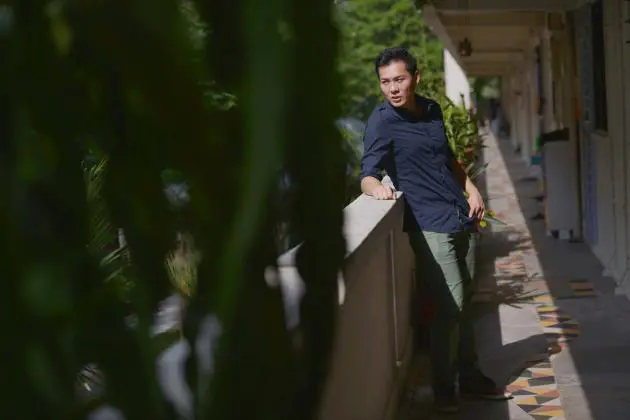
This is a good time to be Anthony Chen. Winning the Camera d’Or prize at the Cannes Film Festival in May has made him the Singapore filmmaker with the highest festival honours ever.
The 29-year-old, for years feted as a talented newcomer on his home turf, joins the ranks of Camera d’Or winners such as the UK’s Steve McQueen (who won for “Hunger”, 2008), Jafar Panahi from Iran (“The White Balloon”, 1995) and Jim Jarmusch (“Stranger Than Paradise”, 1984). The Camera d’Or is awarded to the best work from a first-time maker of a feature film.
Chen’s schedule, post-win, has been a whirlwind of press conferences, photo calls and travelling around the world, speaking to audiences and distributors.
“It’s been so unreal. The whole Cannes journey has been the most surreal memory of my life,” he says.
Going into the festival, he had doubts. His first feature, the semi-autobiographical drama “Ilo Ilo”, about a Filipino domestic helper working in a middle-class Chinese home in 1997, is dense with Singaporeana – iron grilles of government Housing and Development Board flats, the little Manila of Lucky Plaza and the riot of languages. It is mostly in Mandarin, sprinkled with English, Hokkien, Cantonese, Tagalog and Ilongo, the tongue of the maid’s home province.
“I was worried that it would be too culturally specific, too local. Would the ang mohs understand it?” he says.
He need not have worried because the “ang mohs” (foreigners) got it. Despite power glitches causing three blackouts during the Cannes screening, the audience gave the film a standing ovation.
And “Ilo Ilo” is also Singapore’s entry to next year’s Academy Awards.
The journey to Cannes began at a very young age. The laser-beam focus and tenacity that would define his temperament as writer-director showed itself in the pursuit of his dream to make films.
Chen thinks the seeds of his fascination with film must have been planted at age four, when his mother took him to the cinema to see Bernardo Bertolucci’s “The Last Emperor” (1987). “My mum thought since there was a child emperor in it, it was suitable for a child. But it was nearly three hours long and there was a scene of an eight-year-old breastfeeding.
“I remember it so well because I asked my mother about it. I was startled.”
The length of the movie, though, was too much for the young boy, who fell asleep towards the end. “But for a child like me, it was, wow. Lavish sets, the Forbidden City, the costumes, the spectacle. The images stayed in my head,” he says.
Through his childhood to teens, he enjoyed the standard diet of Hong Kong and Hollywood action and comedies. He was fascinated by the Chinese movies that screened on late-night television. It was only in his late teens that he realised that these were the early works of Lee Ang (“Pushing Hands”, 1992; “The Wedding Banquet”, 1993) and Zhang Yimou (“Red Sorghum”, 1987; “Raise the Red Lantern”, 1991).
Acting was also an outlet. From about age 10 to 18, he was involved in children’s theatre with the performing arts troupe in the Singapore Hokkien Huay Kuan cultural group.
By age 15, this had all solidified into a decision to erase any option that did not lead to a career in filmmaking. The alumnus of Nan Hua Primary and, later, Chinese High School, decided that rather than go to Hwa Chong Junior College, as was expected of Chinese High students, he would go to Ngee Ann Polytechnic.
It was then the only school here offering anything like a filmmaking course.
Once he was in Ngee Ann Polytechnic, the recognition began. His graduating short film, “G-23” (2005), won awards in France, Korea and Belgium. The shorts to follow – “Ah Ma” (2007) and “Haze” (2008) – would also earn plaudits.
After national military service, Singapore’s Media Development Authority awarded him a scholarship that paid his fees at Britain’s National Film and Television School. There, his work – “Hotel 66” (2009), “Distance: (2010) and graduating film “Lighthouse” (2010) – would show that he could do more than Singapore stories.
It was in England that he made friends with fellow student, Frenchman Benoit Soler, who would be cinematographer on “Ilo Ilo” as well as “Lighthouse” and two other recent shorts, “Karang Guni” and “Homesick”.
Another collaborator on “Ilo Ilo” was Malaysian Charlotte Lim, 32, who was assistant director. She got to see, first hand, the perfectionism that has come to mark Chen’s reputation since his Cannes win got the attention of the media.
For example, 12-year-old Koh Jia Ler, who had not acted previously, was found only after Chen had rejected thousands of children, both trained and untrained in acting.
The lipstick worn by actress Yeo Yann Yann, playing the boy’s mother, had to be a precise shade of period-correct bright red. Filipino actress Angeli Bayani plays domestic helper Teresa, based on Chen’s memories of Teresita D Sajunia, who was employed by his family from the time he was four until age 12, and with whom the boy developed a strong bond.
Lim, who has worked with Lee Ang and celebrated Malaysian-born director Tsai Ming-Liang, says Chen is “very particular about casting, about acting”.
His quest for authenticity meant that actors had to turn up for frequent rehearsals, often meeting at night after they were done with other jobs. He would roll cameras only after he felt the actors had transformed themselves into the characters he saw in his mind, she says.
Intensive rehearsals are rare in television and film work in Singapore, where the emphasis is on getting things done quickly. Actors and directors rely on typecast, exaggerated behaviour, served up with dialogue that spoonfeeds intention and plot to the audience.
“He is a very good observer and very sensitive,” she says about the way he watches actors work.
But make no mistake about whose vision it is – Chen wants what he wants on set. Lim recalls how in one scene, the boy Jiale (played by Jia Ler) is supposed to be overjoyed at receiving a pet chick as a present, and holds and caresses the bird.
But Jia Ler had developed a fear of the chick and refused to touch it. Chen urged the child to complete the shot, without success. It became a contest of wills between the petrified boy and an utterly frustrated Chen, she says, laughing.
The crew worked out a compromise: veteran actor Chen Tianwen, playing the father, would hold the bird, and with the clever use of camera angles, the boy would appear to touch it.
Chen admits that he can be exacting when he has a goal. “I can’t deny that I am a control freak. The films I make in Singapore are very personal and they are about places and people that I know and understand. I believe very much in authenticity and honesty... I don’t want a stylised, nostalgic version of the past.”
Chen has continued to live in London since graduating in 2010. He and his wife Rachel Yan adore the city and its cultural riches, and he relishes the chance to work on a non- Singaporean feature film set in the West.
But while he is keen to use “Ilo Ilo” as a springboard, his next job, he says half-seriously, is related to his recurring themes of children and family. “My wife has been neglected for the last three years because of this film. You could say the film is my first baby. My next big project is for my wife and me to have a baby.”
At home
“Ilo Ilo” is playing in Bangkok at House cinema on RCA. It has English and Thai subtitles. For details, see www.houserama.com.
