
The art of frictionless war


Play
For American voters, war is now just a background drone (pardon the pun). For arms-makers and ideologues, it's a lucrative endeavour too tempting to resist
Critics of America’s lust for meddling overseas will say “Drift” is misnamed in both title and subtitle. The implication is an accidental or inadvertent loosening of the guide ropes, but as Rachel Maddow makes clear inside, there is nothing accidental in the way the good ship USA has sailed into a perpetual state of war. Pirates are at the helm, and they want treasure, not peace.
Maddow has tapped solid source material for this string of excellent essays, which together form a history of the gradual shift in thinking in the White House, Pentagon and Congress since the Vietnam debacle about how and why American military muscle should be flexed. Unfortunately for the rest of the world, and for democracy, the shift has been away from the US Constitution, whose authors bent over backwards to try and forestall exactly the kind of war-making we see today.
The central tenet for the Founding Fathers was that war should be avoided at all costs, to the point that there should be no standing army. All they felt necessary was a trained, part-time, civilian militia, ready to defend America’s shores from attack. And since they knew that heads of state tend to seek out battles that might enhance their personal power, they made sure the president alone could not declare war. That responsibility was commended to Congress.
Thus, “Drift”, released more than a year ago, becomes acutely timely as Barack Obama, winner of the Nobel Peace Prize, begs Congress to let him go to war again, this time to fight the Syrians. Despite the cries of doves and a majority of the population opposing the notion, no one expected Congress to balk (before Russia’s scheme to remove Bashar al-Assad’s chemical weapons saved Obama’s face). Congress has been bowing to fight-picking presidents, with an ominously royal flourish, ever since Lyndon Johnson.
While Vietnam was winding down, the head of the Joint Chiefs of Staff, General Creighton Abrams, recognised that it had been too easy for the White House to wage war. His Abrams Doctrine came into favour, making popular support for war a requisite for its declaration. To gauge that support, it became necessary that the military reserves and National Guard be called up, as they had not been in Vietnam. This way, Americans would see more family members, friends and neighbours sucked into the maw, and if they could tolerate seeing them come back home in body bags, then the war could proceed.
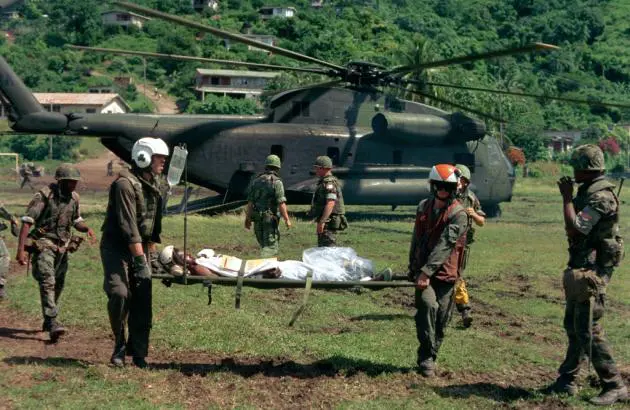
It fell to Ronald Reagan to chisel away at the Abrams Doctrine with his secret wars, leaning on the CIA, which was accountable to no one. It was Reagan who started jacking up the “national security” and Pentagon budgets in earnest, and damn the deficit. Maddow’s retelling of the Grenada and Nicaragua affairs is outstanding.
Then George Bush Snr and Bill Clinton deployed their own diversionary tactics, hiring private firms to do much of the dirty work overseas and thus requiring far fewer military boots on the ground. Nato and the UN provided cover. And so it’s gone, Dick Cheney and Robert Rumsford repeatedly bobbing up in the Oval Office as guns let loose in Kuwait and Afghanistan and Iraq as America invades and invades and invades.
Maddow has particularly sharp criticism for the drone warfare now in vogue – no American casualties at all! There’s also a somewhat out-of-place account of the thousands of accident-prone nuclear warheads that the US has stowed all over the place, still ready to go – if they’re not rotted through.
“Civilian life has rolled on virtually uninterrupted,” Maddow writes. “If you’re not in a military family, you’ve barely even felt it. The country has perfected the art of frictionless war. America’s wars thrum away like Muzak in the background here in the United States, kind of annoying when you tune in, but easy enough to tune out. Three years? Five? Ten? What’s the difference? And where are we fighting, anyway? We’re shooting missiles into Pakistan all the time. Does that count? Are we allowed to know?”
The only major drawback to “Drift” is Maddow’s glibness, which some might kindly shrug off as “collegiate humour” but is really just juvenile. Maddow is one of the talking heads on MSNBC, where she holds forth with the same edgy, sarcasm-soaked brassiness that has made Jon Stewart rich and famous. This topic is really too serious for light treatment – but, if the gags make more Americans understand their ship has been shanghaied, I withdraw my objections.
Drift: The Unmooring of American Military Power
By Rachel Maddow
Published by Broadway, 2012
Available at Asia Books, Bt450
Reviewed by Paul Dorsey
