
After the earthquake


Play
An arts festival reflects Japanese society following the March 2011 disaster
Contemporary art often serves as a mirror of the times. Aichi Triennale 2013, an international art festival running until October 27 in Aichi Prefecture, focuses on the stresses of today’s society.
The festival, titled “Awakening: Where Are We Standing? – Earth, Memory and Resurrection”, is one of the largest of its kind in Japan. The theme has taken a dramatic turn from that of the previous event in 2010, which was “Arts and Cities”.
This year’s theme appears to suggest that one of the main functions of the event is to preserve the memory of the Great East Japan Earthquake in March 2011 and explore the possibility of regaining peaceful landscapes.
The festival, which is being held mainly in Nagoya and Okazaki, features art exhibitions, stage performances and videos, with 122 individuals and groups of artists from 34 countries participating.
With Nagoya’s Aichi Arts Center and the Nagoya City Art Museum serving as the core facilities, the event extensively covers the prefecture. Other venues include the Choja-machi site and the Nayabashi site in Nagoya, and three sites have been set up in Okazaki, including one at Higashi-Okazaki Station. On some weekends in August and September, artworks toured four other municipalities in the prefecture.
The cost of the event is about 1.26 billion yen (about Bt400 million), slightly more than the previous triennale.
The festival’s theme is a stark reminder of the 2011 disaster. Taro Igarashi, a professor at Tohoku University who serves as the festival’s artistic director, has been active in the disaster-hit region.
Many artists have visited the region since the disaster, with many of the resulting artworks having a documentary feel, according to Igarashi.
The word “awakening” in the title seems to indicate that artists have accepted the unusual severity of the disaster and regard it as an opportunity to break down spiritual and physical walls that had been built in themselves and in society, prompting an awakening of new senses.
Many architects are also participating in the event at Igarashi’s invitation.
“Fukushima Dai-ichi Sakae Nuclear Plant,” by architect Katsuhiro Miyamoto, is on display at the Aichi Arts Centre. Using the walls and floors from the 10th floor to the second basement, the work uses coloured tape to create a life-size design of some of the facilities at the Fukushima No. 1 nuclear power plant, which was crippled in the disaster.
A video installation called “Cardboard Walls” by Aernout Mik, a Netherlands artist, shows how disaster evacuees built walls with cardboard to make their sleeping spaces at temporary shelters, based on local people’s reconstruction of the event. The artist also installed real cardboard walls to give visitors a sense of the reality of the situation.
A work by Janet Cardiff and George Miller from Canada that features a chorus emanating from 40 speakers, and a work by Kenji Yanobe, themed on church building, present a wish for relief.
Among the artworks on display at the Nagoya City Art Museum is “The Red and Blue Line,” jointly created by architect Jun Aoki and painter Hiroshi Sugito. The two were scheduled to give a joint exhibition at the Aomori Museum of Art, but it was cancelled due to the disaster.
Photographer Lieko Shiga’s “Rasen Kaigan” (“Spiral Coast”) comprises panels of photographs that capture the lives of people in a coastal area in Miyagi Prefecture, which was hit hard in the disaster. The panels are on display at a shopping centre in Okazaki, that Shiga, a native of the city, often visited as a child.
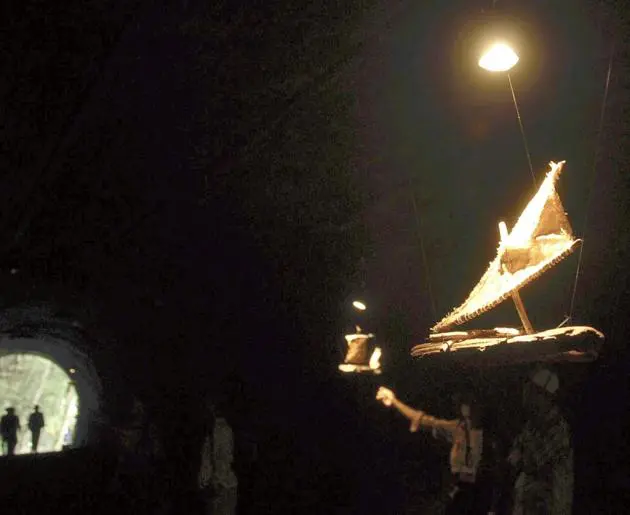
In conjunction with the Aichi Triennale festival, an exhibition “Koya no Hikari” (“Light in Wild”) is being given in four of about a dozen defunct tunnels on the borders of Aichi and Gifu prefectures.
The exhibition is being hosted by an organisation that aims to preserve and use the railway tunnels, known as the Aigi Tunnel Group. The tunnels were used from 1900 to 1961 and acknowledged as a heritage of industrial modernisation by the Economy, Trade and Industry Ministry.
Visitors are invited to walk through the tunnels, which are located in a 1.7-kilometer stretch of land along the Shonaigawa river from JR Jokoji Station. Eight individual artists and one group are displaying their works, which are impressively enhanced in the darkness.
One of the artists, Yukio Fujimoto, has placed four electronic keyboards in a tunnel at the same intervals, mesmerising visitors with a disharmony of sounds flowing from the instruments as they move forward. Fumito Urabe has hung a group of small sailboats made of driftwood and cloth from the ceiling.
Walkways between the tunnels also serve as exhibition sites for several sound and sculpture works.
