
Tugging at the heart strings


Play
A Karachi Instrument-maker struggles to survive but remains optimistic about the future
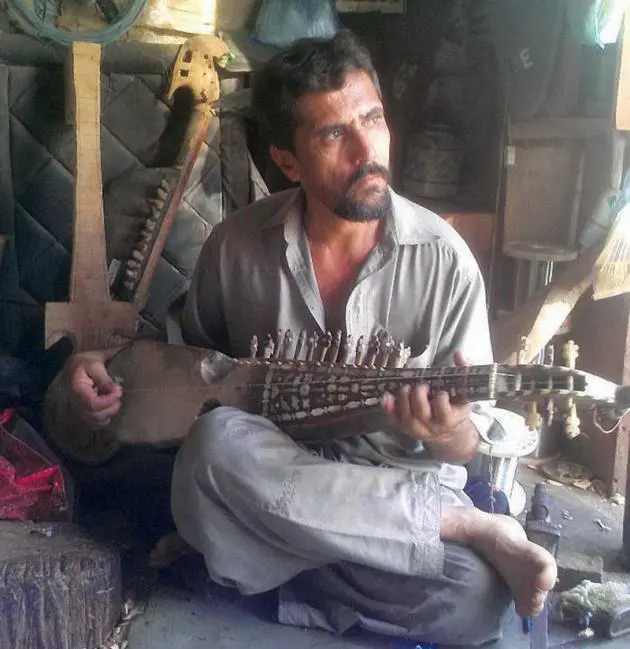
About half a kilometre from Karachi's famous Banaras Chowk, to the left side of Banaras Nullah, stands a tiny old shop. The exterior is far from impressive; the interior even less so. A small space has been cleared out on the floor to provide seating; two old exhaust fans are tied to the roof in place of ceiling fans and all the remaining space is taken by musical instruments – stacked in the corners, hanging from the walls and piled up wherever there is an inch to spare. Some are finished and ready to play; others are broken and need to be fixed.
This is the famous Shaheryar Musician House owned by Sohail Muhammad, the sole rubab maker of Karachi.
The Pakhtuns who came to Karachi seeking their livelihood brought many of their traditions and customs with them. One beautiful tradition is that of the majlas, a gathering of professional and amateur singers and musicians who take any opportunity to perform, earn their living and provide a few hours of entertainment to the appreciative audience. While other musical instruments also make an appearance, the rubab is considered the essential piece at such events.
In Karachi, however, the character of the majlas is a bit different from those held in the villages: due to a dearth of professionals, amateur singers who spend their days toiling at hard labour shed their cares and revel in traditional folk poetry accompanied by the melodious strains of the rubab.
“My father, Gul Muhammad, opened this shop in 1965 after he retired from the army,” Sohail explains. "He had learnt the art of making music instruments from my uncle Shad Muhammad Sitari, who was a professional sitar player at Radio Pakistan. “He started making sitars to order. The rubab was not that common as only professionals were able to play it. However, with the passage of time, the sitar lost its place to the rubab and my father started getting orders for rubabs".
Sohail took charge of the shop in 1996 on his father’s death. In keeping with tradition, the shop is named after his elder son, Shaheryar. Asked about the growing extremism, which has threatened people associated with various forms of art, Sohail says he has no complaints.
“I have never been threatened because of my work; in fact, thanks to the rise of media and TV channels, the image of people associated with music and art has actually improved; the younger generation, especially, now treats us with awe and admiration for our art, unlike the old days when people often used derogatory terms for people associated with singing and music.
Profits are small, not least because making a rubab takes a whole month. The cost, he adds, depends on the material used. “Usually we use wood of the plum tree as it’s cheaper and a rubab made from this can fetch around 6,000 - 7,000 Pakistan rupees (Bt1,750-Bt2,050). People who are willing to pay more insist on using wood of walnut or mulberry trees.”
Sohail says he’s happy about the fact that with the rise of the electronic media, Pakhtun singers are making it to the mainstream. Various new bands using traditional instruments like the rubab have also emerged and the demand for rubab is no longer restricted to Pakhtuns.
“I now get many orders from Baloch customers as well as customers from Gilgit Baltistan; rubab and chardah are used in the traditional music of various parts of Gilgit Baltistan and the Baloch place orders for the rubab and another local instrument, the sazinaa,” Sohail says.
“Over the last two years, I have received plenty of orders from Gilgit Baltistan. A customer informed me that they have an academy of arts which offers courses in various arts including music theory, vocals and instruments; hopefully they will place an order for stringed instruments in bulk. I have also been promised by a music teacher friend in Karachi that he will help promote the rubab as an instrument in the academy he is associated with,” says Sohail.
At the end of our session, he takes one of his handmade rubabs, tunes it and plays a melodious Pashto song. As I prepare to leave, he invites me to a majlas in the nearby Elahi Colony, which I gratefully accept.
