
Pedal power and amazing attractions


Play
Koh Samui is home to several cycling clubs and each enjoys its very own scenic route
RESIDENTS OF Koh Samui, Thailand’s third largest island, have long been accustomed to getting around on two wheels. Today even visitors are being encouraged to get on their bikes as the “Green Island” campaign gains traction in its aims to restore the beautiful natural environment and traditional ways of life.
“We are working hard to persuade residents and tourists to ride a bicycle rather than drive. Our campaign centres on the walking street in Mae Nam every Wednesday and Thursday, Bophut on Friday, Chaweng every Saturday and Lamai on Sunday,” says Anawat “Ben” Potnetrakom, founder of Samui Cable TV and the brand new Mae Nam Cycling Club in Koh Samui.
Anawat set up his club just a month ago and already has attracted 60 members ranging in age from nine to 60.
“We started riding to improve our health. Later, we attended a cycling competition and did very well. Now we are working to build our cycling team so it becomes a representative of Koh Samui,” says the 50-year old, who has been riding a mountain bike for seven months.
“We hold a training course for children every evening from Mae Nam Soi 1. We also ride on the race track and through the coconut groves. Our aim is to compete in cycling competitions in the 14 Southern provinces.”
In addition to Mae Nam, there are other cycling teams on Koh Samui who take their names from the districts like Nathon, Bophut, Bang Rak and Lamai. The Nathon cycling team has been up and running for more than three years and has 20-30 members between the ages of 30 and 50. They ride every Sunday morning.
“My team prefers to ride to different destinations and stay overnight before coming home,” says Kreangpong Panasampon, 46.
The island has lots of bike routes in addition to the race tracks. The longest route is 52 kilometres around the island on good roads and over the challenging hills of Laem Yai and Bophut.
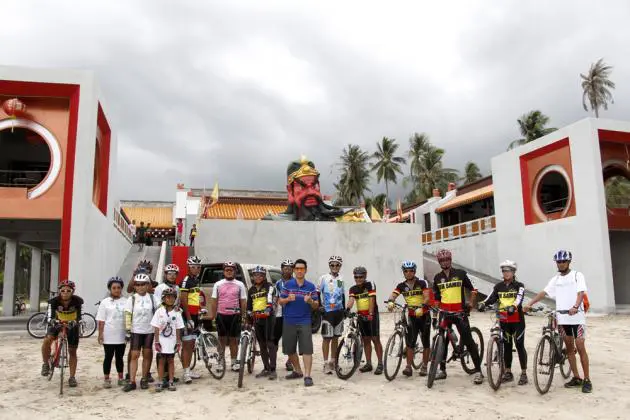
Our group was given two choices of routes, 3 km and 10km. We opted for the shorter, which took us past several interesting attractions including the Hainan Temple in Nathon and the mosque in the Muslim fishing village before finishing at Samret Temple. The 10km-ride continues on to Wat Jang.
“The Hainanese Shrine was built by the Hainanese who settled in Hua Thanon District,” says Anawat, whose father hailed from Hainan and one of the immigrants who initiated the building of this temple. “We want it to be a landmark of Koh Samui, the biggest Guan-Yu in Asia.
“The Muslim fisherman from the village sometimes catch a Chinese silver pomfret or butterfish, weighing almost one kilogramme. One kg costs about Bt1,500. The Chinese like steaming it with soy sauce and it is served in such popular restaurants as Go Teng and Khao Hom. Wat Samret is more than 100 years old and features a rare teakwood house and a house built of coral,” he explains.
Kreangpong adds that the Nathon cycling group usually take a 10-km route from Song Ruea Waterfall and turn back towards the Hainan Temple before ridng on to Hin Lad Waterfall. The Mae Nam group takes a longer, 20km route starting at Mae Nam Soi 1 and passing several holy places before ending end up at Wat Na Phra Lan.
