
Blinded by the light


Play
A German food scientist discovers that parasitic organisms can be stopped from growing in different kinds of light
Biologist Markus Schmidt-Heydt made a major scientific discovery in a “light-bulb” moment - literally.
A fungi specialist at Germany’s Max Rubner Institute (MRI), Schmidt-Heydt had to move his numerous petri dishes containing mould cultures to another laboratory one day due to construction work.
His previous workplace had been fairly dimly lit, but the new one was brightly illuminated. Surprisingly, some of the fungal filaments in the dishes stopped growing.
Aha!
Up to then, scientists had tried to combat the parasitic organisms, which each year destroy a quarter of the world’s food crops even before they reach the consumer, with heat.
Schmidt-Heydt, 39, whose employer is one of Germany’s main research laboratories on food and nutrition, realised that the problem needed to be put in the proper light.
“Every fungus is inhibited by a certain kind of light,” he said, a discovery he made by attaching filters of various colours - similar to those used for stage lighting - under the laboratory lamps.
Fusaria, for example, a type of filamentous fungi widely distributed in soil that can destroy entire crops of grain such as maize in the field, have an aversion to red light.
Penicillium fungi, used in the production of Camembert cheese and antibiotics but capable - as grey mould - of spoiling stored foodstuffs, cannot tolerate blue light.
Mycotoxins - the toxins produced by fungi - are among the most toxic of all natural substances, and fungal infestation is one of agriculture’s biggest unsolved problems, Schmidt-Heydt notes. Besides huge crop losses, an inestimable amount of food is spoiled in households by mould.
Using light to keep harmful fungi in check is no simple matter, though. Green fuzzes on old bread and mushrooms in a forest are merely the fruiting bodies of an underlying fungus that can grow to be humongous.
In a forest, the network of fine filaments - called hyphae - below the surface sometimes covers an area of more than a square kilometre and reaches an extremely old age.
Since the actual extent of mould is invisible to the naked eye, Schmidt-Heydt advises that mouldy food always be thrown away in its entirety. Heating it by toasting or boiling is pointless, he says: “The fungus will die, but some of the toxin breaks down only at temperatures around 300 degrees Celsius.”
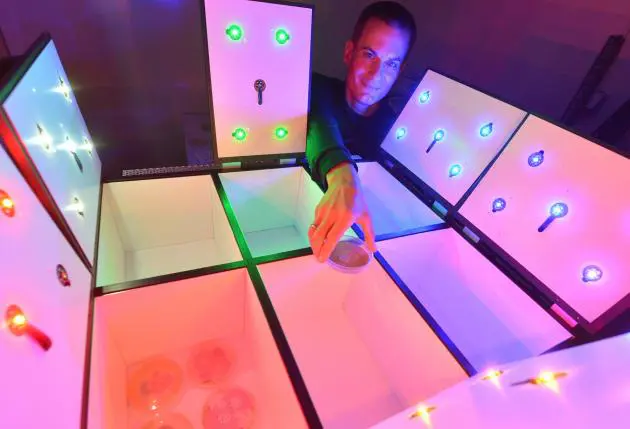
To test the effects of light on fungi, Schmidt-Heydt and his colleagues at the Karlsruhe institute’s department of fruit and vegetable quality have devised a light box in whose chambers they can subject fungi samples to varying light wavelengths and frequencies.
“With weak blue light you can inhibit fungi’s toxin formation, with strong blue light you can inhibit their growth, and with very strong blue light you can kill them,” he says
“Light-induced prevention of toxin formation is a promising strategy,” says Ebrahim Razzazi-Fazeli, a professor of bioanalysis at the University of Veterinary Medicine in Vienna.
He warns, however, that practical implementation of the method was still a long way off.
Meanwhile, Schmidt-Heydt is already considering simple mechanical solutions. “It would be possible to make warehouses in the Third World mould-proof with special, coloured glass panes that provide the right light,” he suggests.
