
Paintbrush and whistle


Play
The Rajdamnoen rally grows an art exhibition, no less rebellious.
Art shadows politics in Thailand, trailing closely behind big brother Thaksin and little sister Yingluck and their foes through the turbulent times since 2006. Art lurks among the furious crowds and mimics every politician’s decisive move.
The activist as artist was there on Rajdamnoen Avenue last week – Vasan Sitthiket, Naowarat Pongpaiboon and Sutee Kunavichayanon, among others – heeding the wake-up call for political engagement. The anti-government demonstration, with its opposition politicians and their cheerleaders taking turns spewing vitriol, was fuel to the artists’ creative fire. They wrote and they sketched on the spot.
The avenue is now the scene of an art exhibition as well, with more than 50 paintings and a poem by National Artist Naowarat on display, fresh from the fiery nights of protest. The words and images are aesthetic and they are sarcastic, every one of them confronting the Thaksin regime with disdain.
One of the paintings – by an anonymous hand – shows Thaksin Shinawatra in the skin of a crocodile – or perhaps it’s a loathsome water monitor. He sleeps peacefully, harmlessly, in a business suit, curled up like a baby. But his great green tail thrashes about and the lizard’s head has sneering, blood-red eyes. The clear threat posed by the cunning Thaksin-beast forces us to become active participants in the image.
The political unrest surges to and fro around Bangkok and upcountry as the former prime minister, ousted in the 2006 coup and sulking in self-imposed exile overseas, plots to regain his lost fortune and dignity. Thailand’s vast divide – between the Thaksin admirers in red and his critics in yellow – grows deeper as hate speech fills rallies and the Internet. For pushing the country to the precipice – if not civil war – with its ill-advised attempts to introduce self-serving legislation, the government faces widespread outrage that is utterly reflected in the art exhibition.
Among the Thaksin cronies under artistic siege is Chalerm Yoobamrung, the bulldog of a police captain who was a deputy premier and interior minister until he was sidelined to the Labour Ministry. Newly recovered from health woes, he’s been brought back into the fray to try and head off the protesters.
The outspoken Chalerm’s portrait in the Rajdamnoen exhibition wears an ambiguous facial expression, but there’s nothing ambiguous about the characteristics of Adolf Hitler on one side of that face. The artist sees Chalerm as being drunk with power and depicts him under attack from a rhinoceros and a gaur (wild bison) – animals associated with crooked and corrupt politicians.
The artworks are not all vicious. One painting portrays a young girl standing alone in the dark. Her hair is tied with a bow that looks like the Thai
flag. It seems to be a tribute to the young generation of urban students who have joined the marchers on the streets of Bangkok, blowing the whistles of discord.
Die-hard activist artist Vasan Sitthiket has contributed a remarkable piece that reflects his great sense of absurdist humour. He’s redrawn the map of Thailand in the shape of nude woman, and at the same time as the cake from which everyone wants a slice. She is crying in pain because her citizens – among them soldiers, monks, politicians and civil servants – have riddled her body with knives and forks. “Enough! Stop abusing Thailand” Vasan has inscribed on the canvas.
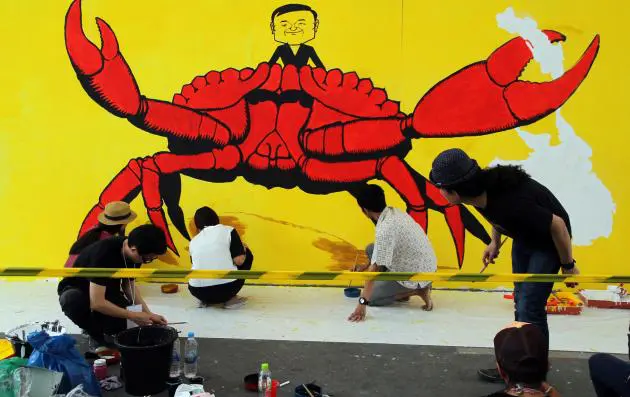
In another startling work, Sutee Kunavichayanont mocks Thaksin and Yingluck Shinawatra in a painting of a huge red crab on a yellow background. A square-faced man rides the crab, which holds in one of its pincers another outline of Thailand – upside down. Blood drips from the man’s mouth.
If art has the power to make visible what is normally invisible, Sutee’s piece is testimony. Yingluck, whose nickname is Poo, meaning “crab”, runs a cabinet widely regarded as the puppet of her older brother, the “backseat driver”.
The poem by Naowarat is four lines on canvas meant to encourage the whistleblowers who expose government misconduct.
“Don’t use your hands to pay obeisance,” he says, in a rough translation. “Don’t use your hands to cover your eyes blind. Don’t use your hands to beg for justice. Instead, punch your hands in the air and reach for victory.”
“Don’t stay silent” is the message. Get out in the street and tell the powerbrokers you’ve had enough abuse.
The sleep of nations produces monsters, if I can paraphrase Francisco Goya, the great Spanish painter and social commentator of the late 18th century.
