
Stone versus Leaf


Play
South India's world-famous Thanjai big temple wins every time with most visitors, but the unassuming library nearby is the true star of ancient Thanjavur
Few visitors bother to thumb through Sarasvati Mahal in the southeast Indian state of Tamil Nadu. It’s one of Asia’s oldest libraries, but most travellers give its crumbling walls barely a glance as they rush past to its Unesco World Heritage neighbour, Thanjai Big Temple.
But inside Sarasvati Mahal’s dull cover lies a gleaming treasure.
The library is piled high with priceless ancient knowledge culled from centuries of thinking and collected in palm-leaf manuscripts. Some 6,000 volumes cover a wide range of topics – principally, science, astrology, ayurvedic medicine, music, language, literature, philosophy, art and architecture.
India has spawned more ancient palm-leaf manuscripts (olai chodi in Tamil) than anywhere else in the world. For thousands of years the dried leaves served as a natural and easily available medium to pass down knowledge.
Dried palm leaves were pressed flat and letters were inscribed from left to right. Holes were then made to string the palm leaves together into “books”. Kings and priests ensured that the oldest manuscripts were ritually disposed of only after they had been copied onto new palm leaves. This method of transmitting information was a laborious and often risky one.
Scholar-monks took long pilgrimages, braving disease, thieves and dangerous roads to collect or copy these manuscripts and preserve their precious knowledge in their own temples and libraries.
Sarasvati Mahal is among the most impressive stores of wisdom gathered by this treacherous, centuries-old quest. It started as the private library of the Nayak Kings of Thanjavur, who ruled from 1535 to 1675.
The present-day guardian of its riches, conservator and librarian Dr P Perumal, invites us in to view some of the collection’s finest “jewels”. Erudite and twinkly-eyed, 59-year-old Perumal’s deep knowledge of ancient Indian history and literature is matched by his expertise in old Tamil and Sanskrit and other languages of the subcontinent.
The library is divided into five sections – Publication, Manuscript, Reference Book, Conservation and Reprography. Perumal takes us on a tour, shedding light on the precious palm-leaf manuscripts displayed in countless rows of wooden cabinets.
He leads us to the reprography section to demonstrate how the manuscripts are conserved on microfilm using special equipment and lighting. They can then be studied through projectors that enlarge the script for scholars to extract every nuance of information.
The translated manuscripts are edited by pundits and then published as books. So far, the library has published over 535 in five languages.
Among its many unique works is a text called the Sabdartha Chintamani. Read it from left to right and you get the story of the Ramayana. But follow the words right to left and it tells the tale of Krishna.
The library’s oldest manuscript dates back almost a thousand years to the 11th century. Perumal also shows us one of its most colourful – an illuminated book of gold-tinted pictures of the famed Mughal Darbar Palace. It’s a painstaking and beautiful pictorial record of daily life in a Mughal court.
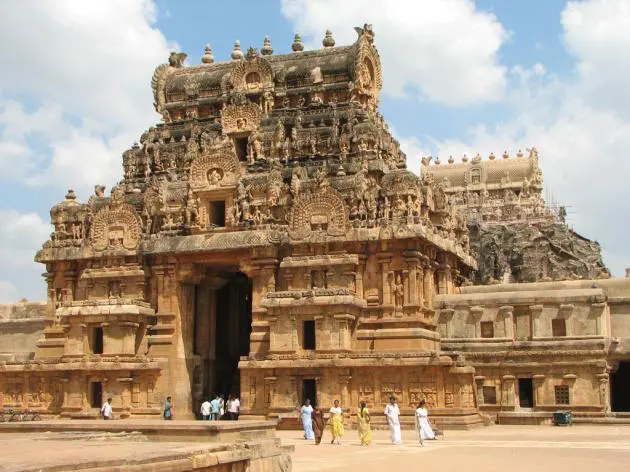
After the tour, we walk over to the Thanjai Big Temple (aka Brihadeeswara) which towers over this bustling city. Built 1,100 years ago, it is the largest temple in India and one of the world’s first granite temples.
Standing 66 metres high, the vimana (sanctum tower) is one of the tallest in the world and an architectural masterpiece.
Dedicated to Lord Shiva, the temple comprises six tiers, all wreathed in ornate carvings.
Inside the entrance we are greeted by Shiva’s mount, Nandi the bull, resplendent and “life-size” in black stone. Making our way through the dense crowd, we approach the karuvarai (innermost sanctum) and glimpse the huge lingam stone which symbolises Lord Shiva. The sight of this “holy of holies” draws prayers from the lips of thousands every day. But I can’t help thinking they are missing out on an even greater experience just down the road. Sarasvati Mahal library, for those who know how to look, is a sacred store of treasure.
