
Soldiers of misfortune


Despite reforms, Myanmar is still enlisting youngsters for its army
He disappeared when he was 12 years old, a skinny boy named Min Thu from the wrong side of town who thought he’d stumbled on the golden ticket.
It began one afternoon when a swaggering, pot-bellied businessman bumped into Thu at the market, offering him an escape from a neighbourhood where the houses are made of lumberyard scraps and the air smells of fish and decay and woodsmoke.
It ended with four years in the army.
“The guy comes by and says, ‘You’ll have a great life if you come with me’. He promised me food and a salary that would allow him to help my parents,’’ says Thu, now a stone-faced 17-year-old,
“I was in fifth grade. I didn’t even know what the guy was saying.
Thu is among the thousands of boys who have been swallowed up over the years by Myanmar’s army, one of the most feared institutions in this country. The businessman was also a broker for army recruiters, most likely paid the standard fee about $30 (Bt960) and a bag of rice for every person he persuaded to sign up.
Over the next four years Thu would spend countless days carrying supplies and working on army-owned farms. He saw people die, in combat and in training as well as much of his salary taken by his superiors.
As Myanmar shifts away from decades of military rule, emerging as a quasi-democracy where generals still wield immense political power, the government craves international respectability. Political prisoners have been freed, censorship has been abolished and, the government promises, the days of child soldiers are over.
The United Nations and local rights activists say recruiting of underage soldiers has gone down, but many boys remain in the army, despite a government agreement to clear the military of anyone under age 18 by December 1. Some have been taken in just the past few months.
“What we see and what the government is saying are completely different,’’ says Mya Sein, 65, a small-town rights activist who has worked with the families of child soldiers. “I don’t believe their promises.’’
Still, in the often paradoxical ways of the new Myanmar, a system has been created to get children out of the army. If a boy soldier – or more likely his family – is able to contact an activist or international aid group, a bureaucratic process can be started leading to the boy’s discharge.
“Some time ago the government came out of denial, which was excellent, and now there is firm policy in place,’’ says Steve Marshall, Myanmar head of the UN’s International Labour Organisation, which has helped arrange many child soldier releases. “The critical issue now is getting that policy applied.’’
Analysts say it’s unclear how many children are in Myanmar’s military. About 500 boys have been discharged in the past few years, some as young as 11, though most between 14 and 16 years old, Marshall says. He adds, though, that those children “are a small proportion’’ of Myanmar’s total number of child soldiers.
Take San Htet Kyaw, 16, who left home in July, hoping to find work as a day labourer in Yangon. Instead, an army recruiter dazzled him with tales of the money he’d bring back to his mother.
The village he left behind, Kanyin Kauk, is a speck in the Irrawaddy River delta. Twenty minutes by boat from the nearest paved road, it has no electricity, no stores and no jobs but farming. It’s a place where five families will pool their money to buy a cheap mobile phone.
“There was nothing for him here,’’ says his mother, San Myint.
Sometimes, activists say, young recruits are simply forced into the army. More often, as with Thu, they are boys who fall victim to fast-talking pitches, cannot reverse course once they realise what has happened, and are kept in the military by a toxic combination of fear and disorientation.
Myanmar has some of the deepest poverty and highest unemployment in Asia. Government jobs, particularly in villages and small towns, are seen as holy grails offering small-but-reliable paycheques.
But despite that, the Tatmadaw, as the army is called, has long had trouble attracting recruits.
The country of 55 million has one of the largest armies in the region, analysts say, with at least 400,000 soldiers. It has grown immensely since a failed 1988 pro-democracy uprising against military rule.
While top generals have turned their power into immense wealth, at the bottom of the army is a vast underclass of soldiers who don’t even have ranks. Their salaries are not bad by the standards of rural Myanmar – now about $60 a month – but officers regularly skim off much of that.
That is the army Thu saw.
“As soon as we got to the base I knew we were in the wrong place,’’ he says. But Thu learned to get by. He stifled his tears, he marched in formation, he did what he was told.
For years, occasional phone calls were his parents’ only connection. Then, suddenly, he called from a Yangon military hospital, saying he needed help. They found a boy so swollen from kidney disease that he was barely recognisable.
His father, rickshaw-driver Saw Win, did not hesitate.
“We’re running away,” he told his son. So they slipped out of the room, out the back door of the hospital, and into a taxi
Months of medical care followed, paid for with loans, and finally a return to Chaung Tha.
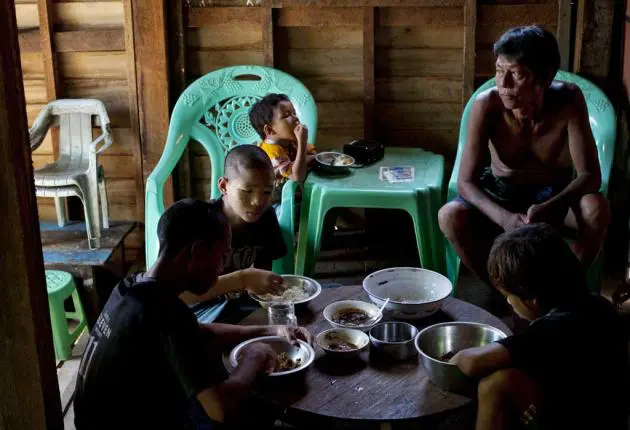
But the damage has been done. Thu has become a silent presence in the family’s two-room wooden house.
“He doesn’t care about things anymore,’’ says his mother, Daw San, 58, as Thu, in a black shirt advertising Lucky Eleven whiskey, sat silently.
