
Always a packed house


Play
There's a lot of enthusiasm for filmaking in Luang Prabang, even though there are no cinemas and no film distribution
Growing every year since it started in 2010, this year’s Luang Prabang Film Festival is the biggest yet.
At least that’s what the festival organisers are saying.
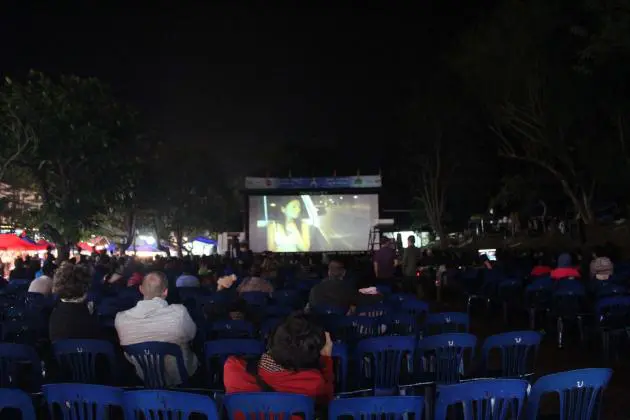
But it’s tough to keep track of the audience, given how locals and tourists to Laos’ ancient former royal capital tend to drift in and out of the main venue, an outdoor screen in the central Handicraft Market. With room for 1,000 or more, the main feature of the fest, besides that big screen, are the 800 blue plastic chairs that have become the festival’s egalitarian icon. And on opening night, it was tough to find one that wasn’t occupied.
And at another screening, in the 40-seat daytime venue, the Amantaka Hotel, so many folks had turned up to see the Sundance-winning Cambodian documentary “A River Changes Course”, that some were turned away.
Also, with 28 films from all 10 Asean countries (yes, there’s even a film from Brunei), more than half had the directors turning up, the most the festival has ever had.
“We are always amazed by the turnout,” says festival director and founder Gabriel Kuperman. “When we started the festival, just a few filmmakers came but this year more than half are here and the crowds are staggering. We are having to turn people away from full screenings. We have people lined up against walls and sitting in aisles.
“So many turned out for ‘A River Changes Course’, that we had to schedule in another screening time just so more people could see it,” Kuperman adds.
Getting underway on Saturday, the opening night featured the world premiere of a Lao feature, “I Love Souvanh” by Bounthong Nhotmanhkong. A romance set across the Second Lao-Thai Friendship Bridge from Mukdahan to Savannakhet, it involves a young Japanese man who works as a buyer for a clothing company. He’s sent to Laos to buy fabric, and he falls for a local lass who designs fabric patterns. They grow closer as she explains to him the virtues of traditional Lao weaving.
Among the many filmmakers turning up to walk the festival’s red carpet was Thailand’s Matthew Chookiat Sakveerakul, who has two films in this year’s festival, his teen comedy-drama “Grean Fictions” and the three segment drama “Home”. Along with several of his actors and colleagues from his Studio Commuan, he made a real journey out of his visit to Laos, catching a boat in Chiang Rai and floating for two days down the Mekong before turning up in Luang Prabang.
“It was great,” he said, clearly energised by the adventure.
“Grean Fictions”, a sprawling comedy drama about the exploits of Chiang Mai schoolboys who post their prank-filled video clips on YouTube, played to a packed Handicraft Square on Sunday night. On hand were Chookiat and two of
his stars, Kittisak “Jack” Patomburana and lead actor Pattadon “Fiat” Jan-ngern, to give away two special-edition DVDs of the movie to the first audience members to correctly answer how many films were in the festival and from how many countries they are from.
Those special-edition DVDs were mentioned earlier in the day when Chookiat took part the panel talk, “Distribution Methods in Southeast Asia”, joining Indonesian director Dwi Sujanti Nugraheni, whose documentary “Denok and Gareng” was shown that morning. Others taking part were Lao producer-director Anysay Keola, Hong Kong film critic Clarence Tsui and Vietnamese producer Tran Thi Bich Ngoc.
Piracy came up, and Chookiat noted that the illegal distribution of movies can be stemmed if viewers are given a reason to see the movie in the cinema, such as offering special events with the movies, or special packages to get viewers to buy the legal DVDs.
The discussion eventually centred on the fact that, in spite of all the film activities going on Luang Prabang – and Laos experiencing the beginnings of a new wave in filmmaking – the country has only two active cinemas, and neither are in
Luang Prabang. Moreover, there are no official film distribution channels, and the only way to buy movie DVDs is through pirate dealers.
Anysay, producer of the Lao romantic comedy “Hak Aum Lum”, said his company Lao New Wave Cinema has been experimenting with various distribution methods, even going so far as releasing DVDs in the same plastic baggies as pirated DVDs, but costing a bit more. Vendors balked, saying customers would want more if they are paying more, so they opted for the standard plastic box. “Hak Aum Lum” was even released in Thailand, but didn’t fare well at the box office. Anysay says there wasn’t much marketing for the film’s Thai release, and he understood that it was a risky proposition to begin with.
Chookiat was full of encouragement for the Lao filmmakers though, saying that Lao films should perform especially well in Northeast Thailand. He also urged the building of cinemas in Laos, to truly develop the Lao film industry.
Kuperman, moderating the panel talk, agreed. “People want to see the movies on the big screen,” he said, and proof of that hunger for cinematic entertainment is seen in the great number of locals, especially youngsters, who avidly attend the festival’s outdoor screenings.
